

A passing water test isn’t the whole disclosure story. When selling a home with a well in Loudoun County, it can be helpful to share what you know about the property's condition. Virginia doesn’t require a water test when an existing private-well home is sold, though FHA or VA financing may require proof that a septic system is functional.
It’s understandable to wonder whether an older well, a recent test result, or a buyer’s loan changes what you need to share. This guide explains how Virginia disclosure law applies, what local well records can show, why water testing can still help, and how standards for older wells fit into the picture. You’ll also see how seller representation can help organize the details of a sale so you can move forward with clarity.
Key Takeaways
- Separate local well records from sale requirements so you know which details help clarify a property’s history.
- Understand why a recent water test can reassure buyers, even when a sale-related test isn’t required.
- Put an older well’s drilling date in context: Virginia’s well-drilling standards took effect in 1990.
- Focus on Virginia’s disclosure rule: provide the state form and disclose known material defects.
1. Checking local health department requirements
No. The Virginia Department of Health does not require activities related to buying or selling property with a private well. Under that rule, well permits, inspection records, and maintenance records are not prerequisites for a sale. Still, available records can give buyers useful context about a well’s location, construction, and history.
Start with Loudoun County’s Online RME records, which homeowners and real estate professionals can use when preparing for a sale. Search with Virginia as the state and Loudoun County as the county. A property can be searched by its PIN plus “000” or by site address using only the street number. The street-number search may not show every file, so a result with no records does not establish that the property has no well history.
Record labels can help narrow the search. Loudoun County septic system records are listed as PSSD, while well records begin with WW. Records for systems not yet installed may appear in Loudoun Scanned Records. These entries can help trace a recorded well location or construction history, while making clear what the file does and does not show. A visual review of the property is separate from locating documents.
Virginia requires a newly drilled private well to pass a one-time coliform bacteria test during construction, according to the Virginia Department of Health. That construction-stage test is distinct from a test required at resale. If a well or septic search returns no results, contact the Loudoun County Health Department at 703-777-0234. A real estate professional can help buyers review the available records and understand how the findings relate to financing and a lender’s expectations for a functioning water system. Records support the conversation; they do not, by themselves, establish current water quality or system performance.
2. Well and water-quality inspections
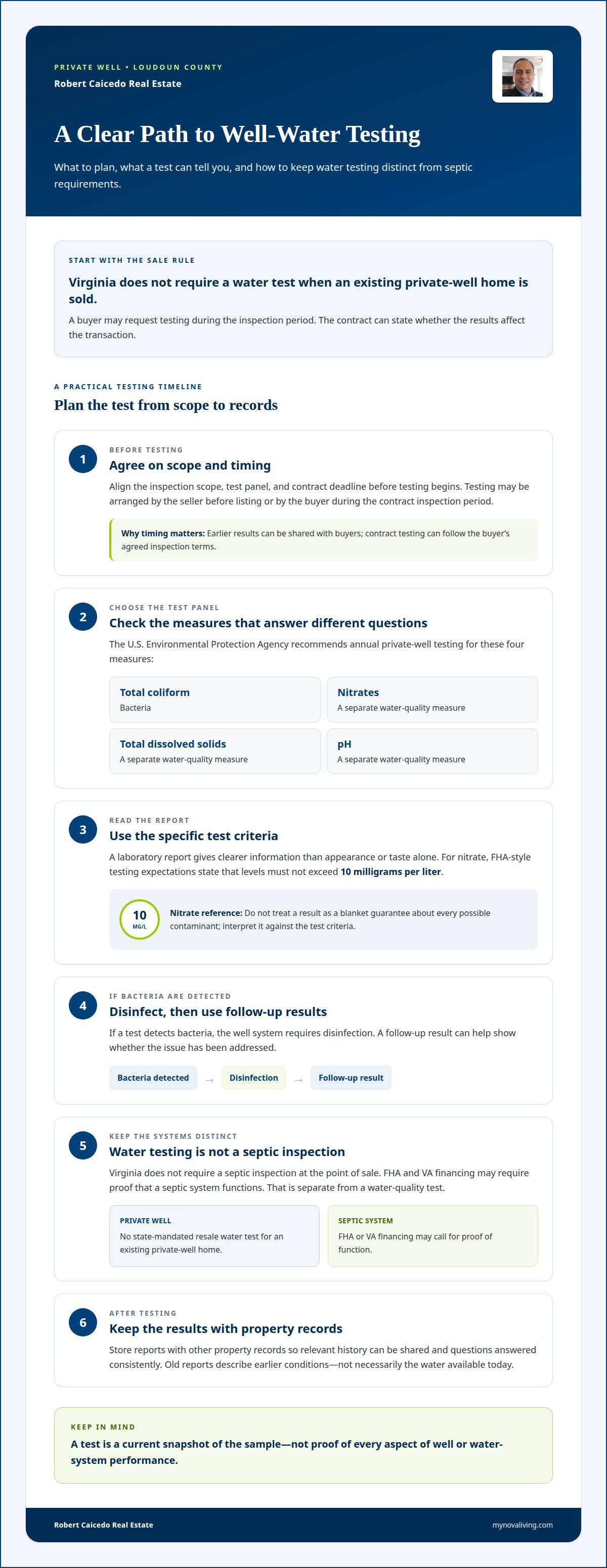
Virginia doesn’t require a water test when an existing private-well home is sold. A buyer may still request testing during the inspection period, with the contract stating whether results affect the transaction. Testing provides a current snapshot of water quality. Old reports describe earlier conditions, not necessarily the water available today.
The U.S. Environmental Protection Agency recommends annual testing of private wells for total coliform bacteria, nitrates, total dissolved solids, and pH. These measurements address different water-quality concerns. A laboratory report gives the parties clearer information than appearance or taste alone. Keep test results with other property records so the seller can share relevant history and respond to questions consistently.
Timing matters. A seller who arranges testing before listing can share the results early, while a buyer may prefer testing under the contract. If a test detects bacteria, the well system requires disinfection. A follow-up result can help show whether the issue has been addressed. Agents can help coordinate the inspection timeline and reflect testing expectations in transaction discussions.
Keep well and septic systems distinct in your review. Virginia doesn’t require a septic inspection at the point of sale, and the sale of a home with an existing well doesn’t require a state-mandated water test. However, FHA and VA financing may require proof that a septic system functions. That is separate from a water-quality test. Buyers using financing should account for lender requirements alongside the contract terms.
For a clearer decision, align the inspection scope, test panel, and contract deadline before testing begins. Nitrates are one useful measure; FHA-style testing expectations state that nitrate levels must not exceed 10 milligrams per liter. Results should be read against the specific test criteria, not treated as a blanket guarantee about every possible contaminant. A documented inspection and clear disclosure form help both parties understand what was tested and what the findings show.
3. Pre-1990 well standards
Virginia’s well-drilling standards took effect in 1990. Wells drilled before 1990 were not subject to the standards that took effect that year. For buyers, that date provides regulatory context during a real estate transaction. It does not, by itself, show whether an individual well is functioning or has a defect. A well’s age and its present condition are separate considerations.
For a pre-1990 property, the recorded construction date can help explain which standards applied when the well was drilled. A buyer reviewing a listing can distinguish older construction from later work documented in the property’s history. If construction details are available, they add context to the well’s design and location. Missing historical details don’t establish a particular condition, so current observations and testing address different questions.
Virginia’s older wells may predate the standards introduced in 1990, but that does not mean every older well has the same design or condition. The wellhead’s position is one practical detail to document, such as maintaining at least 10 feet between a wellhead and any permanent structure. Treat this as a recommendation, not a statement that every older well automatically violates a current legal requirement.
During a transaction, buyers can consider the well’s documented history alongside its present condition. A professional inspection can document visible features and identify questions for further review. Water testing provides separate information about the quality of the sample. If the property also has a septic system, its location and records can help buyers understand the site layout, but they don’t establish the well’s construction date.
For sellers preparing a listing with Robert Caicedo Real Estate, organize any available records by date and keep descriptions precise. Separate original construction information from later repairs, changes, or test results. That distinction helps buyers understand what each document covers without treating an old record as proof of current performance. In Loudoun County, the 1990 standards date is a useful starting point for discussing an older well, not a substitute for property-specific evidence.
4. Virginia Residential Property Disclosure Act
Virginia’s Residential Property Disclosure Act, Code of Virginia 55.1-700 et seq., requires sellers to provide the state disclosure form. Sellers must disclose known material adverse facts about a property’s condition. For sellers asking what to disclose when selling a home with a well in Loudoun County, the practical focus is on known issues and accurate answers, not treating a water test as a substitute for disclosure.
The form lets sellers select “owner makes no representation” for most items. That choice means the seller doesn’t certify the condition of those systems. It doesn’t erase the separate duty to disclose known material defects. Virginia sellers must also disclose known defects in a property’s septic system. Keep form answers distinct from permits, maintenance records, inspection findings, and water-test results.
Virginia’s Residential Property Disclosure Statement was updated July 1, 2026. Use the current form and follow the transaction timeline. The Virginia Department of Health doesn’t require activities in conjunction with buying or selling property with private wells. A water test and the disclosure form serve different purposes: test results describe the sample, while the form addresses seller representations and known adverse facts.
Do Virginia seller disclosure rules differ for real estate agents, estate sales, or new construction? Sellers should answer the disclosure form accurately and identify known issues with the property. An agent’s involvement, an estate sale, or a new-construction label doesn’t replace that requirement.
A useful approach to what to disclose when selling a home with a well in Loudoun County is to clearly distinguish known conditions from supporting documents. If a seller knows about a well or septic defect, concealing it can have serious consequences. A buyer who proves the seller knew about a defect and concealed it can pursue contract rescission, return of the purchase price, and damages. Clear, accurate disclosure helps buyers assess the property and keeps the transaction grounded in known facts.
Robert Caicedo Real Estate: New Construction Homes
Robert Caicedo Real Estate provides Seller Representation for owners preparing a Loudoun County home for market. When a private well is part of the property, representation can help keep disclosure details, available records, and buyer questions in view throughout the transaction.
Bring the well’s history, test results, and known concerns into the sale discussion. Organizing them clearly helps you explain what the documents show and distinguish that information from the well’s condition today. If you’re buying instead, Buyer Representation can help you assess property details as you consider a home with a private well. For a new-build purchase, New Construction Homes may be the more relevant path.
Contact Robert Caicedo Real Estate to discuss representation for your sale.
Move forward with a clear plan
Knowing what to disclose when selling a home with a well in Loudoun County can help you approach the next stage with greater clarity. Keep property information organized, answer questions accurately, and make decisions with the full transaction in view. A well is one part of a home’s story, and thoughtful representation can help keep that story clear as you plan a sale or purchase.
Robert Caicedo Real Estate provides Seller Representation and Buyer Representation for residential transactions, as well as New Construction Homes services for those considering a newly built property. Choose the path that fits your next move, whether you’re preparing to sell or looking for a place to call home.
Contact Robert Caicedo Real Estate to discuss your real estate plans. With a considered next step, you can move ahead with confidence and welcome what comes next.
Frequently Asked Questions
Do VA and FHA loans require well and septic testing?
Virginia doesn’t require a water test when an existing private-well home is sold. FHA or VA financing may require proof that the septic system is functional, which is different from requiring a well-water laboratory test. Buyers can address requested inspections or testing in the purchase contract, including who arranges them and how results affect the transaction.
Is there any state requirement for a brand-new well or septic system?
Yes. Virginia requires a newly drilled private well to pass a one-time coliform bacteria test during construction. A new septic system needs a permit and health department sign-off before it is covered. These construction requirements differ from sale requirements for an existing home, so installation records can help explain a new system’s approval history.
What Does a Seller Have to Disclose in Virginia?
Sellers should be candid about known material problems with the property’s condition. Known septic system defects must also be disclosed. Although the form allows “owner makes no representation” for most items, that selection doesn’t replace disclosure of known material defects. The key distinction is between declining to certify a system’s condition and withholding a known problem.
What Happens If You Don’t Disclose Something You Know?
A buyer who proves a seller knew about a defect and concealed it can pursue contract rescission, return of the purchase price, and damages. The issue is not simply whether a problem appears after closing: the buyer must prove the seller’s knowledge and concealment. Keeping communications and property records consistent with the disclosure helps create a clearer account of what was known during the sale.
What do buyers need to know about wells and septic systems in North Central Virginia?
Buyers in Loudoun County and nearby communities such as Aldie and Leesburg should consider the well and septic system as separate parts of the property. Records may document locations or installation history, while inspections and testing address different questions. Before the contract timeline advances, clarify which systems will be evaluated and how results will be handled in the purchase terms.
What does a standard well water test check for?
The U.S. Environmental Protection Agency recommends that private well owners test annually for total coliform bacteria, nitrates, total dissolved solids, and pH. A report reflects the sample and measures included in that test. It doesn’t describe every possible water concern or establish the well’s mechanical condition. Review the reported analytes and results together rather than treating “passed” as a complete system assessment.


