

The tax implications of selling a second home in Virginia can include federal capital gains tax and Virginia income tax. For 2026, federal long-term capital gains rates are 0%, 15%, or 20%, depending on income and filing status, while Virginia generally taxes taxable real estate gains at its top ordinary income tax rate of 5.75%. According to the IRS, long-term capital gains rates apply when you’ve held an asset for more than one year.
The sale price alone doesn’t show what you’ll owe in taxes. Your taxable gain depends on your adjusted basis, eligible selling costs, how long you owned the property, and whether it qualifies for a home-sale exclusion. A second home generally doesn’t qualify unless it meets the requirements for a primary residence.
This guide explains how to calculate your gain, when the federal exclusion may apply, and how Virginia treats taxable gains. It also covers how rental use and depreciation can affect the calculation, helping you identify the tax questions to address before selling.
Key Takeaways
- Holding a property for more than one year generally brings long-term federal capital gains treatment; a shorter holding period means the gain is taxed at ordinary income rates.
- Estimate taxable gain by comparing net sale proceeds with adjusted basis, accounting for eligible improvements, selling costs, and depreciation.
- According to the Internal Revenue Service, eligible single filers may exclude up to $250,000 in capital gains from a primary residence sale, but a second home must meet the applicable requirements.
- Virginia generally taxes taxable real estate gains at its top ordinary income tax rate of 5.75%; according to the Internal Revenue Service, depreciation claimed during rental years is taxed at a 25% rate when a second home is sold.
Capital Gains Taxes on a Second Home: When to Pay?
Your federal tax rate depends partly on how long you owned the property and your income. Virginia generally follows federal home-sale exclusion rules, but taxable gains may also be subject to Virginia income tax.
Short- and Long-Term Capital Gains Rates
Short-term gains apply to assets held for one year or less and are taxed at ordinary income rates. The Internal Revenue Service classifies gains on assets held for more than one year as long-term capital gains. That distinction can affect your federal tax bill. The holding period runs from acquisition to sale, so the sale date matters.
Federal Rates and Income Thresholds
For 2026, federal long-term capital gains rates are 0%, 15%, or 20%, based on income and filing status. Single filers with income below $49,450 may qualify for the 0% rate; married couples filing jointly qualify with income up to $98,900. The 20% rate applies to single filers above $545,500 and married couples filing jointly above $613,700. These thresholds help frame the federal tax implications of selling a second home in Virginia, but taxable income and filing status shape the result.
Second-Home Gains and Residence Exclusions
A second home generally doesn’t qualify for the primary-residence exclusion simply because you own or use it. Eligible homeowners may exclude qualifying gain only when the property meets the ownership and use tests for a principal residence. A vacation or rental property is generally outside that exclusion unless its use and ownership history qualify. If you rented the home, depreciation claimed during rental years is taxed at a 25% rate when the property is sold, according to the Internal Revenue Service.
Virginia Conformity with Federal Exclusions
Virginia generally follows federal capital gains exclusion rules for qualifying home-sale gains. Taxable real estate gains receive no special lower Virginia capital gains rate and are generally taxed at the state’s top ordinary income tax rate of 5.75%. Virginia also has a grantor tax of $0.50 for every $500 of property value; Northern Virginia adds $0.10 per $100. The grantor tax is generally paid by the seller as grantor, while closing documents show the transaction’s charges and allocation.
Calculating gain from sale proceeds, basis, and selling costs
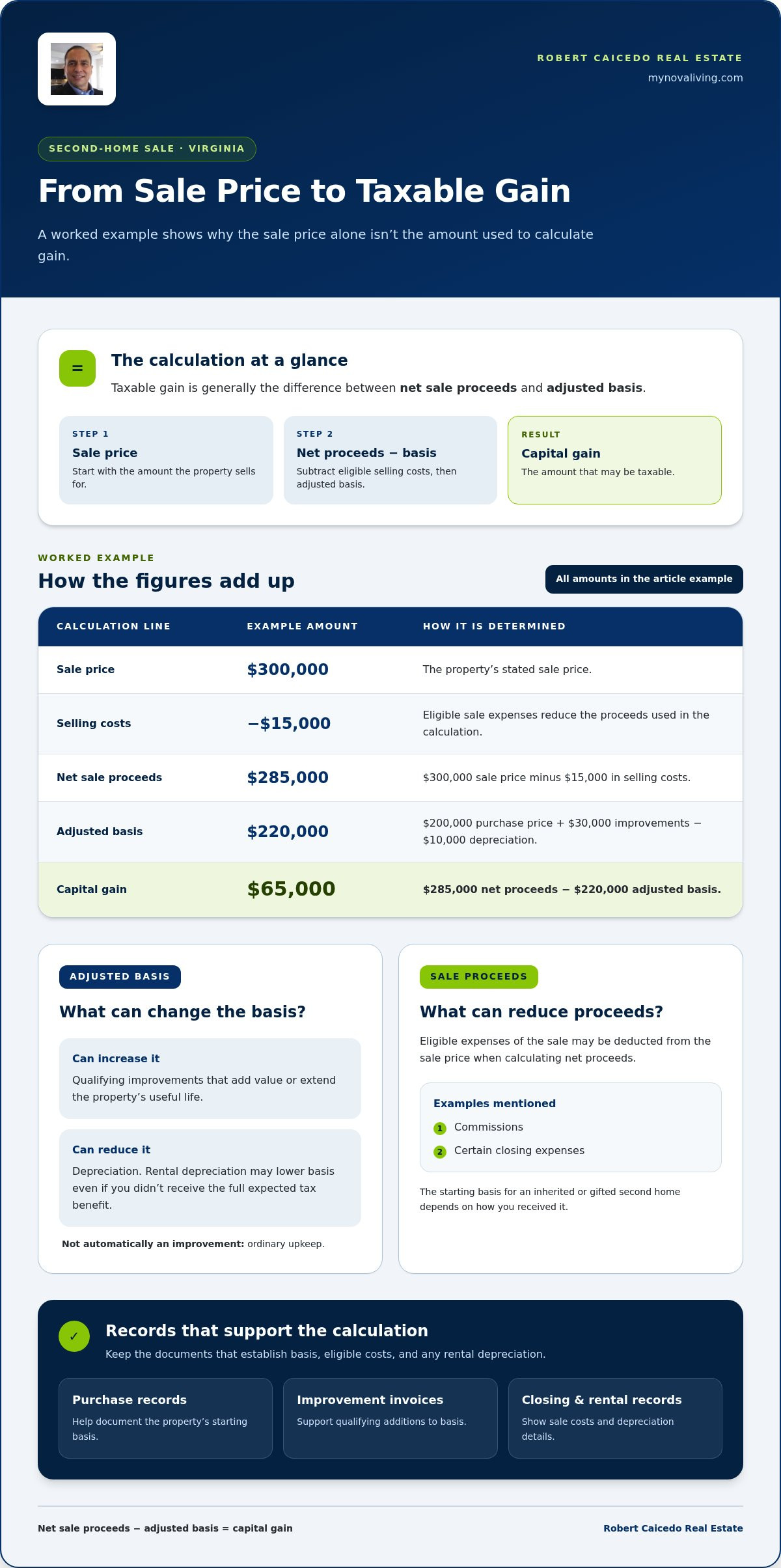
Taxable gain is generally the difference between net sale proceeds and adjusted basis. A documented calculation helps distinguish the sale price from the amount treated as taxable profit.
Calculating Adjusted Basis
Adjusted basis starts with the property’s purchase price, adds qualifying improvements, and accounts for depreciation. It matters because a higher adjusted basis can reduce the capital gain. For example, a second home bought for $200,000, improved by $30,000, and depreciated by $10,000 has an adjusted basis of $220,000.
Keep purchase records, improvement invoices, and rental depreciation details together. Improvements that add value or extend the property’s useful life can affect basis, while ordinary upkeep isn’t automatically treated as an improvement. If the home was rented, depreciation may lower its basis even if you didn’t receive the full expected tax benefit.
For an inherited or gifted second home, the starting basis depends on how you received it. That figure, later adjustments, and eligible selling costs all affect taxable gain, so don’t assume the sale price equals your profit.
Sale Proceeds and Selling Costs
Net sale proceeds begin with the sale price, less eligible expenses of the sale. Those proceeds are compared with adjusted basis to calculate gain. In one example, a home sells for $300,000, with $15,000 in selling costs. Net proceeds are $285,000; subtracting the $220,000 adjusted basis leaves a $65,000 capital gain.
Commissions and certain closing expenses may reduce the sale proceeds used in the calculation.
Before calculating, gather the closing statement, receipts for qualifying improvements, and rental depreciation records. These documents help establish the basis and costs used to determine the amount that may be taxable under federal and Virginia income tax rules. For property owners seeking professional guidance on complex gain calculations and reporting, tax and accounting firms such as Wright CPAs, LLC can provide valuable support.
Primary residence exclusion eligibility and limits
Section 121 can exclude qualifying gain when a property meets the federal primary-residence tests. A second home must qualify as your main home, not simply a place you own or visit.
Section 121 Exclusion Eligibility
The Section 121 exclusion applies when ownership and use requirements are met before the sale. Generally, you must have owned and used the property as your primary residence for at least two of the five years before selling. The test focuses on the home’s role in your life, so a vacation property used occasionally won’t qualify on that basis alone. Keep a clear record of when the property served as your residence.
If you’re married and filing jointly, both spouses must individually meet the use test. You’re generally ineligible if you excluded gain from the sale of the same or another home during the two years before the current sale.
Primary-Residence Exclusion
For a qualifying sale, the exclusion reduces the capital gain subject to federal tax. According to the Internal Revenue Service, eligible single filers may exclude up to $250,000 in capital gains from the sale of a primary residence. Eligible married couples filing jointly may exclude up to $500,000, according to the Internal Revenue Service.
These limits apply to qualifying primary residences, not automatically to every property described as a second home. If the property’s use changes and it becomes your principal residence, its ownership and residence history determine whether the sale meets Section 121. A home’s sale proceeds alone don’t establish eligibility.
Exclusion Limits
The exclusion can generally be claimed only once every two years. The two-out-of-five-year ownership and use tests must also be considered alongside that timing rule. If you used the home for rental or business purposes, depreciation claimed or allowable after May 6, 1997, generally can’t be excluded from gain under Section 121.
A converted vacation home may qualify for an exclusion on some gain, while depreciation remains taxable. Review the property’s residence timeline, prior home-sale exclusions, and rental records together. These details determine how the rules apply and which proceeds may remain taxable.
Virginia income tax on real estate gains
Virginia generally treats taxable real estate gains as income rather than applying a separate, preferential capital gains rate. The state’s top ordinary income tax rate is 5.75%, and Virginia applies the same state tax rates to short-term and long-term gains. Your federal holding period can therefore change federal treatment without creating a separate Virginia rate for long-term gains.
Virginia generally follows federal capital gains exclusion rules for qualifying home sales. If a gain qualifies for a federal exclusion, that treatment generally carries through to Virginia. But a second home that doesn’t qualify for the federal primary-residence exclusion can still generate taxable income on both returns. Report the sale in the tax year it occurs, and keep the federal calculation consistent with your Virginia filing.
Rental use adds another layer. According to the Internal Revenue Service, depreciation claimed during rental years is taxed at a 25% rate when a second home is sold. Depreciation reduces the property’s adjusted basis, which can increase the gain calculated at sale. Keep rental records and depreciation figures with your sale documents, since this portion of the gain may receive different federal treatment from the remaining appreciation.
The federal net investment income tax may also apply to eligible sellers. Its rate is 3.8% when modified adjusted gross income exceeds the applicable filing-status threshold: $200,000 for single filers and heads of household, $250,000 for married couples filing jointly, or $125,000 for married filing separately. This is a federal tax, not an additional Virginia capital gains rate. Assess it separately from Virginia income tax, using your filing status, income, and property-sale details. The practical takeaway: calculate federal gain first, then account for Virginia’s treatment and any federal tax on investment income or rental depreciation.
Robert Caicedo Real Estate: Seller Representation
Robert Caicedo Real Estate provides seller representation for homeowners preparing to put a second home on the market. Once you’ve estimated your gain and considered how rental history or residence use may affect taxes, a real estate professional can guide you through the sale itself.
Keep the decisions distinct: sale terms shape your proceeds, while basis, depreciation, and eligibility rules shape taxable gain. Seller representation supports you through the transaction, but it doesn’t replace calculating the tax treatment. If you’re also considering another property, buyer representation or investment property consulting may help with that next decision.
For support selling your Virginia home, contact Robert Caicedo Real Estate.
Move Forward With a Clear Sale Plan
Planning for the tax implications of selling a second home in Virginia can help you make a more considered decision about timing, proceeds, and what comes next. As you prepare, organize the property’s financial records and consider how the sale fits your broader real estate goals.
Robert Caicedo Real Estate can support the sale through seller representation. If your plans include another move, buyer representation or help finding new construction homes may fit your next step. Selling is about more than closing a transaction. It’s also an opportunity to choose a direction that suits the life you want to create.
Contact Robert Caicedo Real Estate to discuss your next move. Take the next step with clarity and confidence.
Frequently Asked Questions
What Is Capital Gains Tax on Real Estate in Virginia?
The tax implications of selling a second home in Virginia include state income tax on taxable gain, generally at ordinary rates rather than a special capital-gains rate. Virginia’s top ordinary income tax rate is 5.75%. Federal tax may also apply, depending on holding period and income. For sellers in Aldie, Leesburg, Middleburg, Ashburn, Sterling, Reston, and the Washington, D.C. area, distinguish taxable gain from gross sale proceeds.
What Goes Into Adjusted Basis?
Adjusted basis generally starts with what you paid, increases for qualifying capital improvements, and decreases for depreciation. Keep purchase records, improvement invoices, and rental depreciation information together. Qualifying improvements can affect basis, while selling expenses generally reduce sale proceeds. Separating these records helps show where each amount belongs in the gain calculation, rather than treating every property expense the same way.
What Is Considered a Second Home?
A second home generally means a dwelling you own in addition to your primary residence, often used for personal stays or vacations. A property can also have rental use, which may affect its tax treatment. The home’s label alone doesn’t settle the tax question; actual personal and rental use matters. IRS Publication 523 discusses how home use and rental use can affect a home sale.
What’s the Current Long-Term Capital Gains Tax Rate?
For 2026, federal long-term capital gains rates are 0%, 15%, or 20%, depending on taxable income and filing status. For example, single filers with income below $49,450 may qualify for the 0% rate, while the 20% rate applies above $545,500. Those thresholds are not a tax rate by themselves; your filing status and taxable income determine which rate applies to your gain.
How Is Capital Gains Tax Calculated When Selling a Second Home in Virginia?
First determine net sale proceeds by subtracting eligible selling costs from the sale price. Then subtract adjusted basis, including qualifying improvements and applicable depreciation, to find the gain. Tax is calculated on the taxable gain, not simply the gross price. If you receive Form 1099-S, the sale generally should be reported on your federal return even when the full gain is excluded.
What Are the Federal Long-Term and Short-Term Capital Gains Tax Rates for Selling a Second Home?
Short-term gains on property held for one year or less are taxed at ordinary income rates. Long-term gains on property held for more than one year use federal rates of 0%, 15%, or 20% for 2026, based on income and filing status. That holding-period distinction affects federal treatment; Virginia uses the same state tax rates for short-term and long-term gains.


