

A non-holiday Sunday from 1:00 p.m. to 4:00 p.m. is a recommended window for an open house. If you’re learning how to hold a successful open house as an FSBO seller in Washington, DC, start by choosing a time that gives buyers a clear opportunity to visit while fitting the rhythm of your neighborhood.
A welcoming, well-prepared home and thoughtful follow-up can help turn visits into meaningful conversations. To learn how to hold a successful open house FSBO in Washington, DC, plan how you’ll promote the event, create a polished first impression, answer buyer questions, and reconnect with interested visitors. A clear schedule makes the process more manageable, from choosing open-house hours to deciding what to do next.
Key Takeaways
- Consider a non-holiday Sunday from 1:00 p.m. to 4:00 p.m., and plan promotion and visitor materials ahead of the event.
- Make the home feel clean, spacious, and welcoming with decluttering, personal-item removal, and attention to minor repairs.
- Ask interested visitors whether they’re mortgage pre-approved, and keep property information ready for their questions.
- Gather visitor contact details, invite feedback, and follow up promptly to answer questions or arrange a private showing.
1. When Should You Schedule Your Open House?
Choose a non-holiday Sunday from 1:00 p.m. to 4:00 p.m., a recommended window for visitors. A few days before, consider an invite-only preview for friends and neighbors. It gives you a chance to practice describing the home and notice details to address before the public event.
Prepare a flyer with the home’s features, recent updates, asking price, and your contact information. Keep property disclosures, inspection reports, utility bills, and details about taxes and major systems available for interested buyers. If someone asks about mortgage pre-approval, ask whether they’re pre-approved. If not, suggest they speak with a lender before making an offer.
Place a sign-in sheet near the entrance and invite visitors to share their names, phone numbers, and email addresses. Explain that you’ll use the details to answer questions or arrange another showing. Secure valuables and important documents, and have at least one other person present. They can welcome guests while you answer questions.
Washington, DC FSBO sellers should follow applicable local requirements and have relevant property disclosures ready. Before accepting an offer, review the contract, disclosure obligations, and settlement estimate with a DC real-estate attorney or settlement professional. The estimate identifies applicable taxes and closing costs.
Follow posted restrictions for signs and parking, and keep sidewalks, driveways, and access points clear. Place directional signs only where permitted. Don’t block neighbors’ entrances or use reserved spaces.
Promote the event through social media and local community groups. You can also consider listing on the MLS through a flat-fee MLS service. Compare the costs of your chosen channels or listing service with your advertising plan.
Before setting your asking price, compare nearby completed sales of homes with similar size, condition, and features. Account for meaningful differences, and use active listings as context, not as proof of what buyers have paid.
2. Deep cleaning and minor repairs
Start preparing well ahead of the event so cleaning, repairs, and staging don’t become a last-minute rush. Walk through the home as a visitor would, starting at the entry and moving room by room. Note cluttered surfaces, scuffed paint, loose handles, and anything that makes it harder to move through the space. Address the most visible issues first.
Give the living room, kitchen, and primary bedroom special attention. Buyers use these spaces to picture daily life, so arrange furniture to make each room feel open and easy to navigate. Remove extra chairs, clear kitchen counters, and pare back bedside items. A tidy layout helps visitors see the room’s proportions instead of focusing on belongings.
Pack away family photographs, memorabilia, and personal collections. Clear floors, closets, and countertops, while keeping a few purposeful accents to make rooms feel welcoming. Don’t hide belongings in overfilled closets, since buyers may look inside. Keep entryways and hallways clear, and make coats, shoes, and bags less prominent.
Clean from top to bottom. Dust light fixtures and shelves, wash windows, wipe baseboards, and vacuum floors. In the kitchen, clean appliance fronts, cabinet handles, and the sink. In bathrooms, scrub fixtures and mirrors, remove residue, and put out fresh towels. Take out the trash and address lingering odors instead of covering them with strong fragrances.
Finish with small, visible maintenance tasks. Tighten loose knobs, replace burned-out bulbs, touch up obvious paint marks, and make sure doors open smoothly. Outside, sweep the entrance, clear leaves from the walkway, and tidy the front steps. Before visitors arrive, switch on the lights and check that each room feels clean, spacious, and ready to explore.
3. Following up with prospective buyers
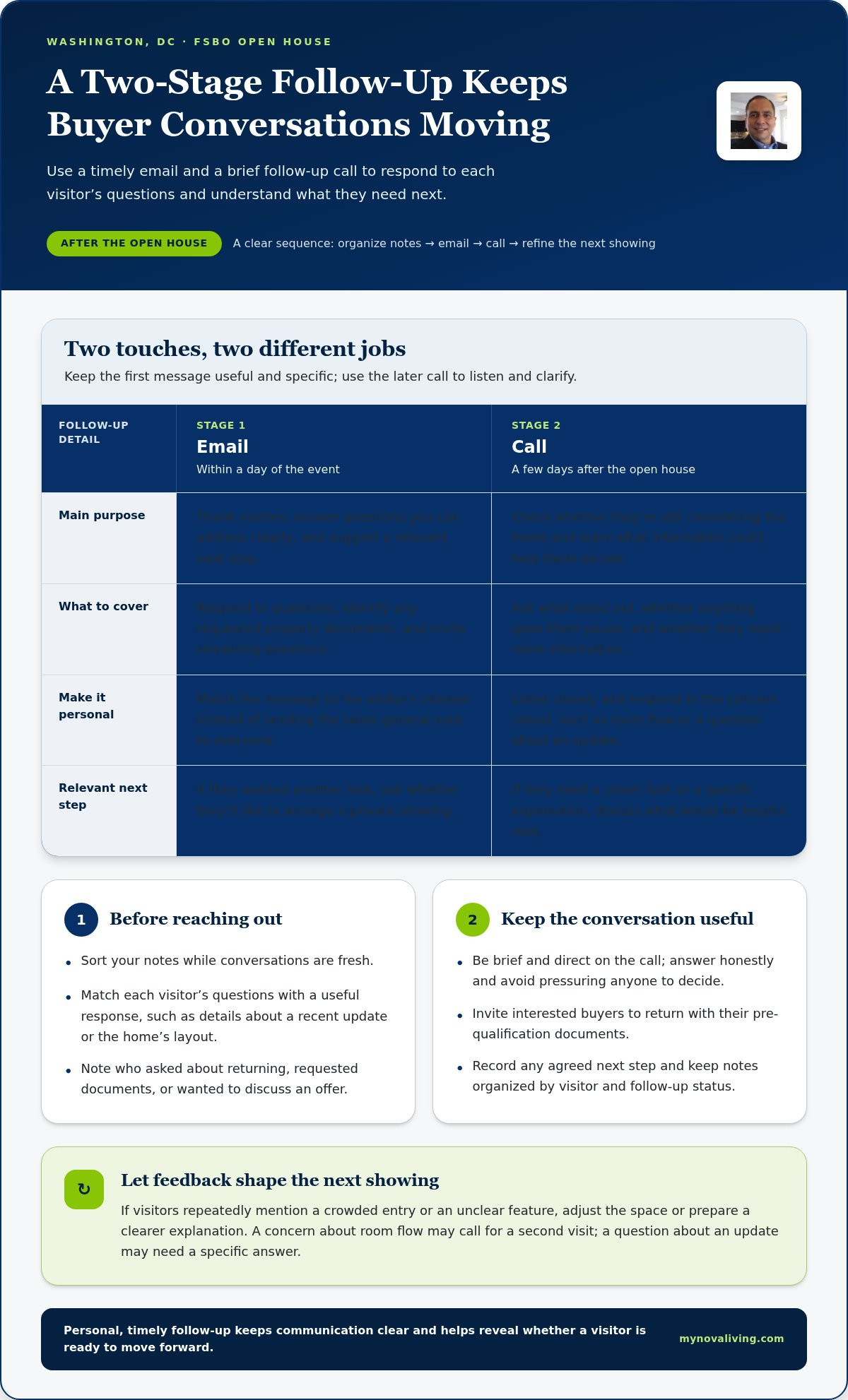
After the open house, sort your notes while conversations are fresh. Match each visitor’s questions with a useful response, such as details about a recent update or the home’s layout. Note who asked about returning, requested documents, or wanted to discuss an offer. This makes it easier to send relevant follow-ups instead of the same general message to everyone.
Email visitors within a day of the event. Thank them for coming, answer questions you can address clearly, and suggest a next step. If someone wanted another look at the kitchen, for example, ask whether they’d like to arrange a private showing. If a visitor requested a property document, specify what you’re sending and invite any remaining questions.
A few days after the open house, call each visitor and ask whether they’re still considering the home. Keep the conversation brief and direct. Ask what stood out, whether anything gave them pause, and whether they need more information to decide. Listen closely: a concern about room flow may call for a second visit, while a question about an update may need a specific explanation.
Use feedback to refine the next showing. If visitors repeatedly mention a crowded entry or an unclear feature, adjust the space or prepare a clearer explanation. Invite interested buyers to return with their pre-qualification documents so you can continue the conversation with their financing readiness in view. Keep notes organized by visitor and follow-up status so no request gets lost. Answer questions honestly, avoid pressuring anyone to decide, and record any agreed next step. Timely, personal follow-up keeps communication clear and helps you understand whether a visitor is ready to move forward.
4. Choosing an open-house day and time
For a clear starting point, choose a non-holiday Sunday from 1:00 p.m. to 4:00 p.m. This recommended window gives visitors a defined afternoon to tour the home. Weekend open houses are also commonly scheduled between 11 a.m. and 4:00 p.m. Use the Sunday window as your first choice, then adjust if neighborhood activity or buyer availability suggests another time.
Consider the home’s setting when choosing a date. A busy street, nearby event, or limited parking can affect how easy it is to visit. Check local event calendars and the immediate area for potential conflicts. If another open house nearby is attracting visitors, coordinating your timing may help you reach buyers already touring the neighborhood.
Build the schedule backward from opening time. Start preparations a couple of months ahead, leaving room for cleaning, minor repairs, and staging. Post the home’s details a few weeks before the event, so prospective buyers can plan a visit. Put directional signs out a couple of days beforehand, where permitted, and make sure the route is clear from the nearest practical approach.
Choose hours that leave you enough time to prepare the home and welcome guests without rushing. If Sunday afternoon conflicts with a community event, consider another weekend slot within the broader 11 a.m. to 4:00 p.m. period. Keep the start and end times consistent across every advertisement, flyer, and social post. Clear timing prevents visitors from arriving after you’ve closed the event.
Before confirming the schedule, walk the route a visitor would take. Check the entrance, nearby parking, and directional signs, then make sure the home will be ready at the advertised start time. Choose a Sunday afternoon window, then adapt it to local conditions and communicate any changes consistently.
Robert Caicedo Real Estate: Seller Representation
Robert Caicedo Real Estate offers Seller Representation for homeowners who want guidance beyond preparing and hosting an open house. If you’re ready to move from attracting visitors to evaluating interest and managing the sale, representation can help you navigate the selling process and make informed decisions at each stage.
Consider professional support if you want guidance on positioning your home, reviewing buyer interest, and navigating the transaction after an offer arrives. Robert Caicedo Real Estate also offers Buyer Representation, New Construction Homes, and Investment Property Consulting for clients whose plans call for those services.
For a thoughtful next step with your sale, contact Robert Caicedo Real Estate.
Take Your Next Step With Confidence
A well-planned open house can be the beginning of a thoughtful sale, not the finish line. As you consider how to hold a successful FSBO open house in Washington, DC, think about what guidance could help you evaluate buyer interest and move toward an offer with confidence.
Selling independently gives you a direct role in presenting your home and connecting with visitors. If you want professional support with the broader transaction, Seller Representation can help you approach the sale with informed guidance. Start with a conversation about your goals, property, and the support that fits.
Contact Robert Caicedo Real Estate to discuss your selling plans. You’ve already started shaping the experience buyers will have. Now move forward with clarity and make the next chapter your own.
Frequently Asked Questions
When Should You Schedule Your Open House?
A non-holiday Sunday from 1:00 p.m. to 4:00 p.m. is a recommended choice for a Washington, DC open house. For sellers deciding how to hold a successful open house FSBO in Washington DC, treat this as a starting window, then account for neighborhood events and visitor access. Publish one schedule consistently, and be ready to welcome guests throughout the advertised hours.
What are the steps to plan and host a successful FSBO open house in Washington, DC?
To understand how to hold a successful open house FSBO in Washington DC, plan the event in stages: prepare the home, share accurate property details, and set up a safe arrival process. During the event, answer questions honestly and note specific buyer interests. Afterward, respond to requests and arrange another showing when appropriate. If a visitor asks about how a room could be used, provide clear information rather than guessing.
How should a home be prepared, staged, and secured for an open house?
Keep the home clean, uncluttered, and easy to move through. Arrange furniture so visitors can see how rooms function, and remove personal photographs that may distract from the space. Secure cash, jewelry, medications, and private paperwork before guests arrive. Close off rooms that aren’t part of the tour, and make sure walkways, stairs, and entry points are clear.
What safety and liability risks should DC FSBO sellers address during an open house?
Plan for visitor safety and protect personal belongings. Don’t host alone; have another person present, keep sightlines clear, and guide visitors away from hazards such as loose rugs or obstructed stairs. Secure valuables and sensitive documents, and avoid making claims about the property that you can’t support. Keep a record of visitor details and any incident requiring follow-up.
Should a Washington, DC FSBO seller hire a flat-fee MLS service or real estate agent for open house support?
A flat-fee MLS service can help publicize a listing, while a real estate agent can provide broader seller representation and transaction guidance. Consider how much responsibility you want to handle, from presenting the home to managing buyer interest and offer discussions. Robert Caicedo Real Estate offers Seller Representation for sellers seeking professional support through the sale process.


