

Historic status alone doesn’t tell you which rules apply. When selling a historic home in Old Town Leesburg, regulations depend first on whether the property is within the Town’s locally designated Old and Historic District, formally known as the H-1 Overlay District. Exterior changes there generally require a Certificate of Appropriateness before work begins, with some maintenance and other exceptions.
It’s easy to assume that an older home or a National Register listing automatically brings local design controls. The distinction is important: Leesburg’s H-1 designation is a local zoning overlay, while National Register and Virginia Landmarks Register listings don’t by themselves create local regulation.
This guide explains what defines the district, which projects may need approval, and how to check whether a property lies within its boundaries. You’ll also learn which records can clarify a home’s status and preservation history, helping you prepare to sell with a clearer understanding of the rules and the property’s story.
Key Takeaways
- Learn which exterior projects may need advance approval and which routine work can follow a different review path.
- Find out how Leesburg’s district boundaries and local oversight affect a property’s renovation rules.
- Understand why a National Register listing alone doesn’t create the same local controls as the H-1 Overlay District.
- See how property records and the town’s architectural survey can help clarify a home’s designation and contributing status.
1. Can I do any projects without a Certificate of Appropriateness?
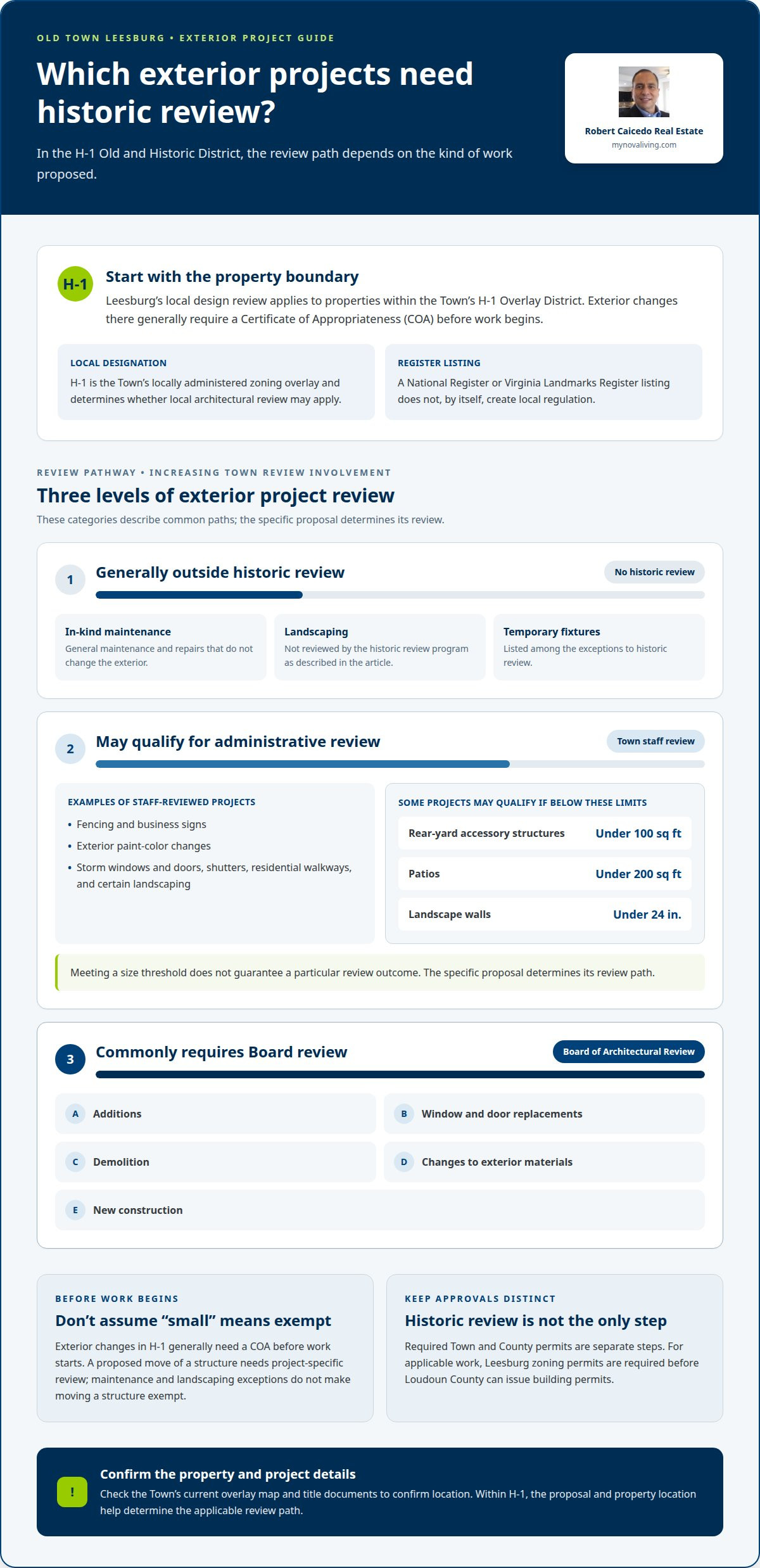
Yes. In Leesburg’s H-1 Old and Historic District, exterior changes generally need a Certificate of Appropriateness (COA) before work begins. The historic review program does not review in-kind general maintenance and repairs, landscaping, or temporary fixtures. Don’t assume a project is exempt just because it seems small.
Leesburg Preservation staff can administratively review certain projects, including fencing, business signs, and exterior paint-color changes. Some rear-yard accessory structures under 100 square feet, patios under 200 square feet, and landscape walls under 24 inches may also qualify for administrative approval. The specific proposal determines its review path.
Which exterior alterations require review by the Leesburg Board of Architectural Review? Additions, window and door replacements, demolition, changes to materials, and new construction commonly require Board review. Window replacements and new construction are clear examples. Some smaller exterior projects, such as storm windows and doors, shutters, residential walkways, and certain landscaping, may instead qualify for administrative review.
Are there restrictions on historic home renovations, additions, demolition, or moving a structure in Leesburg? Renovations that alter exterior features, additions, and demolition may require approval before work begins. A proposed move needs project-specific review; exceptions for maintenance and landscaping do not mean moving a structure is exempt. Required Town and County permits are separate steps.
Middleburg has historic-district rules separate from Leesburg’s. There, an exterior change visible from a public street cannot proceed until its Certificate of Appropriateness (COA) is approved. This may apply to additions, demolition, roof or siding replacement, window and door changes, and new accessory structures.
Two other rules may shape a sale or renovation. For most U.S. pre-1978 housing, federal lead-based paint rules give buyers a 10-day period for a paint inspection or risk assessment, according to the U.S. Environmental Protection Agency. The Virginia Department of Historic Resources says the state historic rehabilitation tax credit is 25% of eligible rehabilitation expenses. For an owner-occupied residential project, the building’s assessed value threshold must be at least 25% before work begins to qualify.
2. What is the Old and Historic District?
Leesburg’s Old and Historic District is a locally administered zoning overlay, formally called the H-1 Overlay District. The Town Council established it in 1963 to protect the historic character of the community. Its original boundaries followed the 1878 Gray’s New Map of Leesburg, and the historic core covers 36 blocks.
What historic preservation rules apply to selling a home in Old Town Leesburg, Virginia? The H-1 overlay brings local architectural review for applicable exterior changes, while the property’s underlying zoning rules still apply. The district does not itself regulate use, parking, or lot coverage. For a sale, known preservation restrictions and records of approvals can help buyers understand renovation limits.
Confirm the property’s location using Leesburg’s current overlay map and title documents. The Town of Leesburg administers this district, so a historic listing elsewhere does not replace the town’s boundary determination. Within H-1, the Town’s design review focuses on how proposed exterior work relates to the district’s historic character. Additions and other visible changes can have project-specific review paths, so plans and the property’s location matter.
What are typical selling prices and days on market for historic homes in Old Town Leesburg? Town-wide figures are not benchmarks specific to historic homes. A property’s condition, features, and location shape its individual market position.
Are there tax credits, grants, or incentives for preserving historic homes in Leesburg or Loudoun County? Virginia’s historic rehabilitation tax credit may be available for qualifying projects, subject to eligibility requirements. District designation itself does not impose a separate historic-district tax. When preparing a listing, organized preservation records can help explain a home’s approvals, restrictions, and renovation history to prospective buyers.
3. Local regulation versus honorary historic-register listing
Leesburg’s H-1 Overlay District is a local zoning designation with authority to review applicable exterior changes. By contrast, listing on the National Register of Historic Places or Virginia Landmarks Register is honorary and doesn’t, by itself, create local regulation. For a sale, distinguish the local overlay from a register listing when explaining which preservation guidelines affect future exterior work.
That distinction can shape pre-listing repairs. Work that changes exterior materials or original features may need historic review, while in-kind maintenance follows a different path. If you plan to list in 6 to 18 months, account for approval timelines before scheduling exterior renovations. Leesburg zoning permits are required before Loudoun County can issue building permits for applicable work.
Build a clear property file before listing. Gather prior Certificates of Appropriateness, approved plans, permits, and records of completed work. Include available designation records and preservation requirements, as well as information about known restrictions or pending preservation issues. These documents help buyers understand the home’s history and any limits on additions, renovations, or other exterior changes.
Does the district determine inspection, appraisal, or financing outcomes? No. The H-1 overlay governs local design review, while inspections and financing involve separate assessments. A standard home inspection generally doesn’t determine whether a property has pests, termites, asbestos, lead-based paint, or mold. Appraisers may use older comparable sales when they explain why those sales apply; Fannie Mae also requires lenders to maintain a reconsideration-of-value process when buyers challenge a home’s value.
Before marketing, organize inspection records with the preservation paperwork. This gives prospective buyers a practical view of the home’s condition, approvals, and restrictions without suggesting that a historic-register listing alone governs renovations. For a home with an addition that appears unpermitted or a replacement feature, records can clarify whether prior review took place and support informed discussions during the sale.
4. Is my property in an architectural control district?
Start with the Town of Leesburg’s current overlay map and the property’s title documents. Together, they help establish whether the parcel falls within the locally regulated H-1 district. Historic age and architectural significance are separate questions: a home may be old without being a contributing resource, and a newer structure may sit inside the overlay.
Leesburg’s survey of three neighborhoods abutting the Old and Historic District considered a primary resource historic if it was at least 50 years old. The survey recorded 71 primary resources, including 59 historic buildings. Age helps describe the property’s history, but the town’s contributing or non-contributing classification affects how design review may treat proposed exterior changes.
A non-contributing structure inside H-1 remains within the zoning overlay. Leesburg says these structures can often use newer materials, alternative designs, and more flexible review standards. That flexibility isn’t the same as automatic exemption from review. A window replacement or other exterior project still needs the review path that applies to its scope and location.
For the sale, assemble a property file that connects the home’s appearance with its work history. Include available survey or designation records, approved plans, permits, and prior Certificates of Appropriateness. Note whether past repairs matched existing materials or changed features such as windows, doors, or siding. Clear records help distinguish routine maintenance from alterations that may have required approval.
Maintenance matters, too. In-kind general repairs are treated differently from changes to exterior materials or design, while some smaller projects may receive administrative review. Keep invoices, permit records, and photographs of completed work. For a replacement window or addition, approval documents can help explain the property’s current condition and preservation history to buyers.
Before listing, organize these records with the home’s inspection materials. A concise timeline of exterior work, permits, and repairs gives prospective buyers useful context without implying that every older property has the same restrictions.
Robert Caicedo Real Estate: New Construction Homes
Robert Caicedo Real Estate provides Seller Representation to help you turn preservation paperwork into a well-prepared sale. If you’re planning to sell a home in Old Town, discuss how to present its approvals, permits, and renovation records clearly to buyers. Organized information helps prospective buyers understand the property’s history and applicable restrictions.
If you’re considering a newly built home for your next move, Robert Caicedo Real Estate also provides representation for New Construction Homes. Whether you sell first or move into a new residence, representation can help connect your property goals throughout the transition.
For help planning your next real estate step, contact Robert Caicedo Real Estate.
Plan Your Next Move With Confidence
Understanding the regulations for selling a historic home in Old Town Leesburg can help you make thoughtful decisions about what comes next. Consider the kind of home and lifestyle you want after this chapter, and how your timeline shapes that choice. Knowing your priorities can focus conversations about selling or buying in Aldie, Leesburg, Middleburg, Ashburn, Sterling, Reston, or Washington, D.C.
Robert Caicedo Real Estate provides Seller Representation, Buyer Representation, and representation for New Construction Homes. Whether you’re preparing to sell, exploring a purchase, or considering a newly built home, the firm can help connect your real estate decisions to your next goal.
Contact Robert Caicedo Real Estate to discuss your next move, and take the next step with confidence.
Frequently Asked Questions
What is the Old and Historic District?
The historic district is Leesburg’s local preservation overlay, and a home’s location within its boundaries matters more for local design review than its age alone. For a property near the edge, compare its parcel location with the town’s overlay map and title documents. This helps distinguish a home near the district from one inside it, an important difference when planning exterior work or describing the property to buyers.
What makes a property historic?
Historic status can refer to a property’s age, architectural significance, or formal designation; these terms are not interchangeable. Leesburg’s survey used an age threshold to identify historic resources, while contributing status describes a property’s relationship to the district’s historic character. A home’s age alone does not establish that every feature is original or that it receives the same review treatment as a contributing building.
Can I do any projects without a Certificate of Appropriateness?
Yes, some work may proceed without historic review, such as an in-kind repair that preserves an existing feature rather than changing its design or material. For example, repairing a damaged section with matching material differs from replacing an entire window with a different style. The type of work, not simply its size, determines the distinction; proposed changes may follow administrative or Board review.
How can a real estate professional determine whether your property is in an architectural control district?
A real estate professional can compare a parcel’s location with Leesburg’s overlay map and review title documents for property-specific context. The town’s updated architectural survey can provide information about a home’s history and resource classification. These records help clarify whether local design review may apply, while separate private covenants or condominium restrictions may also affect the property.
Is there a list of approved or required contractors, paint colors, or materials that I must use?
Don’t assume one contractor roster or universal palette answers every project question. In Leesburg, the review path depends on the proposed exterior work; paint-color changes, for example, may qualify for administrative review. For a renovation, identify the specific change and materials involved, then determine which review process applies before scheduling work or committing to replacement materials.
What disclosures apply when selling an older home in Virginia?
Residential property sales may involve disclosure forms addressing matters such as property condition and recorded restrictions. For selling a historic home in Old Town Leesburg, regulations and recorded restrictions may also affect how buyers plan future work. Disclose known preservation issues and provide available records that help explain approvals or restrictions. Federal lead-based paint requirements may apply to most pre-1978 housing.


