

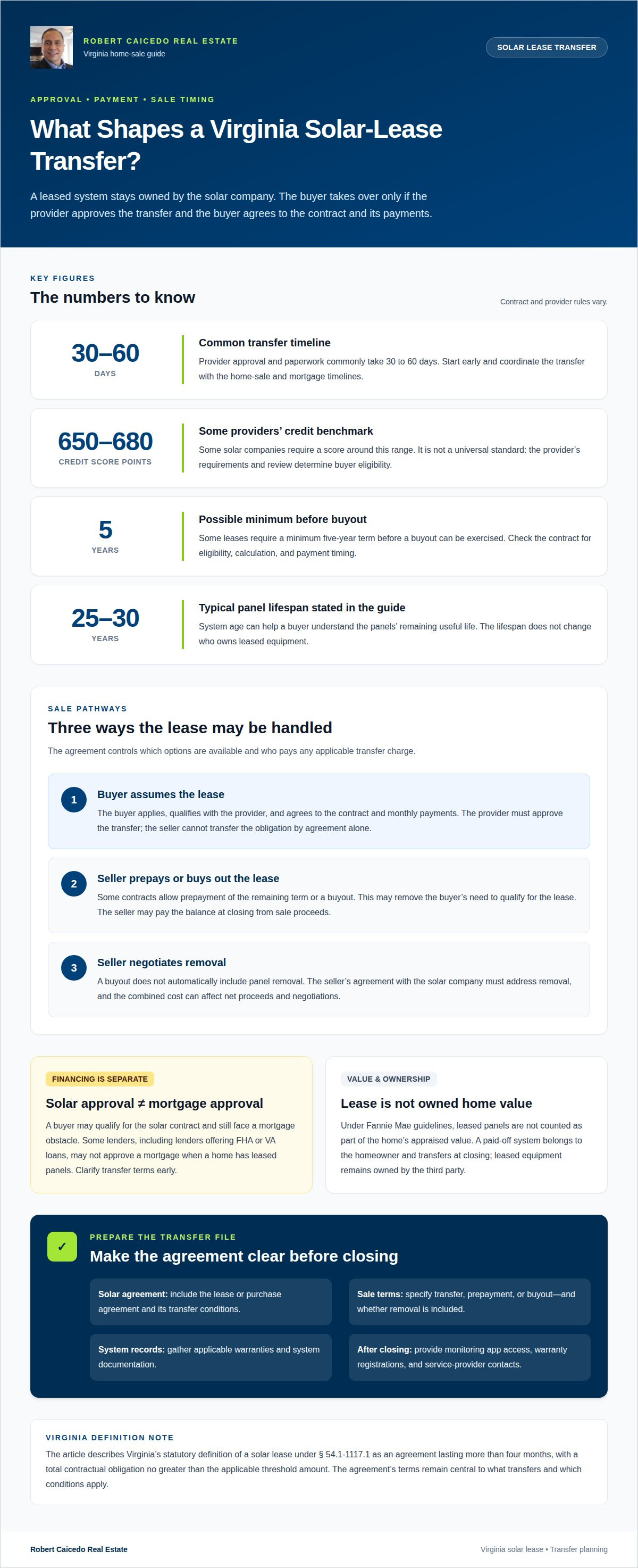
A leased solar system usually stays with the home unless the lease is transferred, prepaid, or bought out under the contract. To understand how to transfer a solar panel lease to a new home buyer in Virginia, start with the leasing provider’s approval: the buyer must qualify and agree to take over the contract and its payments. A transfer commonly takes 30 to 60 days.
It’s natural to wonder whether you can take the panels with you. Because a leased system belongs to a third-party company, moving it isn’t the same as taking equipment you own; the lease terms determine the available options. This guide explains how buyer approval and transfer paperwork affect a Virginia home sale, when seller-paid removal or a buyout may make sense, and how to plan early so the lease doesn’t become a last-minute obstacle.
Key Takeaways
- Start the transfer process early: buyer qualification and provider paperwork can affect the timing of your home sale.
- Compare lease assumption with prepayment or a buyout to understand which option fits the buyer and sale terms.
- Review the lease’s transfer conditions and payment obligations so both sides know what the solar agreement means for the transaction.
- Factor the lease into your home-buying decision, including the added monthly payment and approval process.
Buyer qualification and approval by the leasing provider
A solar lease transfer is not automatic when a Virginia home changes hands. The buyer must qualify with the leasing provider and agree to take over the contract and its monthly payments. The provider must approve the transfer, so the seller’s agreement does not automatically become the buyer’s obligation. Approval and paperwork are typically handled through the leasing company.
Expect the buyer to submit an application for a new lease and undergo a credit check. The provider uses its own requirements to assess eligibility, and some solar companies require a credit score around 650 to 680 credit score points. That range isn’t a universal standard. The contract and provider’s review determine what the buyer must satisfy. A buyer who doesn’t qualify may need to consider another arrangement with the seller, such as prepayment or a buyout.
Virginia’s statutory definition can help clarify whether an agreement is a solar lease. According to the Virginia General Assembly, Virginia defines a solar lease under § 54.1-1117.1 as lasting more than four months and having a total contractual obligation no greater than the applicable threshold amount. The agreement’s terms remain central to understanding what transfers and which conditions apply.
Mortgage approval is a separate consideration. Some lenders, including lenders offering FHA or VA loans, may not approve a mortgage when a home has leased panels. This can be a concern if the lease terms are unclear or the lease cannot be transferred. For example, a buyer may qualify for the solar contract but still face a mortgage obstacle if the lender does not accept its terms. Clarify the lease’s transfer conditions early and coordinate the transfer timeline with the buyer’s mortgage application. This helps keep solar approval and home financing on track as related, but separate, steps.
Negotiating seller-paid removal or lease buyout
Are there fees or costs to transfer a solar panel lease to a buyer in Virginia? Transfer costs depend on the agreement, and the buyer may also need to budget for ongoing monthly payments. The contract determines whether a transfer charge applies and who is responsible for it.
Can a Virginia seller buy out or prepay a solar lease instead of transferring it? Yes. Some contracts allow prepayment of the remaining term or a buyout, which can satisfy the seller’s lease obligation and remove the buyer’s need to qualify for the lease.
If a buyer declines the agreement, the seller may need to buy it out before closing. Some agreements permit prepayment, which can simplify the sale by avoiding a transfer of monthly lease payments to the new homeowner. The seller may also pay the lease balance at closing from the home-sale proceeds.
Read the buyout terms closely. They explain whether the option is available, how the amount is calculated, and when payment is due. Some leases require a minimum term of five years before a homeowner can exercise a buyout. After that minimum term, the buyout amount may decrease over time. A power purchase agreement is a different contract, so review its transfer or termination terms separately.
A buyout does not automatically include panel removal. If the buyer wants the panels removed, the seller’s agreement with the solar company must address that work. The combined cost can affect the seller’s net proceeds and the negotiation.
Set the proposed arrangement out clearly in the home-sale agreement. Specify whether the seller will transfer, prepay, or buy out the solar contract, and whether removal is included. For example, a seller could offer to pay off the lease at closing rather than require the buyer to assume the payments. This makes the purchase easier to assess while clarifying the system’s production and electricity arrangements.
Transferring a leased solar system when selling a home
Before selling a home with solar, establish who owns the equipment and what the agreement requires. Ownership, appraisal treatment, and transfer documents shape the buyer’s obligations.
Identifying System Ownership
Determine whether the homeowner or a third-party company owns the panels. A lease or power purchase agreement generally leaves ownership with the company, while a fully paid-off system belongs to the homeowner. The distinction matters: a leased system requires attention to its contract, while an owned system transfers with the home at closing without additional lease approval.
Review the solar agreement and payment arrangement to identify the system type. A leased-system homeowner makes monthly payments to rent the energy produced, while an owned system has no lease obligation to transfer. Solar panels typically last 25 to 30 years, so the system’s age can also help the buyer understand its remaining useful life.
Appraisals and Leased-System Value
An appraisal estimates a home’s value, but leased panels aren’t counted as part of that value under Fannie Mae guidelines. For a buyer, this means the system may support electricity production, yet the lease remains a separate contract rather than an owned home feature.
For example, a buyer considering a leased system should weigh the contract payments and transfer requirements separately from the home’s appraised value. A paid-off system transfers to the buyer at closing, unlike leased equipment, which remains owned by the third party.
Home-Sale Documentation
Solar home-sale documentation includes the lease or purchase agreement and its transfer terms. Virginia’s solar lease disclosure must describe whether the lease is transferable and any conditions. This information shows the buyer and seller what approvals or contract steps apply before closing.
Organize the agreement with applicable warranties and system records. Solar warranties may cover panels, performance, the inverter, workmanship, and roof penetrations. The new owner should receive updated monitoring app access, warranty registrations, and service provider contact information. These records help the buyer understand how the system operates after the ownership change.
Transfer Timing During a Home Sale
A solar lease transfer during a Virginia home sale typically takes 30 to 60 days. That timing matters because an unstarted transfer can delay the transaction, especially when contract paperwork and buyer approval remain outstanding.
Start early and include the solar agreement with the home-sale documents. For example, a buyer can review transfer conditions while arranging mortgage approval rather than encounter the lease close to closing. Early coordination also clarifies whether the buyer will assume the contract or the seller will pursue another option.
How solar lease transfers affect a home purchase
A lease transfer adds a contract and payment decision to buying a Virginia home. Virginia law and utility rules affect disclosures and bill credits, while the lease sets the transfer conditions.
Effects on the Home Purchase
A solar lease transfer means the buyer takes responsibility for an existing agreement, not ownership of the panels. That distinction matters because the buyer must consider both the home’s price and the lease’s monthly obligation. Credit review, paperwork, and an additional payment may make some buyers reluctant to proceed.
For example, a buyer may like a home with solar but prefer not to assume the lease. The parties can then consider a seller buyout or prepayment, depending on the contract. A solar loan creates a different decision: the seller typically pays it off at closing, or the buyer assumes it if the lender permits. Solar loans are secured debt and usually involve a UCC-1 filing against the equipment, so the loan arrangement matters separately from lease ownership.
The practical takeaway is to make the solar obligation clear during purchase discussions. Buyers can weigh the contract payment, energy production, and financing together instead of treating the panels as an outright-owned feature.
Applicable Laws and Utility Rules
Virginia’s solar rules shape contract disclosures, while utility net metering affects bill credits after a sale. Buyers need to understand both the agreement and how the home’s solar electricity is treated.
When a Virginia customer sells a home, the solar lease disclosure must describe whether the lease is transferable and any conditions for transfer. The agreement sets out the relevant steps, and provider approval remains part of the process. Under Virginia net metering rules, the solar system continues producing bill credits for the new owner.
For instance, a buyer may assume the lease and receive ongoing bill credits but still need to qualify under the contract’s transfer terms. Keep utility credits separate from ownership: credits do not make leased equipment property owned outright. Review both points when evaluating the home, especially when the solar installation is leased rather than financed with a loan or purchased.
Robert Caicedo Real Estate: Buyer Representation
Robert Caicedo Real Estate offers Buyer Representation for your home search, including when a property comes with a solar lease. A representative can help you factor the agreement, payment obligation, and transfer status into your assessment of the purchase. This context helps you weigh the home’s features alongside the commitment attached to its solar system.
Turn to Buyer Representation as you compare homes or consider an offer on a property with leased panels. Your purchase decision can account for both the residence and the practical implications of assuming the solar contract, while keeping your priorities in focus.
For guidance as you explore buying a home with a solar lease, contact Robert Caicedo Real Estate.
Move forward with a clear home plan
As you plan how to transfer a solar panel lease to a new home buyer in Virginia, treat the agreement as one part of a larger housing decision. Your next move may be buying a home with leased panels, selling a property with an existing contract, or choosing new construction instead. Each path calls for a decision that fits your priorities and the way you want to live.
Robert Caicedo Real Estate offers Buyer Representation, Seller Representation, and New Construction Homes. Bring your real estate plans into focus with guidance suited to the transaction ahead, whether you’re preparing a property for sale or searching for your next home.
Contact Robert Caicedo Real Estate to discuss your next real estate move. A considered plan can help you step into what’s next with confidence.
Frequently Asked Questions
Can I Take the Panels With Me?
Not automatically. With a lease or power purchase agreement, the solar company owns the equipment, so you can’t treat the panels as belongings you own outright. Moving them requires an arrangement allowed by the contract and the system owner. For example, a seller planning to relocate should resolve the lease obligation and removal arrangements before treating the equipment as part of the move.
Do solar warranties transfer when you sell your home?
Solar warranties may transfer to a new homeowner, but the warranty terms and transfer process determine how coverage continues. Coverage may include panel product and performance, inverter, workmanship, and roof penetration warranties. Keep warranty registrations and system records with the home-sale documents. After closing, the new owner should receive updated registrations and service provider contact details to help manage future warranty questions.
First: What Type of Solar Agreement Is It?
Identify whether the system is leased, covered by a power purchase agreement, financed with a solar loan, or owned outright. A lease or power purchase agreement leaves equipment ownership with a third-party company. A paid-off system belongs to the homeowner and transfers with the home. A solar loan is debt secured against the equipment, so it creates a financing obligation rather than a lease payment for rented energy.
How do I transfer a leased solar panel agreement to a home buyer in Virginia?
To understand how to transfer a solar panel lease to a new home buyer in Virginia, begin with the contract’s transfer conditions. The buyer submits an application, completes the leasing provider’s credit review, and agrees to the contract obligations. The provider handles transfer paperwork and must approve the change. Coordinate the process with the sale timeline, since a transfer commonly takes 30 to 60 days.
What steps does a Virginia solar provider require to approve a lease transfer?
The provider typically requires the buyer to apply for a new lease, complete a credit check, and agree to take over payments. The solar company handles the transfer paperwork and reviews the application against its requirements. The transfer proceeds only after provider approval. For example, a buyer’s willingness to assume the agreement alone does not complete the process; provider approval and the required contract documents are also needed.
What credit requirements must a Virginia home buyer meet to assume a solar lease?
There’s no single credit score requirement for every Virginia solar lease. Some solar companies require a credit score around 650 to 680 credit score points, while each provider applies its own requirements. The buyer’s application and credit review determine whether they qualify for that contract. A buyer who doesn’t meet the provider’s criteria may need the seller to pursue another contract option rather than transfer the lease.


