

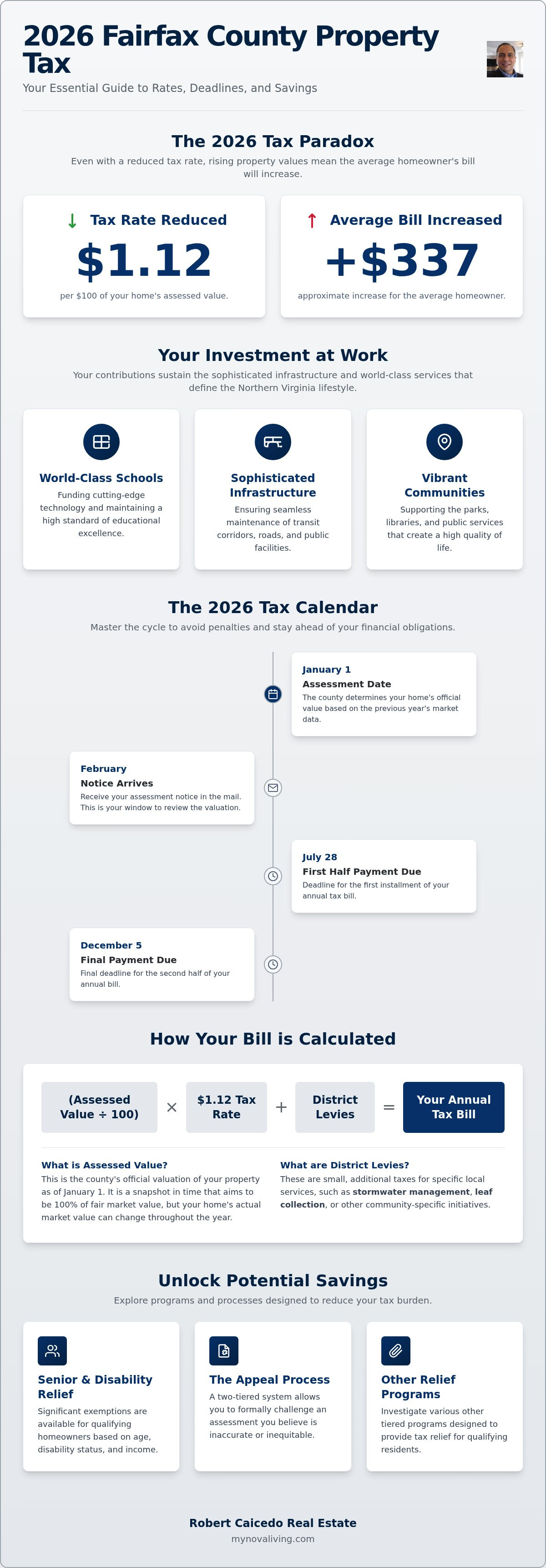
Did you know that even with a recent reduction in the official tax rate to $1.12, the average homeowner will see their bill increase by roughly $337 this year? It's a frustrating paradox that defines the 2026 fairfax county property tax landscape. You've likely felt that familiar pulse of anxiety when your assessment notice arrived in February, watching your property value climb while wondering how it impacts your monthly budget. It's easy to feel lost in a sea of deadlines and complex calculations when you simply want to enjoy the vibrant, curated lifestyle that makes Northern Virginia so special.
We believe that managing a high-end real estate portfolio should feel like a reward, not a chore. You deserve a clear path through the 2026 tax cycle that protects your assets and eliminates the fear of surprise penalties. This strategic guide provides the professional clarity you need to optimize your investment. We'll break down the $1.12 rate, highlight the critical July and December payment dates, and explore the tiered relief programs available to you. By the end, you'll have the confidence to evaluate your true cost of ownership and make informed decisions for your future.
Key Takeaways
- Discover how your tax contributions sustain the sophisticated infrastructure and world-class schools that define the Northern Virginia lifestyle.
- Master the 2026 fairfax county property tax cycle to stay ahead of assessment notices and secure your investment against late-payment penalties.
- Learn to calculate your exact bill by factoring in the latest tax rates and specific district levies like stormwater and leaf collection.
- Identify opportunities for significant savings through senior exemptions, disability relief, and the two-tiered assessment appeal process.
- Transform tax data into a strategic advantage whether you're evaluating a new construction home or positioning a property for sale.
Demystifying Fairfax County Property Tax: The 2026 Essentials
Your home is more than an address; it's a significant financial asset that requires careful stewardship. Understanding the fairfax county property tax begins with the concept of ad valorem. This Latin term simply means "according to value." Every year, the county evaluates your residence to determine its fair market worth as of January 1. This assessment serves as the foundation for your annual contribution, ensuring a transparent and equitable system for all residents. It's a reflection of your property's standing in one of the nation's most desirable markets.
The Fairfax County Board of Supervisors manages the delicate balance between fiscal responsibility and community growth. They direct these funds into the very pillars that uphold our region's prestige. From the cutting-edge technology in our classrooms to the seamless maintenance of our transit corridors, your taxes are the lifeblood of Northern Virginia's success. It's an investment in a collective standard of living that remains the envy of the East Coast. You aren't just paying a bill; you're securing the resilient market value you'll enjoy for years to come.
Why Fairfax County Taxes Matter for Your Lifestyle
Consider the vibrant energy of Reston Town Center or the timeless elegance of McLean estates. These aren't accidents of geography. They're the result of intentional, tax-funded planning and maintenance. High property values are inextricably linked to the quality of local public services. When you see a new park trail or a renovated library, you're seeing your equity at work. This high quality of life creates a "lifestyle environment" that continues to attract international interest and land development opportunities. This cycle of reinvestment ensures that your neighborhood stays contemporary and connected.
Key Dates for the 2026 Tax Calendar
Precision is key to a stress-free financial strategy. The 2026 fairfax county property tax cycle follows a predictable rhythm designed to help you plan your cash flow with ease. Staying organized ensures you avoid unnecessary penalties and maintain a frictionless ownership experience. Mark these essential milestones on your calendar:
- January 1: The official date for property assessments. The county determines your home's value based on market data from the previous year.
- February: Look for your assessment notice in the mail. This is your window to review the county's valuation before the billing begins.
- July 28: The deadline for your first half payment installment. Timely payment keeps your investment in good standing.
- December 5: The final deadline for the second half of your annual bill.
By tracking these dates, you transform a technical requirement into a managed part of your broader real estate strategy. Whether you're interested in new construction homes or managing a diverse portfolio, these deadlines are the anchor of your fiscal year.
The 2026 Assessment Cycle: How Your Home Value is Determined
Your 2026 assessment notice is more than just a number; it's a curated reflection of the market energy from 2025. The Department of Tax Administration (DTA) looks back at every sophisticated transaction in your neighborhood to set the stage for the new year. It's vital to understand the distinction between your "Assessed Value" and "Market Value." While the county aims for 100% of fair market value, your assessed value is a fixed snapshot taken on January 1. Your actual market value might be higher on a vibrant spring weekend when buyers are competing for your home's unique charm. This snapshot ensures the fairfax county property tax remains equitable across the region's diverse residential landscape.
Every luxury condo sale in Tysons or traditional estate closing in Oakton during 2025 creates a data point. The DTA analyzes these trends to project the 2026 landscape. If your area saw an average increase in residential assessments, it's a testament to the enduring desirability of Northern Virginia. Understanding these nuances is the first step toward a frictionless real estate experience. If you're planning your next move, consider how buyer representation can help you navigate the tax implications of your dream home.
The Mass Appraisal Process Explained
The DTA uses Computer Assisted Mass Appraisal (CAMA) to maintain an efficient Fairfax County real estate tax system. This technology groups residences by style, size, and location to ensure consistency. This means your neighbor’s record-breaking sale directly influences your tax assessment, even if you haven't changed a thing. The county also conducts periodic inspections and data collection to verify property characteristics. They look at everything from square footage to the number of bathrooms, ensuring the data matches the reality of your residence. It's a massive undertaking that relies on high-quality data to keep the process fair for everyone.
New Construction and Property Renovations
Adding a custom pool or finishing a designer basement in neighborhoods like Great Falls adds immediate lifestyle value, but it also triggers a re-evaluation. For those exploring new construction homes, the timing of assessments can be unique. You might receive a "partial assessment" if your home was mid-build on January 1, followed by a supplemental bill once the structure is complete. This ensures the county captures the full value of your modern residence as it evolves from a blueprint to a finished masterpiece. Staying ahead of these supplemental bills helps you avoid unexpected costs and keeps your financial strategy on track.
Calculating Your Bill: Rates, Levies, and Comparisons
Estimating your annual contribution is a straightforward process when you have the right formula. For 2026, the adopted real estate tax rate stands at $1.12 per $100 of your home's assessed value. To find your base amount, simply use this calculation: (Assessed Value / 100) x 1.12 = Annual Tax. If you own a residence with the median assessed value of $760,400, your base bill would be approximately $8,516 before any specific district levies are applied. This transparency allows you to plan your lifestyle budget with total confidence.
Your final statement often includes small, targeted levies that fund essential local services. These might include the Stormwater Service District fee or Leaf Collection charges if you live in a participating neighborhood. While these add a few cents to the base rate, they ensure your community remains pristine and functional. If these figures feel overwhelming, remember that the county offers several property tax relief programs designed to support residents during different life stages. Taking advantage of these resources can significantly lower your overall fairfax county property tax burden.
Understanding the Real Estate Tax Rate
The Board of Supervisors sets the annual rate each May during the budget process. They weigh the community's need for infrastructure against the goal of maintaining a competitive tax environment. Fairfax County aims for "fair and equitable" distribution of the tax burden. This intentional approach keeps the region attractive for long-term land development and residential growth. In specific urban hubs like the Tysons Service District, you may see an additional surcharge. These funds directly fuel the high-energy, transit-oriented improvements that make these areas world-class destinations for modern living.
Regional Comparison: Fairfax vs. The Rest of Northern Virginia
Context is everything when you're evaluating a real estate investment. Comparing Fairfax County to its neighbors reveals a nuanced financial landscape. For example, while the historic charm of Alexandria, Virginia offers a unique urban vibe, its tax structure differs from the suburban expansive feel of Fairfax. You'll find similar variations when looking at the modern hybrid lifestyle in Sterling or the luxury enclaves of Ashburn in Loudoun County.
Tax rates are only one part of the home-buying equation. A lower base rate in a neighboring county might be offset by higher HOA fees, private utility costs, or special community development assessments. Fairfax County's consolidated services often provide a more predictable total cost of ownership. We help our clients look past the raw percentages to see the full lifestyle value of a property. This holistic view ensures your move isn't just a transaction, but a strategic step toward a frictionless, high-quality existence.
Maximizing Savings: Tax Relief and the Appeal Process
Protecting your wealth means knowing exactly where you can trim costs without compromising your standard of living. While the fairfax county property tax supports the community's prestige, the county also offers several elegant avenues to reduce your individual burden. These programs ensure your residence remains a source of joy rather than a financial weight. For those who have served, the Disabled Veterans Real Estate Tax Exemption provides a 100% exemption for veterans with a total service-connected, permanent disability. It's a significant benefit that honors your contribution to our community while providing substantial fiscal ease.
We believe every homeowner should feel empowered to manage their property's financial footprint. Whether you're interested in sustainable upgrades or navigating a change in life stages, these relief options are designed for your benefit. They represent the county's commitment to a diverse and inclusive residential landscape. Staying informed about these opportunities is the hallmark of a sophisticated real estate strategy.
Eligibility for Tax Relief Programs
If you're a senior aged 65 or older, or living with a permanent disability, the 2026 relief program is tailored for your convenience. For the current cycle, your total household income must remain below $90,000. Additionally, your total assets, excluding your primary home and up to one acre of land, must not exceed $400,000. Don't forget the May 1, 2026, deadline for these applications. We also encourage you to look into the Solar Energy Equipment Tax Exemption. It's a stylish way to modernize your home while enjoying a dedicated tax break for your commitment to contemporary sustainability.
How to Successfully Appeal Your Assessment
Sometimes the county's mass appraisal doesn't capture the specific, high-quality nuances of your residence. If you believe your assessment is too high, you have the right to challenge it through a tiered process. First, file an Administrative Appeal by the April 1, 2026, deadline. This is your chance to correct data errors directly with the Department of Tax Administration. If you aren't satisfied with that result, you can move your case to the Board of Equalization by June 1, 2026. Follow this checklist to build a persuasive case:
- Review your property record card: Look for errors in square footage, the number of bathrooms, or features like finished basements.
- Collect comparable sales: Find "comps" from 2025 that support a lower value. Focus on similar homes in your immediate neighborhood.
- Document property issues: If your home requires significant repairs that lower its market value, provide photos or contractor estimates.
A well-organized appeal is a powerful tool for maintaining your home's true cost of ownership. If you're looking to maximize your home's value before a potential move, our seller representation services can help you position your property strategically in the Northern Virginia market.
The Real Estate Impact: Taxes as a Strategic Investment Tool
Viewing your fairfax county property tax as a static expense is a missed opportunity. In the sophisticated Northern Virginia market, savvy owners treat these figures as strategic variables in a larger financial narrative. Whether you're curating a personal residence or expanding a commercial portfolio, understanding the interplay between taxes and equity is essential for a frictionless experience. These numbers don't just represent a cost; they reflect the health and desirability of your investment's location.
If you're preparing to sell, don't overlook your home's tax-efficient upgrades. Highlighting features like solar panels or high-performance insulation in your listing isn't just about lifestyle. It's about demonstrating a lower cost of ownership to prospective buyers. In a competitive market, a home with verified tax exemptions stands out as a smarter, more contemporary investment. We position these details front and center to justify your premium pricing and attract discerning buyers who value long-term efficiency. Robert Caicedo Real Estate specializes in these financial nuances, ensuring your property is seen as a high-quality asset rather than just a structure.
Property Taxes and Your Buying Power
When you're securing buyer representation, your consultant should look beyond the list price. Property taxes are a core component of your debt-to-income (DTI) ratio. A monthly tax bill that's just $100 higher can noticeably shift your mortgage qualification threshold. This makes "tax shopping" a vital strategy for buyers across the region. We help you integrate precise 2026 tax estimates into your initial budget so there are no surprises at the closing table. It's about ensuring your buying power remains robust while you target the specific community that fits your vision.
Investment Strategy and Tax Planning
For those focused on land development and investment consulting, taxes are a primary driver of the "cap rate." A slight fluctuation in the fairfax county property tax can alter the long-term yield of a multi-unit project or a commercial lot. We also guide high-net-worth individuals through the complexities of 1031 exchanges. These transactions require a deep understanding of how tax liabilities transfer and evolve over time. Professional consulting is essential here to ensure your portfolio remains both compliant and high-performing. By treating taxes as a tool rather than a hurdle, you create a more resilient and energetic investment strategy.
Empower Your Northern Virginia Real Estate Strategy
Transforming your property tax knowledge into a strategic asset is the hallmark of a sophisticated homeowner. By mastering the nuances of the fairfax county property tax, you move beyond mere compliance and into a space of intentional financial planning. You now understand how the $1.12 rate fuels our community's prestige and how to protect your equity through the appeal process. This clarity ensures that your residence remains a source of comfort and a high-performing investment in our vibrant region.
Robert Caicedo is here to guide you through every financial complexity with ease. We offer sophisticated market analysis for every transaction and deep expertise in the Fairfax and Loudoun County tax landscapes. Our focus remains on the aspirational lifestyle that discerning buyers deserve. Ready to find your next Northern Virginia home? Explore our curated listings and expert consulting services today.
Your journey in the DMV market should be frictionless and rewarding. Take the next step with confidence, knowing you have the insights to optimize your residence for 2026 and beyond. Let's build a future where your home's value is as exceptional as your lifestyle.
Frequently Asked Questions
How do I pay my Fairfax County property taxes online?
Pay your bill online through the official county portal via e-check or credit card. It's a frictionless way to manage your fairfax county property tax from anywhere in the world. You can also use the MyFairfax mobile app for a contemporary, on-the-go experience. Most residents prefer e-checks because they avoid the processing fees associated with credit cards. This ensures your payment is secure, timely, and perfectly aligned with your modern financial lifestyle.
When are Fairfax County real estate tax bills mailed in 2026?
You should expect your real estate tax bills to arrive in your mailbox during May and October. These mailings precede the two main payment installments due on July 28 and December 5, 2026. Receiving these documents early allows you to review the figures and integrate them into your seasonal budget. If you haven't received your statement by early June or November, contact the Department of Tax Administration to ensure your records are up to date.
Can I appeal my property tax assessment if I think it is too high?
You can absolutely challenge your assessment through a structured appeal process if the value feels inconsistent with the current market. Begin with an administrative appeal by the April 1 deadline to correct clerical errors or data discrepancies. If that doesn't resolve your concerns, you have until June 1 to file with the Board of Equalization. This tiered approach provides a fair path to ensuring your residence is valued accurately based on 2025 sales data.
Are there property tax breaks for seniors in Fairfax County?
Fairfax County offers a tiered relief program for seniors aged 65 and older who meet specific financial criteria. For the 2026 cycle, your household income must be $90,000 or less, and your assets should not exceed $400,000, excluding your primary home. This program is designed to provide ease and stability for long-term residents. Make sure to submit your application by the May 1 deadline to secure these significant savings for your household.
What happens if I miss the Fairfax County tax payment deadline?
Missing a deadline triggers immediate late payment penalties on the unpaid balance. Additionally, the county applies interest to the overdue amount until the bill is settled in full. To maintain a frictionless ownership experience, we recommend setting digital reminders for the July and December due dates. Staying ahead of these deadlines protects your investment from unnecessary costs and ensures your financial standing remains pristine within the Northern Virginia community.
How does Fairfax County determine the fair market value of my home?
The county determines your home's value using a mass appraisal system that analyzes 2025 market trends. This process evaluates your property’s characteristics, such as square footage, age, and location, against similar homes that recently sold in your neighborhood. The goal is to establish a fair market value as of January 1. This data-driven approach ensures that the fairfax county property tax remains equitable while reflecting the energetic growth of our local real estate market.
Is there a tax exemption for disabled veterans in Virginia?
Virginia provides a 100% real estate tax exemption for veterans with a service-connected, permanent, and total disability. This benefit applies specifically to the veteran's primary residence and includes up to one acre of land. Surviving spouses may also qualify for this exemption, provided the home remains their principal place of residence. It’s a meaningful way the Commonwealth honors those who have served, offering substantial financial relief and peace of mind for eligible families.
Do I have to pay property tax if my home is in a mortgage escrow account?
If your mortgage includes an escrow account, your lender is typically responsible for making the tax payments on your behalf. They use the funds collected as part of your monthly mortgage payment to settle the bill with the county. While you will still receive a copy of the tax bill for your personal records, it usually includes a note indicating that the original has been sent to your mortgage company for processing.


