

If you’ve searched “fear of my Leesburg home not selling in 2026,” you’re likely weighing the same questions: Does your asking price match what buyers expect? Do fewer showings or a weak offer point to a bigger issue? And how long can you manage the carrying costs and disruption?
Those concerns are real, but frustration alone won’t show you what to change. A clearer picture comes from the evidence around your listing, including buyer response, competing homes, and how your property is presented and priced. A slow period doesn’t automatically mean your home won’t sell. It does mean it’s time to review the details and choose your next step with care.
This guide will help you identify likely barriers, interpret listing activity, and consider measured adjustments rather than making a rushed decision. You’ll also see how seller representation can help you review the evidence and shape a strategy around your Leesburg home, timing, and goals.
Key Takeaways
- Treat low showing activity or weak offers as clues to investigate, not a verdict on your home’s value.
- Compare your listing with relevant Leesburg homes by location, property type, condition, and timing before changing your asking price.
- If you have the fear of my Leesburg home not selling in 2026, use listing evidence to choose a measured next step instead of reacting out of frustration.
- Weigh the potential benefits and trade-offs of presentation updates, easier showing access, refreshed marketing, and a pricing review.
- Gather listing dates, showing patterns, buyer feedback, and current comparable evidence for a focused strategy review with a local seller representative.
Why a Leesburg home may not be selling in 2026
A home that isn’t attracting the response you expected can make every quiet day feel significant. If you’re searching for “fear of my Leesburg home not selling in 2026,” start here: a slow response is a reason to investigate, not a verdict on your home or your plans. The useful question is what the listing evidence suggests and whether several signals point to the same issue.
There’s no single pace that defines a stalled listing. Review inquiry and showing activity, visitor feedback, offers, and the performance of comparable homes. These signals need context. Buyer demand and competition can vary by property type, price range, location, condition, and recent Leesburg-area activity. The principles of real estate economics help explain how supply, demand, and pricing interact, but your next move should be grounded in evidence for homes like yours.
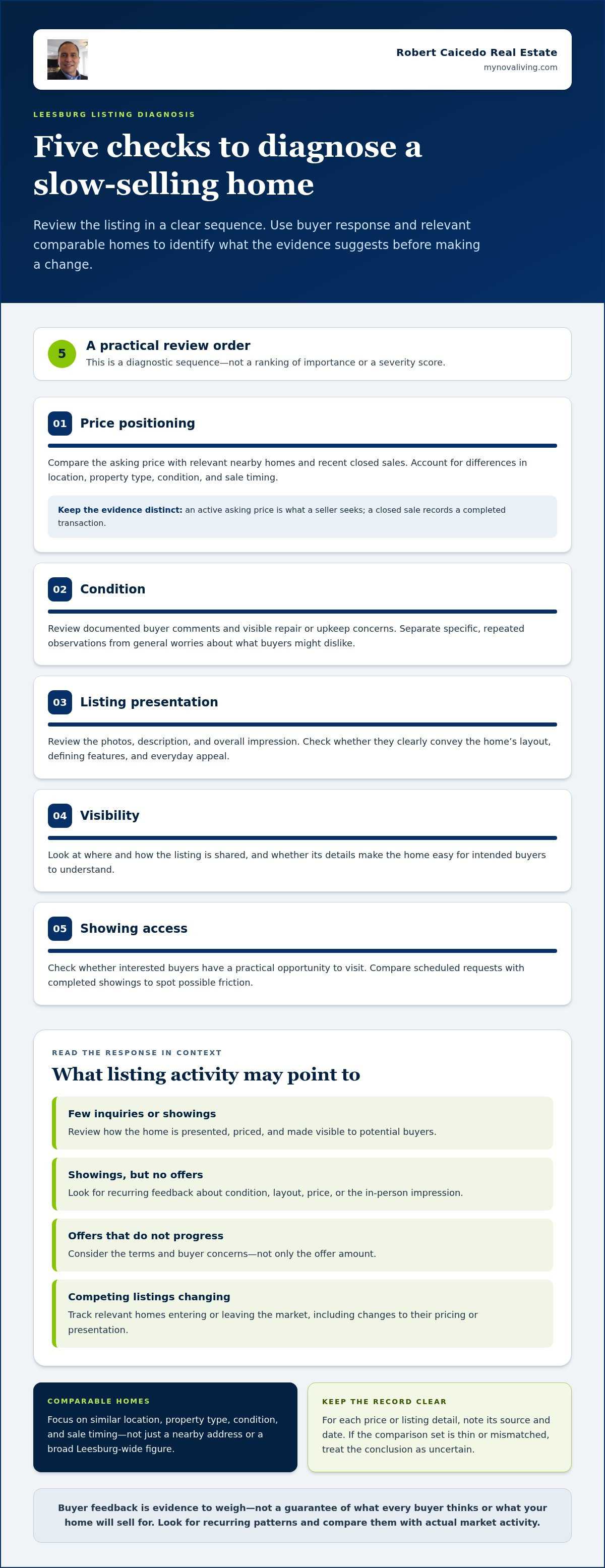
- Few inquiries or showings: Review how the home is presented, priced, and made visible to potential buyers.
- Showings but no offers: Look for recurring feedback about condition, layout, price, or the in-person impression.
- Offers that don’t progress: Consider the terms and buyer concerns, not only the offer amount.
- Competing listings changing: Track relevant homes entering or leaving the market, as well as changes to their pricing or presentation.
Which listing signals should a Leesburg seller review first?
Start with your listing’s timeline. Compare inquiry and showing patterns over time, then note whether a change in marketing, availability, or presentation coincided with a shift. Sort buyer comments into themes such as price, condition, layout, and presentation. One person’s preference may be individual; the same concern raised repeatedly deserves closer attention.
Next, review current and recently sold comparable homes. Focus on properties with similar locations, types, conditions, and sale timing rather than relying on a broad Leesburg-wide figure. Record the source and date for each price or listing detail. This makes your comparison easier to evaluate and helps keep an outdated or mismatched example from steering your decision.
What does a slow response mean, and what does it not mean?
Limited response can have more than one cause. Few showings may point to visibility, price positioning, presentation, or access. Showings without offers suggest buyers are seeing the home but may have concerns after experiencing it. Neither pattern proves a single problem. Weigh feedback and comparable evidence together before deciding what to adjust.
Listing feedback is evidence to weigh, not a guarantee of what every buyer thinks or what your home will sell for. If comments conflict, look for recurring patterns and compare them with actual market activity. A measured diagnosis gives you a stronger starting point than reacting to one quiet week or one buyer’s opinion.
Diagnose why your Leesburg home isn't selling
The phrase “fear of my Leesburg home not selling in 2026” can make every possible explanation feel urgent. Slow the process down. A useful diagnosis moves through the listing in order, separating what the evidence shows from what you’re assuming. If important information, such as showing feedback or comparable-sale details, is missing, gather it before making a costly or disruptive change.
Review each area in sequence. This can help reveal whether one issue stands out or several factors may be working together.
- Price positioning: Compare your asking price with relevant nearby homes and recent closed sales. Note differences in location, property type, condition, and sale timing.
- Condition: Consider documented buyer comments and visible repair or upkeep concerns. Distinguish a specific, repeated observation from a general worry about what buyers might dislike.
- Listing presentation: Review the photos, description, and overall impression. Do they clearly convey the home’s layout, defining features, and everyday appeal?
- Visibility: Look at where and how the listing is shared, and whether its details make the home easy for intended buyers to understand.
- Showing access: Check whether arrangements give interested buyers a practical opportunity to visit. Compare scheduled requests with completed showings to spot friction.
How should you assess price against comparable Leesburg homes?
Choose comparables based on meaningful features, not just a nearby address. A townhome and a detached home, for example, may attract different buyers even if they’re close together. Compare location, property type, condition, and timing, then separate active asking prices from closed-sale evidence. An asking price shows what a seller is seeking; a closed sale records a completed transaction. Review dated local MLS data for Leesburg or Loudoun County and record the date and source. If the comparison set is thin or mismatched, treat the conclusion as uncertain rather than precise.
How do presentation, exposure, and access affect buyer response?
Check whether photos show the home clearly and whether the description communicates useful details while conveying the layout and feel of the space. Then compare the listing’s reach and showing arrangements with the audience you hope to attract. A listing can be polished yet difficult to visit, or available to view but unclear online. For broader context on regional conditions, the Northern Virginia real estate market guide can complement a property-specific review.
Robert Caicedo Real Estate represents sellers and can help connect your goals and timing with the listing evidence, then identify which adjustment deserves attention first. Discuss your Leesburg sale strategy.
Which sale-strategy changes make sense for a Leesburg listing?
Once you’ve identified where buyer response may be breaking down, match any adjustment to the evidence. A pricing change won’t fix photos that fail to show the home’s flow, and new marketing may not resolve repeated concerns about condition. Choose a focused next step and assess whether it addresses a specific barrier. No single adjustment suits every property or guarantees a particular result.
| Option | Evidence to consider | Potential benefit | Possible trade-off |
|---|---|---|---|
| Targeted presentation updates | Repeated comments about clutter, lighting, condition, or unclear rooms | Can help buyers understand the home’s features and imagine its use | Requires effort or expense, and may not address price or demand |
| Improved showing access | Requests are difficult to schedule or don’t become completed visits | May create more opportunities for interested buyers to see the home | More flexibility can disrupt household routines |
| Refreshed marketing | Photos, description, or listing details don’t highlight the home clearly | Can present the property more effectively to intended buyers | A refresh alone won’t resolve a mismatch between price and buyer expectations |
| Pricing strategy review | Asking price, relevant closed sales, and buyer response appear persistently misaligned | Can reposition the listing in light of current competition and seller priorities | A change affects the seller’s expectations and should be considered carefully |
When might presentation or showing access deserve attention?
Let specific feedback guide the scope. If visitors repeatedly say a room feels crowded, try rearranging the furniture before considering a larger project. If the home’s best features are hard to see in listing photos, review which views or details could be shown more clearly. These are options to test, not assured fixes. Also compare showing requests with completed visits. If limited scheduling is creating friction, consider what access changes fit your household and privacy needs.
When is a pricing strategy review worth considering?
Consider a review when current, relevant closed-sale evidence and competing listings suggest a sustained gap with your asking price, especially if buyer response points in the same direction. Before changing the price, weigh your preferred timing, financial priorities, and acceptable trade-offs. A broad median or a neighbor’s asking price isn’t enough on its own; property type, location, condition, and sale timing all shape a useful comparison.
A pricing decision is strongest when current local evidence and your priorities point to the same next step. If they don’t, clarify what’s missing before acting. Robert Caicedo Real Estate can work with you to review listing evidence and weigh strategy options around your goals and circumstances. A focused conversation can help turn uncertainty into a considered plan without promising a particular price or timeline.
What to do if your Leesburg home isn't selling
If the question “fear of my Leesburg home not selling in 2026” is weighing on you, turn the next week into a structured review rather than a countdown to a decision. The seven-day framework below gives you a sequence for gathering facts and agreeing on next steps. It doesn’t mean every task takes a day; some records or feedback may take longer to assemble.
- Day 1: Gather the listing date, status or marketing changes, and a timeline of important events.
- Day 2: Review inquiry and showing patterns. Note requests, completed visits, and scheduling limits.
- Day 3: Organize buyer feedback by theme and collect prior offers or questions, including how each conversation concluded.
- Day 4: Record changes to the home since listing, such as repairs, updates, or changes in how rooms are used. Note household constraints that affect showing access.
- Day 5: Assemble current and recently closed comparables that match the home’s location, property type, condition, and timing. Record the source and date for each figure.
- Day 6: Compare what the evidence supports with what remains an assumption. Identify missing feedback or market information before settling on a change.
- Day 7: Review the findings with your listing representative and agree on one or two measurable adjustments, plus a point to review the response.
What information should you bring to a listing strategy review?
Bring the full picture, not only the most recent quiet stretch. Include listing performance, showing feedback, prior offers, your preferred timing, and any constraints that shape access. Add notes on changes made to the property since it went on the market. For pricing context, use verified, relevant Leesburg-area comparables rather than broad regional headlines, which may describe different property types or buyer conditions.
Nearby development may also matter if it changes the alternatives buyers are considering. Keep that context specific to the property and verify details before treating it as a factor. In Leesburg and nearby communities, development context may be relevant when it changes the housing options buyers are weighing. The Northern Virginia land development guide offers broader context for considering this factor.
How can you evaluate whether a change is working?
Agree with your listing representative on an observation period suited to current conditions and the adjustment being tested. Track the same signals before and after: inquiries, showing requests and completed visits, buyer feedback, and offers. If you change several things at once, it can be harder to tell which one influenced the response. A focused review gives you clearer information for the next decision.
Robert Caicedo Real Estate can help you review the evidence, seller priorities, and possible next steps collaboratively. Discuss your Leesburg listing strategy and shape a plan around your circumstances, without assuming any adjustment guarantees a sale or timeline.
How seller representation can reset your Leesburg home sale
A listing that isn’t moving can leave you juggling questions about price, timing, carrying costs, and what to change first. Seller representation gives you a collaborative way to sort through those questions. Robert Caicedo Real Estate can review your goals, how the property is positioned, and the feedback and activity your listing has received, then help you consider practical next steps in the context of current local conditions.
If the search phrase “fear of my Leesburg home not selling in 2026” captures what you’re feeling, you don’t have to turn that worry into an immediate price cut or renovation. The aim is to understand the evidence, weigh options, and make a decision that fits your property and priorities. Representation provides a focused process, not a promise of a particular sale price or timeline.
What should a seller expect from a focused strategy conversation?
Start with your timing and priorities. A useful discussion considers your listing history, showing patterns, buyer feedback, prior offers, and the comparable evidence gathered so far. From there, Robert Caicedo Real Estate can help you explore options such as refining presentation, reviewing access, refreshing marketing, or reassessing price positioning. Each choice has trade-offs, so connect the evidence to your circumstances rather than applying a generic fix.
Robert Caicedo operates as an independent real estate consultant affiliated with Spring Hill Real Estate, established in 2005. His seller-representation approach is locally grounded and focused on your home and decision-making. The process is collaborative: you bring your knowledge of the property, timing, and household needs, while the strategy review organizes available listing and market evidence into choices you can assess.
How can you move forward without making a rushed decision?
Use current local data alongside your own priorities. If your preferred timing is flexible, you may weigh options differently than if you’re coordinating a move or managing ongoing carrying costs. Before agreeing to a change, clarify what it is intended to address and what evidence would help you evaluate its effect. A clear purpose makes the next review more useful.
Close the conversation with a simple written plan: what action you’ve agreed to take, who is responsible for each part, and when you’ll review inquiry, showing, feedback, and offer patterns again. Set the review point to reflect the listing’s circumstances and market activity, not an assumed universal deadline. If the response doesn’t change as hoped, use the evidence to guide a further discussion instead of guessing.
You deserve a thoughtful way to move forward, with room to ask questions and consider the trade-offs. Discuss your Leesburg home sale with Robert Caicedo Real Estate and explore next steps that fit your goals.
Make your next move with clarity
Uncertainty can make every possible adjustment feel urgent. But the fear of my Leesburg home not selling in 2026 doesn’t have to make the decision for you. Give yourself room to compare the evidence with what matters most: your timing, your plans, and the role this sale plays in what comes next.
A thoughtful conversation can help turn those priorities into a practical next step. Robert Caicedo Real Estate’s seller representation focuses on reviewing your property’s position and refining a plan around your circumstances. You remain part of each decision, without a promise of a particular price or sale date.
Robert Caicedo Real Estate represents sellers in Leesburg and nearby communities, including Aldie, Middleburg, Ashburn, Sterling, and Reston, as well as Washington D.C. Talk through a thoughtful plan for your Leesburg home sale and take the next step with a clearer sense of direction.
Frequently Asked Questions
Why is my Leesburg home not selling in 2026?
Your Leesburg home may not be reaching the right buyers, presenting its strongest features, or matching what buyers see as good value. The cause can vary between a townhome near a popular commuter route and a detached home with different upkeep needs. If you’re feeling the “fear of my Leesburg home not selling in 2026,” remember that a lack of response alone doesn’t explain why. Look for a pattern in buyer behavior before deciding what it means.
Should I lower the price if my Leesburg home is not getting offers?
Not automatically. First consider whether buyers are seeing the home and whether the listing is generating meaningful interest. If there’s interest but no offer, buyers may have concerns beyond price. If the listing is being overlooked, its position against current alternatives may deserve closer review. A price adjustment is consequential, so weigh recent comparable sales, competing listings, and your own priorities rather than relying on a single opinion or broad market estimate.
How long should I wait before changing my home-selling strategy?
There isn’t one waiting period that fits every Leesburg listing. The right review point depends on what you changed, how buyers are responding, and whether the competitive picture has shifted. For example, after updating listing photos, allow enough time to see whether new inquiries or showing requests follow. If a comparable home enters the market or your home receives new feedback, revisit the plan rather than following an arbitrary calendar deadline.
Can better photos and staging help my Leesburg home sell?
They can help buyers understand the home, but they can’t guarantee a sale. Clear images of the entry, room connections, and natural light can make a listing easier to picture before a visit. Simple staging choices, such as clearing a crowded counter or arranging furniture to show a room’s scale, may improve the impression without a major renovation. Keep the presentation authentic and ensure photos accurately reflect the home’s current condition.
What happens if my home gets showings but no offers?
Showings without offers mean buyers have experienced the property, but something may be holding them back. Review whether comments point to a consistent concern, such as room function, maintenance, or value compared with another home they toured. If visitors raise different issues, avoid treating any single comment as decisive. A concise follow-up question about what would have made the home a stronger choice can surface useful detail.
Is the 2026 Leesburg housing market the reason my home is not selling?
The market can influence buyer choices, but it may not be the only reason for a slow response. Conditions can differ by neighborhood, property type, and price range, even within Leesburg. Buyers may also consider alternatives in nearby communities such as Ashburn or Sterling, depending on their needs. Compare your listing with the relevant local segment before attributing the result to the wider market alone.
Should I take my Leesburg home off the market and relist it?
Consider a pause only if it serves a clear purpose, such as preparing the home for a meaningful presentation change or aligning the sale with your plans. Taking a listing down doesn’t by itself resolve concerns about price, condition, or buyer fit, and relisting doesn’t guarantee fresh interest. Before deciding, review your listing arrangement with your representative, clarify what will change during the pause, and consider how the plan fits your timing and costs.


