

What if solar panels make your Loudoun County home more appealing, but don’t automatically raise its sale price? The answer to “does having solar panels increase home value in Loudoun County” depends on how the system is owned, how well it fits the property, and what comparable local sales show. An owned system and a leased system can raise very different questions for a buyer.
It’s understandable to look for a clear number, especially when national estimates suggest solar can add value. But those figures don’t determine what buyers in Ashburn, Leesburg, or elsewhere in Loudoun County will pay for a specific home. Buyers may consider potential energy savings alongside the system’s condition, ownership terms, and any contract they’d need to assume.
This article explains the factors that can shape solar’s resale contribution, what buyers and appraisers may look for, and how ownership or a power purchase agreement can affect a sale. You’ll also learn which system details and records to gather before listing. A property-specific review and current comparable sales can help you present your home’s solar features clearly without counting on a standard premium.
Key Takeaways
- Whether does having solar panels increase home value in Loudoun County depends on the home and transaction, so separate possible resale impact from buyer appeal and energy savings.
- Review the system’s age, condition, expected service life, panel placement, and roof condition to anticipate how buyers may see its overall fit.
- Clarify whether the system is owned, financed, leased, or covered by a power purchase agreement, and understand any transfer terms before listing.
- Gather ownership and contract documents, utility bills, energy production records, maintenance history, and equipment details to help buyers assess the system.
- Use current comparable sales alongside the home’s solar records and features. National studies and automated estimates may not reflect a specific Loudoun property.
Does having solar panels increase home value in Loudoun County?
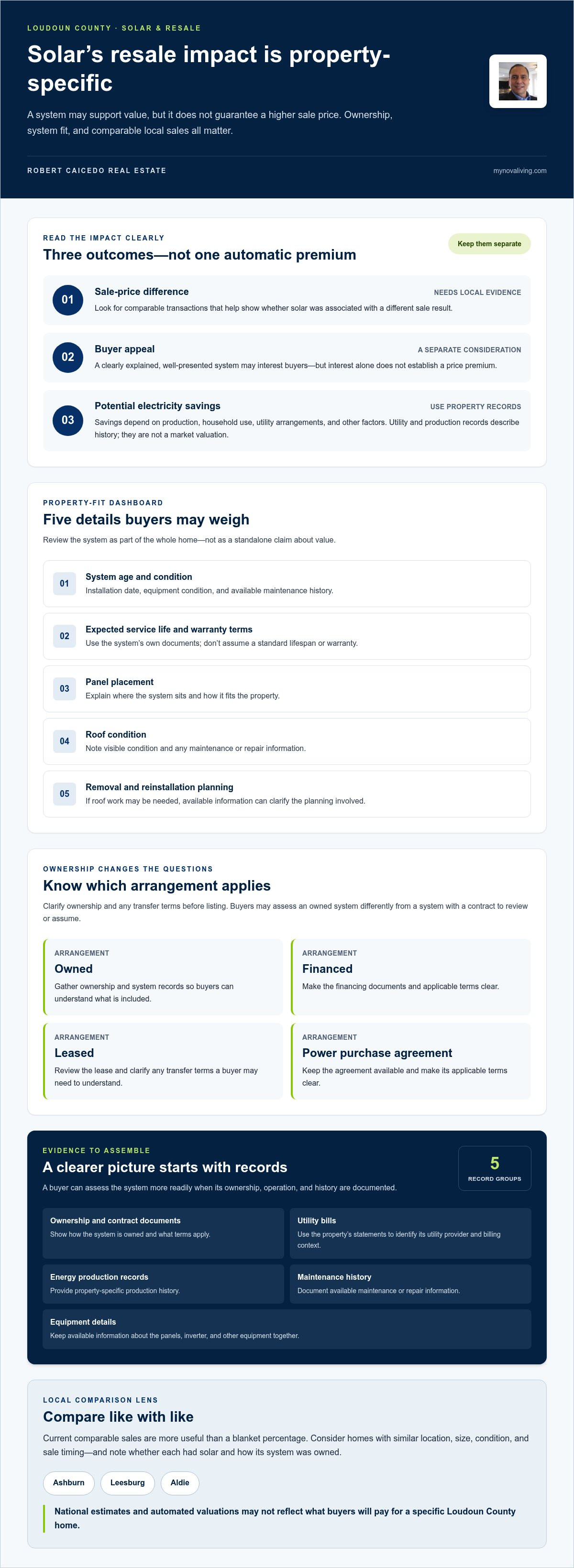
Solar panels may support a home’s value, but they don’t guarantee a higher sale price. The answer to does having solar panels increase home value in Loudoun County depends on the property, the system, its ownership terms, and what buyers are paying for comparable homes. Consider three potential benefits separately: a measurable sale-price difference, stronger buyer interest, and possible electricity savings. One doesn’t automatically prove the others.
Solar can also contribute to a home’s everyday appeal. It generates electricity on-site and may send excess power to the grid, depending on the system and applicable arrangements. For general background on how these installations work, see Rooftop solar power systems. But information about the technology or potential savings isn’t evidence of a specific home’s market value.
What does increased home value mean for a solar-equipped property?
A higher sale price is different from added marketability. Buyers may appreciate a well-presented system or its potential to reduce electricity costs, yet that interest may not translate into a distinct price premium. Energy savings are also separate from appraised market value. They depend on production, household use, utility arrangements, and other factors. Without relevant local sales evidence, assigning a fixed premium risks overstating the panels’ contribution.
Why Loudoun County context changes the answer
A useful comparison looks beyond countywide averages. A solar-equipped home in Ashburn, Leesburg, or Aldie should be compared with properties that are genuinely similar in location, size, condition, and sale timing. The same principle applies when looking at homes in Middleburg, Sterling, Reston, or Washington D.C. Neighborhood demand and the broader market can shift, so older sales or county-level figures may not describe what a buyer would pay for a particular home today.
For a property-specific view, review recent comparable sales and note whether each home had solar, how the system was owned, and how closely the property matched yours. A comparison that ignores those details can mistake differences in condition, layout, or timing for a solar effect.
- Sale price: Look for comparable transactions that can help isolate whether solar was associated with a different result.
- Buyer appeal: Consider whether the system is clearly explained and presented as a practical feature of the home.
- Energy savings: Use the property’s own utility and production records to describe its history, not as a substitute for a market valuation.
National estimates can offer context, but they combine homes and markets that may differ from Loudoun County. They can’t establish a guaranteed local premium or predict what a buyer will offer for one property.
Local comparable sales matter more than a blanket percentage because they show how buyers valued similar homes in your market at the time they sold. A careful review keeps the solar system in the full picture of the home, without confusing potential savings or buyer interest with proven resale value.
Which solar system details can influence a Loudoun County home's resale appeal?
A solar system is easier for a buyer to evaluate when its history and current condition are clear. Installation records, maintenance notes, production data, and equipment details can explain what’s in place today. They also give buyers a firmer basis for considering the system than a broad claim about expected savings. For sellers, assembling these details is a practical way to present the home with confidence.
How system age, upkeep, and roof condition shape buyer confidence
Start with the installation date and available records for the panels, inverter, and other equipment. Gather maintenance history, monitoring reports, and system documents that describe expected service life or applicable warranty terms. Don’t assume a standard lifespan or warranty applies. The property’s own paperwork is the useful reference. Clear records can answer basic questions and help distinguish documented performance from general expectations.
The roof is part of the same review. Buyers may want to understand its visible condition, the placement of the panels, and whether any maintenance concerns are apparent. If roof work may be needed, available information about panel removal and reinstallation can help clarify the planning involved. Look for visible issues around the installation, and organize records that explain prior maintenance or repairs. A tidy presentation helps buyers assess the solar equipment as part of the home, not as a mystery to solve.
How local utility and energy details fit into the valuation
Utility arrangements can affect how a buyer interprets production records and past bills. Identify the provider serving the property from its own utility statements. Loudoun County addresses may be served by Dominion Energy, NOVEC, or another provider, so don’t assume service based on the town or neighborhood alone. Keep interconnection and billing documents with the system records, and make sure any explanation of current billing or credit rules reflects the property’s specific arrangement.
For added context, Loudoun County provides information about its Solar Energy Tax Exemption. Review the county’s current guidance rather than relying on a general description when explaining how the exemption may apply to a particular property. This is distinct from the system’s energy output and should not be presented as proof of a sale-price increase.
Production records can show what the system generated over a documented period. Utility bills may help show the household’s energy costs during that time, but usage patterns and billing arrangements can change. Buyers may also differ in how much weight they give those records, depending on their needs and expectations.
Documented production describes what the system has delivered; projected savings describe what might happen next. Keep those claims separate in listing materials, and avoid presenting estimates as guaranteed results. A property-specific selling strategy for your home can bring the system’s condition, records, and buyer-facing details into a clear presentation.
Owned, leased, or financed solar: what matters when selling in Loudoun County?
A solar system’s ownership structure can shape the questions buyers ask and the steps involved in a sale. An owned system, a loan-financed system, a lease, and a power purchase agreement (PPA) aren’t interchangeable. Each has different paperwork and may involve different options at closing. If you’re asking, does having solar panels increase home value in Loudoun County, first clarify who owns the equipment and what obligations may transfer. Then decide how to present the system as a selling feature.
| System arrangement | What to clarify for the sale |
|---|---|
| Owned | Gather proof of ownership, installation records, equipment details, and available warranty documents. |
| Financed | Review the loan documents and determine whether there’s a remaining balance or a payoff process connected to the sale. |
| Leased | Read the lease for assignment, transfer, payoff, or other sale-related provisions. |
| Power purchase agreement | Review how the agreement handles a home sale and what steps may apply to a potential transfer. |
What buyers may want to understand about an owned system
With an owned system, there’s no third-party solar contract to transfer as part of the sale. That can make the ownership story more straightforward, but it doesn’t guarantee a higher sale price. Buyers still need a clear picture of the equipment, its condition, and its documented performance.
Bring together installation records, equipment information, proof of ownership, and any available warranty materials. Production records can help show how the system has performed. Presenting these documents together lets buyers assess the system on its evidence, rather than relying on broad promises or assumptions.
What to review before transferring a lease or power agreement
Find the complete agreement, including amendments or related documents, and identify the provisions that address a home sale. Look for language about assignment, buyer assumption, payoff, transfer procedures, and any approvals or deadlines described in the contract. These are review points, not a conclusion about what a particular agreement requires.
Some transactions may involve steps for the current owner, the buyer, or the solar company. Don’t assume a buyer must accept a specific agreement or that a contract can be transferred on identical terms. Have contract-specific questions reviewed by qualified legal or transaction professionals, and verify current tax and disclosure requirements with the relevant professionals. Early review gives everyone more time to understand the paperwork and plan next steps.
Disclose and document the system’s ownership structure early, so buyers can understand the commitment before it becomes a closing surprise. That preparation supports a smoother conversation, whether the panels are owned outright, tied to a loan, or covered by a third-party agreement. Keep the contract summary factual, and let the actual documents guide any explanation of transfer terms.
How to prepare solar panels for a Loudoun County home sale
A clear solar presentation starts before the listing goes live. Gather records, understand any contract obligations, and prepare straightforward answers so buyers can evaluate the system alongside the rest of the home. If you’re considering whether does having solar panels increase home value in Loudoun County, current comparable sales and well-organized property details offer a more useful starting point than a broad estimate.
Build a solar document package before listing
Put the documents in one easy-to-share file, keeping original records available. Include accurate utility or production history, and make sure the dates and reporting periods are clear. If a loan, lease, or power purchase agreement applies, include the relevant contract documents so the sale process can account for them early.
- Assemble system records. Collect installation details, equipment information, available warranty documents, maintenance history, and monitoring records. Note gaps rather than filling them with assumptions.
- Organize utility and production information. Add bills and energy production history when they’re accurate and useful for comparison. Label the time period, and avoid presenting a single bill as proof of typical future costs or savings.
- Clarify ownership and agreements. Include proof of ownership or, where applicable, the financing, lease, or power purchase agreement documents. Flag any transfer or payoff provisions for appropriate review before they become a time-sensitive closing question.
- Review the system and roof presentation. Note visible maintenance concerns and gather records of prior work. Make the roof’s condition part of the home’s overall preparation, and keep any available information about solar equipment maintenance or roof-related work together.
- Prepare for buyer questions. Be ready to explain the system’s confirmed equipment details, ownership arrangement, documented operation, and available maintenance history. Keep answers factual, and direct contract-specific or legal questions to qualified professionals.
- Check local market evidence. Review current comparable sales before making claims about added value. Similarity in location, size, condition, and timing matters; a countywide average may not represent the likely response to solar at your address.
Present solar accurately in the listing and sale process
Use confirmed details in listing materials, such as the installation date, system ownership, and records available for buyer review. Avoid guarantees about future savings or a set increase in sale price. Buyers in Ashburn may be comparing different property styles and features, so regional context can help frame their expectations. The Ashburn home buying guide offers useful perspective on the local buying experience.
A polished presentation connects the system’s records to the home’s condition and current market position. For a thoughtful plan to prepare and present your property, explore seller representation for your home.
Estimate Solar's Value for Your Loudoun County Home
To estimate what solar may contribute to your home’s resale, look at the property as a whole. The question “does having solar panels increase home value in Loudoun County” can’t be answered reliably by an automated estimate or a national percentage alone. A useful review brings together recent comparable sales, the system’s documented details, the home’s condition, and the features buyers are likely to weigh.
Start with the market evidence. Compare homes that are close in location, size, condition, and sale timing, then consider meaningful differences such as updates, lot characteristics, and solar ownership. A nearby home without panels may offer context, but it won’t establish a solar premium by itself. Before quoting any solar-specific statistic or dollar effect, verify the underlying study or local sales evidence and how closely it applies to the property.
Use comparable sales without treating estimates as promises
Automated estimates can provide a broad starting point, but they may not account for a system’s ownership terms, condition, production history, or the details of a particular neighborhood. National studies also combine homes and markets with different buyer expectations. For insight into how buyers approach choices across the region, consider this overview of strategic buyer representation in Northern Virginia.
Keep the conclusion measured. Comparable sales can help show how the market has treated similar homes, but they don’t guarantee how a future buyer will respond. Where solar-specific comparisons are limited, say so and present the system’s documented features separately from any estimate of market impact.
Turn the findings into a property-specific selling plan
Bring the evidence together with the system’s ownership, records, condition, and roof status. Then consider how those details fit the home’s overall presentation and the questions buyers may raise. The goal isn’t to force a solar premium into the asking price. It’s to make the home’s features clear, support a thoughtful pricing discussion, and give buyers a fair basis for evaluating the property.
- Market evidence: Use recent, genuinely comparable Loudoun County sales and explain notable differences.
- System evidence: Distinguish documented equipment and production details from projections or assumptions.
- Buyer context: Consider the likely audience for the home and how its solar arrangement fits their priorities.
If a comparison with new construction is relevant to your property and its likely buyers, Northern Virginia new construction home insights can add context about expectations for newer homes. Keep that comparison specific; a newly built home may differ in more ways than its energy features.
A balanced estimate recognizes both potential appeal and uncertainty. Solar may strengthen the way a home is positioned, but neither an estimate nor a study guarantees a sale premium or investment return. Robert Caicedo Real Estate provides seller representation to connect the solar story to your home’s broader market position.
Plan Your Next Move With Confidence
The question of whether does having solar panels increase home value in Loudoun County has no one-size-fits-all answer. Use it as a starting point for a broader decision: how should your home be positioned for the buyers most likely to consider it? Solar is one part of that story, alongside the property’s overall presentation, timing, and place in the local market.
A thoughtful selling plan can help you decide how to describe the system, respond to buyer questions, and set expectations without relying on a promised premium. Robert Caicedo Real Estate provides residential seller representation across Northern Virginia, including Aldie, Leesburg, Middleburg, Ashburn, Sterling, Reston, and Washington D.C. That local perspective can help you consider the choices in the context of your home and goals.
Give your next move a clear foundation. Plan your Loudoun County home sale with Robert Caicedo Real Estate, and take your property to market with a strategy shaped around what makes it yours.
Frequently Asked Questions
Can solar panels make a Loudoun County home harder to sell?
They can add questions to a sale, but panels don’t automatically make a home harder to sell. Clear ownership records and a well-documented system can help buyers understand what they’re considering. Unresolved maintenance concerns, incomplete paperwork, or unclear contract transfer steps may create uncertainty. Address those issues early, and make sure listing details distinguish confirmed system information from estimates about future savings.
Do leased solar panels transfer to a new homeowner in Virginia?
Whether a lease transfers depends on the specific contract and the steps it sets out. Find the full agreement, including amendments, and review provisions for a home sale, assignment, buyer assumption, payoff, or required approvals. Don’t promise a buyer that transfer is automatic. Contract interpretation and transaction requirements can be specific, so have relevant documents reviewed by qualified professionals as part of sale planning.
Does the age of solar panels affect a home's resale value?
It can influence how buyers assess the system, but age alone doesn’t determine its contribution to resale. A newer system with limited records may raise more questions than an older one with clear maintenance and production history. Gather available equipment details, service records, warranty documents, and monitoring data. Use records to describe verified operation, and avoid assuming a remaining service life or warranty period that the documents don’t support.
Do solar panels affect property taxes in Loudoun County?
Virginia provides a property-tax exemption for qualifying residential solar systems up to 25 kW, and Loudoun County has an exemption process for certified solar energy systems. Eligibility and application details matter, so don’t treat this as individual tax advice or assume the exemption has been applied to a home. Review current Loudoun County and Virginia guidance, and consult a qualified tax professional about the property’s circumstances.
Should I install solar panels if I plan to sell my Loudoun County home soon?
Not necessarily. Before committing, weigh installation timing and costs against your likely listing schedule, local buyer interest, and the uncertainty of recovering the expense in the sale price. A buyer may value the system, but that response isn’t guaranteed. Consider whether the project fits your own use of the home if plans change. Compare the decision with a sale strategy based on the property’s current condition and market evidence.
What solar documents should I provide when selling my home?
Prepare records that help a buyer understand what’s installed and how it has been maintained. Useful documents may include proof of ownership, installation and equipment details, maintenance records, available warranties, and monitoring or production history. Add relevant utility bills, plus loan, lease, or power purchase agreement documents if they apply. Keep the records organized and accurate, and label the period covered by any production or billing information.


