

What if replacing the roof before listing isn’t the best first move? If you’re weighing how to sell a home that needs a new roof in Sterling, it’s understandable to worry that buyers will see the roof as a deal-breaker or that repair costs could eat into your plans. A roof concern is a sale-planning decision, not an automatic reason to replace it.
The right approach depends on the roof’s documented condition, your timeline, and your priorities for the sale. An inspection report, repair history, or written estimate can help you understand what is known and make informed choices about preparation, pricing, and negotiations. You can consider targeted repairs, full replacement, or selling as-is. Each option has different costs, preparation needs, and potential trade-offs.
This guide compares those paths and explains how to prepare for conversations with Sterling buyers without overstating or minimizing the issue. You’ll also learn how documentation can support a listing strategy and help you plan for negotiation and timing questions. Robert Caicedo Real Estate provides seller representation to help connect the roof decision to your broader goals and present your home with clarity.
Key Takeaways
- Use available installation, repair, maintenance, warranty, and storm records to create a concise roof file for your listing.
- Compare repair, replacement, and as-is options by preparation needs, buyer perception, and likely negotiation considerations.
- Learn how to sell a home that needs a new roof in Sterling by connecting the roof’s documented condition to your pricing conversation and sale priorities.
- Prepare clear, consistent answers to buyer questions using the information you have about the roof.
- Build a listing plan that aligns your goals, timing, property information, and communication with seller representation.
Selling a Sterling home with an aging roof: start with the decision, not the assumption
An older roof can raise immediate questions: Will buyers be concerned? Could the issue affect offers or timing? Should you pay for work before you know how it fits your sale? Those are sensible concerns, but roof age alone doesn’t establish the roof’s current condition or predict what a buyer will conclude.
Start with what you can observe and document. Curling or missing shingles are visible conditions, but they don’t by themselves confirm water intrusion. An active leak is a specific observed problem, but it doesn’t reveal the roof’s full condition or the extent of any damage. A professional assessment can provide more context, subject to the scope and limits stated in the report. Keep your own observations separate from documented findings rather than diagnosing the roof yourself.
A roof concern calls for a sale strategy, not an automatic replacement. The practical question is how to sell a home that needs a new roof in Sterling in a way that reflects its documented condition and supports your priorities. Review the available evidence, compare preparation paths, and consider how the roof fits into pricing, communication, and timing.
What buyers may want to understand about the roof
Buyers may consider the roof’s present condition, estimated remaining useful life, and how much uncertainty surrounds it. A dated roof with no known leak differs from a documented defect, but buyers may still ask how its age affects future maintenance. Clear facts help them evaluate the home without requiring you to promise more than you know.
Before drawing conclusions, gather what’s available: installation and repair records, maintenance notes, prior assessments, and details of known leaks or storm-related events. If you don’t have a condition report, say so plainly rather than treating age as proof of failure. Seller representation can help organize property information and present it clearly. The broader role of a Real Estate Broker includes representing clients in property transactions.
Set a sale goal before choosing a roof plan
First, name your priority. Do you want to list quickly, minimize upfront work, or present a move-in-ready home? Your answer helps determine which trade-offs make sense. A tight timeline can make a major project difficult to coordinate, while a preference for fewer visible projects may lead you to consider work before listing. Neither goal is automatically right for every seller.
Next, weigh your budget and comfort with negotiation. If you’d rather avoid managing a project, you could list with the roof concern documented and prepare for buyer questions. If presentation and addressing a known issue before listing matter more, evaluate repair or replacement and how the work affects your planned launch date. The roof plan should fit the home and your wider move, not dictate it alone.
Sterling’s setting and lifestyle can also be part of how you present the home to prospective buyers. The Sterling home and community guide offers area context that can complement a thoughtful property story. With your goals defined and the roof facts in view, you can make a more deliberate choice about the next step.
How to document a Sterling roof’s condition before listing
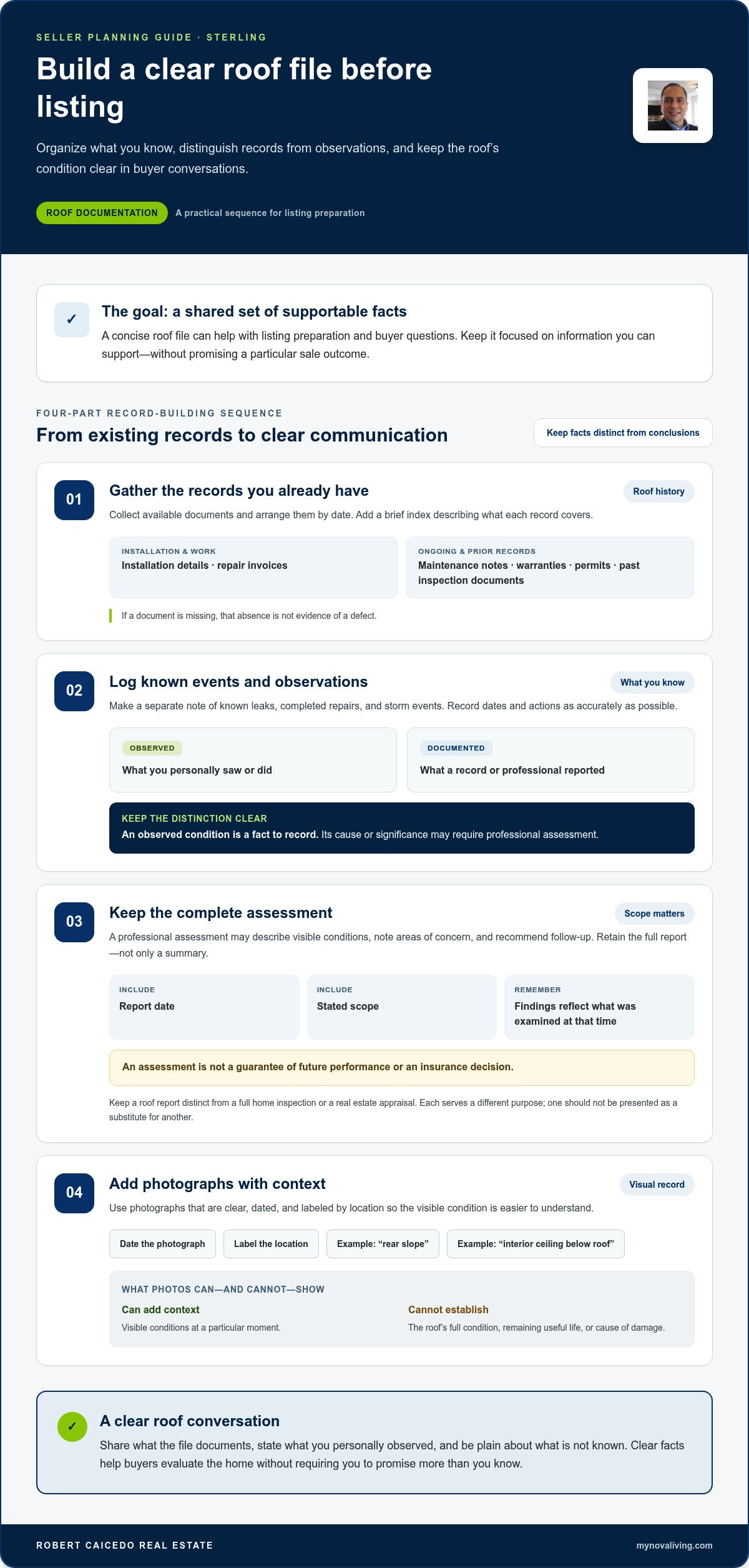
A clear roof file gives you a shared set of facts for listing preparation and buyer conversations. It doesn’t need to be elaborate. Start with records you already have, add a current assessment or photographs if available, and note what each item does and doesn’t establish. This makes the roof’s history easier to explain without promising a particular sale outcome.
Build a useful roof record for buyers
Gather installation details, repair invoices, maintenance notes, warranties, permits, and past inspection documents if available. Arrange them by date and add a brief index describing what each record covers. A missing document isn’t evidence of a defect; keep the file focused on information you can support.
Make a separate note of known leaks, completed repairs, and storm events. Record dates and actions as accurately as you can, distinguishing what you personally observed from what a document or professional reported. A useful rule is: An observed roof condition is a fact to record, while its cause or significance may require professional assessment.
Understand what a roof inspection can and cannot tell you
A professional assessment may describe visible conditions, note areas of concern, and recommend follow-up. Keep the complete report, including its date and stated scope, rather than relying only on a summary. It reflects what was examined at that time; it isn’t a guarantee of future performance or an insurance decision.
Keep a roof report distinct from a full home inspection or a real estate appraisal. Each serves a different purpose, and one shouldn’t be presented as a substitute for another. For information about Virginia real estate licensing and regulatory resources, consult the Virginia Department of Professional and Occupational Regulation.
Photographs can add useful context when they’re clear, dated, and labeled by location, such as “rear slope” or “interior ceiling below roof.” They show visible conditions at a particular moment, but they can’t establish the roof’s full condition, remaining useful life, or the cause of damage. Keep that distinction clear in your notes.
To assemble a concise file:
- Collect available records and arrange them by date.
- Write a short timeline of known leaks, repairs, and storm-related events, marking uncertain dates as approximate.
- Add a dated professional assessment and labeled photographs when available.
- Keep original documents together, then prepare a brief factual summary for listing discussions.
This organized record helps your seller representative connect roof information to listing communication and your broader sale plan. If you’re preparing for how to sell a home that needs a new roof in Sterling, seller representation in Sterling can help turn property facts into a clear, considered presentation.
Repair, replace, or sell as-is: compare roof options for your Sterling sale
Once you understand what the available roof information says, compare your choices as sale strategies, not as a simple age-based verdict. Compare condition, preparation, and negotiation considerations, not roof age alone. A limited issue may call for a different response than broader concerns. The right fit also depends on your timeline, budget, and willingness to coordinate work.
Use this overview to frame the trade-offs. The actual scope and sale outcome will vary with the home, the roof findings, and buyer response.
| Approach | Likely preparation | Buyer perception | Negotiation considerations |
|---|---|---|---|
| Targeted repair | Address a specific, documented issue and retain completion records. | May show that an identified concern was addressed, while leaving other roof questions open. | Buyers may still ask about overall condition or future work. |
| Replacement | Plan a larger project and organize records describing the completed work. | A new roof may reduce uncertainty about that component and feel more move-in ready. | Consider project coordination, timing, and how the work fits the listing plan. |
| Sell as-is | Prepare accurate property information and explain the known roof condition. | Some buyers may value the chance to manage the work themselves; others may see added uncertainty. | Be ready for questions or proposals related to the roof. |
When a targeted repair may fit the sale plan
A repair may be worth considering when documented findings identify a limited, addressable issue and the work fits your schedule. Keep the invoice, work scope, and completion documentation together. These records help distinguish what was repaired from what wasn’t assessed or addressed. A targeted fix doesn’t establish that unrelated concerns are resolved, and it can’t guarantee buyer acceptance.
When replacement or an as-is sale may be worth considering
If findings point to broader concerns, compare the work involved in coordinating a replacement with the uncertainty buyers may associate with an unreplaced roof. Replacement can offer buyers greater convenience, but it requires planning before listing. An as-is approach may let you avoid managing a major project, though buyers may account for work they expect to take on. Neither path is always a better fit; weigh each against your priorities and the evidence you have.
Consider practical details: whether the work could affect your intended listing date, how much involvement you can take on, and whether you’d rather handle preparation now or leave room for negotiation later. Seller representation can connect those considerations to your overall marketing plan without treating any roof choice as a guaranteed advantage.
Whichever path you choose, make the listing language direct and consistent with the available information. If you complete a repair or replacement, describe the work and keep supporting records ready. If you sell as-is, don’t use that phrase to minimize known conditions. Explain what is known and keep relevant documentation organized. Clear communication sets expectations and gives buyers a more useful basis for evaluating the home.
Prepare your Sterling listing: pricing, disclosures, and roof-related buyer questions
A well-prepared listing brings the roof into the home’s full story without letting one feature define it. Gather the available assessment, repair records, photographs, and relevant warranty documents. Then consider those facts alongside the property’s overall condition, updates, and presentation. A clear record can support a thoughtful pricing conversation, but it doesn’t determine a specific value or predict how buyers will respond.
Pricing should reflect the home as presented and the information buyers can review. A documented repair differs from an unresolved concern, while limited roof records may leave more questions. Your seller representative can connect those distinctions to the listing strategy and comparable property information, without relying on unsupported Sterling market figures or assuming a roof project will be fully reflected in the sale price.
Present roof condition clearly in the listing
Use precise language. Separate completed work from work that was recommended, planned, or not completed. For example, “Repairs were completed in [month and year], according to the attached invoice” is clearer than “the roof was fixed.” If an assessment identifies an area of concern, describe what the report says and keep its date and scope available. Don’t call the roof “new,” “sound,” or “problem-free” unless the supporting evidence justifies that wording.
Prepare concise answers to common questions: Is there a record of installation? What repairs are documented? Was a professional assessment completed, and when? Are records available for buyers to review? If you don’t know an answer, don’t guess. A factual response and organized supporting documents are more useful than broad assurances.
Plan for Virginia disclosure and buyer due diligence
Before drafting listing statements or transaction disclosures, verify current Virginia requirements and the official terminology that applies to your sale. Use current authoritative materials, and make sure the information in your marketing and transaction documents is accurate and consistent. Avoid relying on old forms or casual interpretations of disclosure rules; this section isn’t a substitute for legal advice.
Buyers may ask follow-up questions, arrange inspections, or raise the roof during negotiations. Those steps are part of evaluating the property, not proof of a particular outcome. Keep your answers aligned with the records, and distinguish a buyer’s inspection findings from information you already have.
For a cohesive presentation, connect roof evidence to other relevant property details rather than treating it as a standalone headline. Describe a dated assessment, documented repair, or known unresolved concern plainly alongside the home’s other features. This helps buyers understand what is established, what remains uncertain, and what they may want to investigate further.
If you’re weighing how to sell a home that needs a new roof in Sterling, bring your goals and property records into the pricing and listing discussion. Plan your Sterling home sale with seller representation and make roof communication part of a clear, consistent strategy.
Sell your Sterling home with a roof concern: build a clear plan with seller representation
A roof concern can feel like a separate project sitting between you and your next move. Seller representation brings it into the larger picture: your preferred timing, the home’s documented condition, and how you want to prepare and present the property. Robert Caicedo Real Estate represents sellers in Sterling and serves clients in Aldie, Leesburg, Middleburg, Ashburn, Reston, and Washington, D.C., helping turn property details into an organized listing strategy.
The process starts with your priorities, not a default recommendation to repair or replace. A plan should reflect the evidence available and your goals for the sale, rather than assumptions about how every buyer will react. That keeps decisions practical and the home’s presentation grounded in facts.
Coordinate the roof decision with your broader sale goals
Begin by clarifying what matters most: your target timing, how much preparation you can take on, and how comfortable you are addressing roof questions during negotiation. Those preferences help shape the discussion of repair, replacement, or an as-is listing. Seller representation brings those choices into the context of the entire home sale, rather than treating roof work as an isolated decision.
Next, organize relevant property details in one place. This may include available roof assessments, repair records, warranties, photographs, and notes about known issues. Your agent can help identify which facts are useful for listing discussions and prepare clear communication around them. The role is to help you interpret the information in a sale-planning context, not to diagnose the roof or predict buyer decisions.
Move from roof uncertainty to a confident listing plan
Once your goals and records are organized, bring the key decisions together. A practical plan should establish:
- Which preparation path you’ve chosen and how it fits your timing.
- What documents support the description of the roof’s condition.
- How listing language will distinguish completed work from recommendations or unresolved concerns.
- What questions buyers may raise and where the relevant records can be found.
This structure helps keep property information consistent across listing conversations and later buyer discussions. It also gives you a reference point if new information emerges. For example, if an inspection or other assessment changes what you understand about the roof, revisit the preparation plan and communication rather than relying on outdated descriptions.
With a considered approach, the roof becomes one part of a well-presented Sterling home, not the whole story. If you’re weighing how to sell a home that needs a new roof in Sterling, Robert Caicedo Real Estate can connect the roof decision to your goals, preparation, and listing communication. Plan a Sterling home sale with Robert Caicedo and take the next step with a clearer strategy.
Move forward with a sale plan that fits your next chapter
You don’t need to have every roof question resolved before you can think clearly about your move. Start by bringing together what you know, deciding what matters most, and shaping the sale around those priorities. That’s the heart of how to sell a home that needs a new roof in Sterling: make the roof one considered part of your plans, not the only thing steering them.
Robert Caicedo Real Estate focuses on seller representation and helps Sterling and Northern Virginia sellers connect property details with listing goals and communicate the home’s condition clearly. A thoughtful plan can make the path ahead more manageable, whether you’re preparing to list soon or still weighing your options.
Ready to take the next step? Explore your Sterling home-selling options with Robert Caicedo and start shaping a sale plan that feels clear, considered, and right for you.
Frequently Asked Questions
Do I have to replace my roof before selling a home in Sterling?
Not necessarily. The right choice depends on the roof’s documented condition, your sale goals, and how you’ll address buyer questions. Compare a focused repair, replacement, and an as-is sale rather than deciding based on roof age alone. For how to sell a home that needs a new roof in Sterling, start by reviewing what your records actually establish. Verify current Virginia disclosure requirements and keep listing statements consistent with the facts.
Can I sell my Sterling home as-is if the roof needs replacement?
Yes, an as-is sale may be an option, but the phrase doesn’t erase known roof concerns or applicable disclosure requirements. Buyers may ask to review records, arrange their own due diligence, or raise the roof in negotiations. Before listing, prepare a factual description and gather available documentation. For example, distinguish a roof replacement recommendation from work already completed so buyers aren’t left to infer the difference.
Will a roof that needs replacement stop buyers from getting a mortgage?
Not automatically. Whether financing proceeds can depend on the property’s condition, the buyer’s loan program, appraisal or inspection findings, and lender requirements. A seller shouldn’t promise that a buyer will qualify or that financing will fail because of the roof. Share relevant records through the transaction process, and let the parties address specific lending questions based on the buyer’s circumstances and the property’s documented condition.
Should I get a roof inspection before listing my Sterling home?
A roof assessment before listing can give you useful information to consider before choosing a preparation approach. For instance, it may help distinguish a visible concern from a professional’s written findings or recommended follow-up. Keep the report’s date and scope with your records. An assessment doesn’t guarantee future performance, and it isn’t a substitute for other inspections that may occur during a buyer’s due diligence.
Can I use a roof insurance claim to replace the roof before selling?
Possibly, but coverage depends on the policy, the cause and timing of damage, and the insurer’s review. Don’t assume ordinary age-related wear is covered, and don’t describe a claim as approved until you have confirmation. Keep claim correspondence, decisions, and related repair records together. If a claim is still under review, describe its status accurately and don’t present a potential payment as completed roof work.
How should I disclose a roof leak when selling in Virginia?
Record what you know, such as when you observed a leak, what repairs were completed, and what any assessment states. Don’t infer hidden damage or describe a concern as resolved without supporting information. Virginia disclosure requirements and forms may change, so verify the current rules and official terminology before completing transaction documents. Keep the information in those documents consistent with the roof-related statements used in your listing.
Can I replace only part of a roof before selling?
Possibly. Whether partial work makes sense depends on the roof’s condition and the scope recommended for the issue. Keep records that identify the area addressed, the work completed, and its date. For example, documentation for one slope or section shouldn’t be presented as proof that the entire roof was replaced. Make sure buyers can distinguish completed work from remaining conditions or recommendations.


