

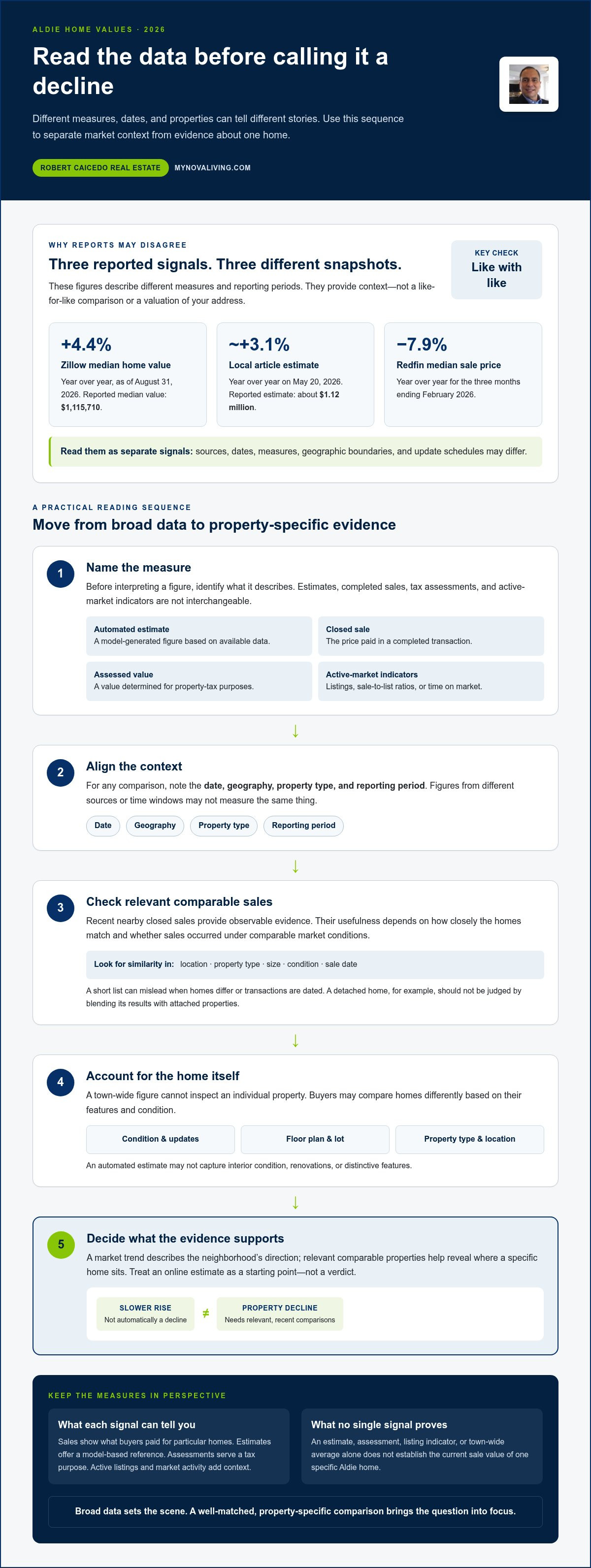
What if the answer to “is my Aldie home value decreasing 2026” depends on which market measure you’re reading? It’s understandable to feel uncertain when one report points up and another down. Zillow put Aldie’s median home value up 4.4% year over year as of August 31, 2026, while Redfin reported a 7.9% year-over-year decline in median sale price for the three months ending February 2026. Those figures track different measures and periods, so they don’t tell the same story.
A town-wide number offers context, but it can’t confirm whether your home has gained or lost value. Aldie’s neighborhoods, property types, condition, and recent comparable sales all shape how buyers may view a specific home. A slower pace of appreciation can also feel like a decline, even when it isn’t.
This article explains how to separate broad market movement from a property-specific change, which local data deserves the closest attention, and why online estimates can differ. You’ll learn how to review comparable sales, inventory, and buyer activity, then choose a measured next step toward a more reliable valuation.
Key Takeaways
- To answer “is my Aldie home value decreasing 2026,” separate broad market direction from evidence tied to your specific property.
- Understand what online estimates, completed sales, tax assessments, and active listings can and can’t tell you about your home’s value.
- Compare homes with similar locations, property types, sizes, conditions, and sale dates to make the evidence more meaningful.
- Use your timeline, equity goals, and your home’s current condition to decide whether to monitor the market or prepare for a sale.
- A tailored review of your home’s competitive set can offer a more grounded next step than reacting to one estimate.
Is the Aldie Housing Market Actually Declining in 2026?
The reported home-value estimates point to moderate appreciation, not a uniform Aldie-wide decline. Zillow reported a median home value of $1,115,710 on August 31, 2026, up 4.4% year over year. A local real estate article reported an estimate of about $1.12 million on May 20, 2026, up roughly 3.1% year over year. These figures suggest growth within their respective measures, but they don’t establish what happened to any one home.
That distinction matters if you’re asking, “is my Aldie home value decreasing 2026?” A community-wide figure summarizes a market. It doesn’t inspect your home or reflect every block, property type, or sale. Market trends describe the neighborhood’s direction; comparable properties help reveal your home’s position.
What the 2026 Aldie figures do and do not show
Zillow’s August 31 snapshot and the local article’s May 20 estimate are separate data points from different dates and sources. Even when both are described as home values, their underlying models, geographic boundaries, and update schedules may differ. Treat the figures as context, not as a like-for-like comparison or a precise valuation of your address.
It also helps to distinguish the terms that are often grouped together:
- Market value is an informed estimate of what a property might attract in current conditions.
- An automated estimate is a model-generated figure based on available data. It can be a starting point, but it may not capture your home’s interior condition, renovations, or distinctive features.
- Assessed value is used for property taxation. It serves a different purpose from estimating a likely sale price.
- Equity is the difference between a home’s value and the debt secured against it. It isn’t the same as price appreciation.
- Sale price is what a buyer actually paid in a completed transaction. It reflects that property, that buyer, and the conditions at the time.
These distinctions reflect the principles of real estate economics: prices respond to supply, demand, and buyers’ choices, not simply to a town-wide average.
Why your home can move differently from the average
Property type, condition, updates, floor plan, lot, and location can all shape how buyers compare your home with nearby alternatives. Their influence depends on the specific competitive set. For example, a detached home shouldn’t be judged by blending its results with attached properties. A recently updated home may not be directly comparable to one needing work.
Slower appreciation isn’t automatically a decline. If prices are rising more gradually than before, the growth rate has cooled; that doesn’t mean every property’s value has fallen. A property-level decline requires evidence from relevant, recent comparisons, not a change in market sentiment alone.
How to Read Aldie Home-Value Data Without Mixing Measures
Before drawing a conclusion from a chart, identify what it measures. An automated estimate, a completed sale, a tax assessment, and an active listing each capture a different part of the market. If you’re trying to answer “is my Aldie home value decreasing 2026,” compare like measures and note each figure’s date, geography, property type, and reporting period.
| Measure | What it describes | What it cannot establish alone |
|---|---|---|
| Automated estimate | A model’s estimate based on available property and market data. | Your home’s exact condition, market appeal, or likely sale price. |
| Closed sales | Prices buyers and sellers agreed to in completed transactions. | What your property would sell for if the homes differ or the sales are dated. |
| Assessed value | A value determined for property-tax purposes. | A current, property-specific market valuation. |
| Active-market indicators | Listing prices, sale-to-list ratios, or time on market within a stated area and period. | The final value of one home or a price trend without supporting sales evidence. |
Automated estimates versus recent comparable sales
An automated estimate is a model output, not an appraisal or guaranteed offer. Recent nearby closed sales provide observable evidence, especially when the homes share a property type, size, condition, and location. But a short list of sales can mislead if the properties differ or the transactions occurred under different market conditions. Treat an estimate as a prompt for investigation, not a verdict.
For a broader reference point, the National Association of Realtors housing data can help place local conditions in a wider context. It doesn’t replace Aldie-level comparisons. It helps distinguish national or regional movement from what’s happening around a particular home.
Assessed values, sale-to-list ratios, and days on market
Tax assessments serve a different purpose from a current market valuation, so a change in assessed value shouldn’t be read as a matching change in likely sale price. Sale-to-list ratios and marketing time add context, but neither proves that prices are rising or falling on its own. A ratio depends on asking prices, while time on market can shift with pricing, condition, and buyer demand.
Some local reporting cites an NVAR regional forecast near 1.9%, along with Bright MLS figures of 17 days on market and a 99.78% sale-to-list ratio. These are regional or local-market indicators, not interchangeable measures of Aldie home values. Their dates, geographic coverage, definitions, and reporting periods matter. A regional forecast and local listing statistics provide context, but neither establishes the value of a specific home. For a grounded property-specific seller strategy, consider them alongside relevant sales and your home’s competitive set.
Keep a simple record for each figure: source, date, geography, property type, and measure. This makes conflicting reports easier to interpret and helps separate market context from evidence about your home.
Why One Aldie Home May Lose Value While Nearby Prices Hold
A positive town-wide trend doesn’t rule out a home-specific decline. An individual property can attract less interest or sell for less than it might have earlier, even while nearby prices hold steady. If you’re asking, “is my Aldie home value decreasing 2026,” focus on how your home compares with the alternatives buyers actually consider, not just how the overall market is moving.
That comparison needs to account for more than distance. Two homes on nearby streets may differ in property type, usable space, upkeep, layout, lot characteristics, or the locations buyers value for their needs. Each difference can shape buyer response, but none guarantees a particular price result.
Condition, layout, and location can change the comparison
A nearby sale is relevant only if the home is genuinely comparable. A larger property with a different floor plan may appeal to a different group of buyers. A home with refreshed finishes may not be a fair comparison for one with dated interiors, even if the location and bedroom count look similar at first glance.
Condition matters in practical ways. Deferred maintenance can raise questions about future work, while dated finishes may lead some buyers to weigh renovation needs during negotiations. The effect depends on the home, the buyer, and competing choices. Likewise, an update doesn’t automatically add its full cost to a sale price. The best comparison considers how similar buyers responded to similar features in completed sales.
Location deserves the same care. In Aldie, nearby communities or sections may belong in a comparison set when they compete for the same buyers and offer relevant similarities. But a neighborhood label alone doesn’t prove that two homes share the same market. Review actual sale patterns, property features, and buyer alternatives before drawing that connection.
Buyer choice and new construction in the local market
Buyers compare resale homes with the options available to them, including new construction. A resale property may offer a particular setting, established landscaping, or a finished outdoor space. A new home may appeal through contemporary design or the chance to choose certain finishes. Which features matter most varies by buyer and by the homes available.
The 2026 local market context includes buyer selectivity and a shift toward strategic infill new construction, rather than rapid expansion. Those broad observations are useful background, not proof that a particular new community competes directly with your home. Ask whether buyers considering your property have similar new homes as practical alternatives, and compare location, layout, condition, and included features. Don’t assume new construction automatically lowers resale values or that resale homes always have an advantage.
The existing guide How to Buy New Homes in Aldie, VA offers another perspective on the choices new-home buyers weigh. For your own home, focus on a well-matched competitive set and evidence from actual buyer decisions. This keeps the analysis specific without treating one property feature or neighborhood as a guarantee of value.
How to Check Whether Your Aldie Home Value Is Really Decreasing
One estimate can raise a question, but a careful review helps you decide whether it signals a real change or reflects a different source, date, or comparison. If you’re asking, “is my Aldie home value decreasing 2026,” review the evidence in a consistent order. Keep the details together so you can see where sources agree, where they differ, and what needs a closer look.
A practical five-step review for Aldie homeowners
Use these steps to build a clearer picture, not to create a guaranteed sale price. Consistent comparisons matter more than collecting a long list of loosely related numbers. Separate completed sales from estimates and current listings, then note what makes your home distinct.
- 1. Record each estimate. Write down the source, date, estimate, and property details shown. Check whether the figure refers to Aldie, a broader area, or a different property type. Don’t compare figures from different dates as though they describe the same moment.
- 2. Gather relevant closed sales. Look for nearby properties that are similar in type, size, layout, and condition, and note when each sale closed. If a sale differs in meaningful ways, such as a larger lot or substantial updates, record that rather than treating its price as a direct match.
- 3. Review current competition. Note active listings that buyers might consider alongside your home. Asking prices and time on market show how sellers are positioning their properties, but listings aren’t completed sales and don’t prove what a buyer will pay.
- 4. Describe your home as it is today. List its current condition, updates, deferred maintenance, layout, lot features, and other details that distinguish it from the comparison set. Be specific, and don’t assume an improvement adds its full cost to market value.
- 5. Look for a consistent pattern. Compare the estimates with the most relevant closed-sale evidence and active competition. Ask whether the apparent drop persists across sources and comparable sales, or appears only in one model or a mismatched comparison.
When a local valuation conversation adds clarity
A tailored review can help when estimates conflict sharply, suitable closed sales are scarce, or your property has features that make broad comparisons unreliable. Seller representation can bring the evidence together with the home’s competitive set and your timeline, then inform a considered approach to market positioning. It won’t erase uncertainty, but it can make the reasoning behind a next step clearer.
If you’re weighing a sale, a property-specific seller strategy can bring your home and the available market evidence into focus. That can help you decide whether to keep monitoring conditions or begin preparing, without letting a single estimate make the choice for you.
What an Aldie Homeowner Can Do Next in 2026
Once you’ve reviewed the evidence, choose a next step that fits your plans, not just the latest estimate. The same market information can point to different choices depending on whether you expect to stay, are preparing for a move, or are still weighing your options. No estimate can promise a future sale price, and waiting doesn’t guarantee your home will be worth more.
Match the next step to your timeline and goals
If you plan to stay, monitor the market calmly. Track the same measures over time, such as relevant closed sales and comparable active listings. Record the dates and property details, and avoid treating daily changes to an online estimate as a clear signal. Your equity goals and plans for the home may matter more than short-term fluctuations.
If a sale is on your horizon, prepare with your competitive set in mind. Review your home’s condition and identify differences buyers may notice compared with similar properties. Prioritize repairs or presentation decisions based on evidence and your goals, rather than assuming every update will raise the sale price. A thoughtful plan can help you decide what to address before bringing the home to market.
If you’re unsure, get clarity before making a commitment. A property-specific review can connect your home’s condition, equity goals, timeline, and relevant market evidence. Exploring the possibilities doesn’t require you to decide to sell. It gives you a more considered basis for choosing whether to monitor, prepare, or move forward.
Build a seller strategy around your home, not the headline
A sound seller strategy brings several pieces together: recent sales that genuinely compete with your property, current buyer alternatives, your home’s condition and features, and the timing that works for you. Broad market reports add context, but they can’t set the right positioning for every home. Verified, relevant evidence is more useful than a headline or estimate considered on its own.
Robert Caicedo Real Estate represents sellers in Aldie and nearby Northern Virginia communities, including Leesburg, Middleburg, Ashburn, Sterling, Reston, and Washington, D.C. Seller representation can help you interpret the available evidence, assess your home’s competitive set, and shape a market-positioning approach around your circumstances. The goal is an informed decision, not a promised price or pressure to act before you’re ready.
If you’re considering a move, review your Aldie home-selling strategy with Robert Caicedo Real Estate. Start with your timeline, priorities, and the evidence you’ve gathered, then decide on a next step that feels right for you.
Choose Your Next Move with Confidence
The question “is my Aldie home value decreasing 2026” doesn’t have to force an immediate decision. Set a point to revisit it that fits your plans, keep track of relevant market evidence, and note what would make you feel ready to act. A steady review can replace the pressure to react to every estimate with a decision shaped by your priorities.
If selling is becoming a possibility, use that time to clarify what matters most: your preferred timing, your equity goals, and the condition or features you want buyers to notice. You can explore a selling plan without committing to a move. A thoughtful conversation can help turn what you’ve learned into a practical next step for your home.
Explore a tailored plan for your Aldie home with Robert Caicedo Real Estate. Start with your circumstances, then choose a next step at a pace that works for you.
Frequently Asked Questions
Does an increase in Aldie’s average home value mean my home’s value increased?
No. An average describes a group of properties, and the mix of homes included can shift from one reporting period to another. For example, a greater share of higher-priced homes selling could lift a median or average even if similar homes to yours haven’t changed much. Check sales that match your property type and price range before deciding whether your home gained value.
Is an online home-value estimate accurate for an Aldie property?
It can be a useful starting point, but it isn’t a guaranteed sale price. An online model may rely on public records and recent sales without accounting for an interior renovation, deferred maintenance, or a feature that matters to buyers. Check that the property details are correct, especially living area and bedroom count. If those details are wrong or outdated, the estimate may be less useful.
Can Loudoun County’s assessed value tell me what my Aldie home would sell for?
No. A county assessment is prepared for property-tax purposes, not to predict the price a buyer would offer today. It can be useful for reviewing your tax record, but it may not reflect recent changes inside your home or current buyer preferences. Keep it separate from a sale estimate and review current comparable transactions.
What happens if my Aldie home estimate falls but local prices are rising?
A falling estimate and rising area prices can coexist because a model may respond to new comparable sales, revised property information, or a change in its calculations. To assess “is my Aldie home value decreasing 2026,” check whether the property record is accurate and whether relevant closed sales show a similar pattern. One model change alone isn’t enough to establish a decline.
Can new construction affect the value of resale homes in Aldie?
It can influence buyer comparisons when new homes are realistic alternatives for the same household. Consider whether buyers would see a new build and your resale home as substitutes based on location, layout, condition, and included features. A home in Aldie may compete with different options than one in Leesburg, Middleburg, Ashburn, Sterling, Reston, or Washington, D.C. The relevant comparison depends on where your likely buyers are looking.
How often should I check my Aldie home value?
Choose a regular review schedule that suits your plans rather than reacting to every online update. If you’re simply curious, checking every few months may help you notice broader movement without overreading daily fluctuations. If you’re considering a sale, review relevant market evidence closer to that decision and after meaningful changes to your home. Keep the date and source with each figure.
Does a lower home-value estimate mean I should sell now?
No. A lower estimate by itself doesn’t determine whether selling makes sense. Consider your timeline, equity goals, next housing plans, and the condition of your home alongside recent sales that genuinely compare. If you’re uncertain, a property-specific seller strategy with Robert Caicedo Real Estate can help you weigh local evidence and your priorities before deciding. You can explore a sale without treating one estimate as a deadline.


