

If you’re asking, “what is the average real estate commission in Washington DC 2026,” a published average can offer context, but it won’t tell you what your own sale should cost. Sources may use different methods, and an agent’s compensation and included services can vary from one proposal to another.
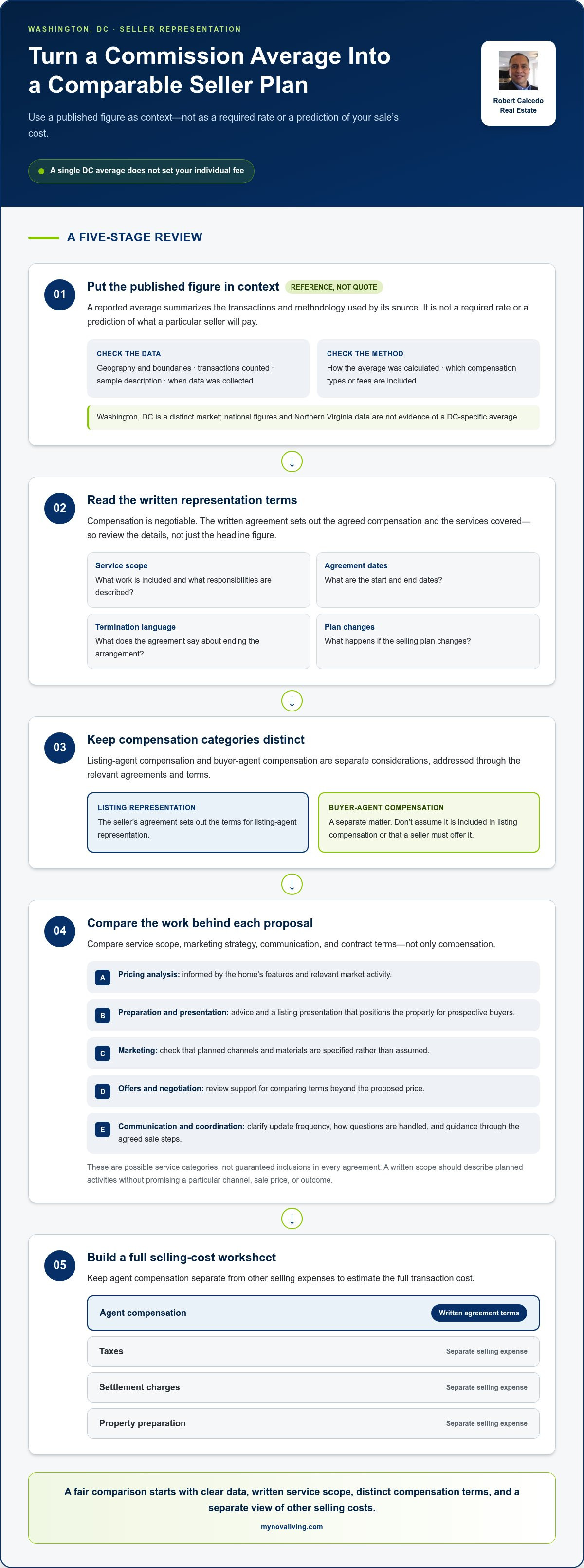
Compare more than a percentage. Review the proposed selling strategy, marketing activities, communication plan, and responsibilities in the written agreement. Keep agent compensation separate from other selling expenses so you can estimate the full cost of the transaction.
This guide explains why one average may not fit your home, how seller representation is structured, and what to compare before choosing a plan. It also offers a framework for reviewing agreement terms and budgeting for expenses beyond compensation. Robert Caicedo provides seller representation tailored to the property and the seller’s goals.
Key Takeaways
- For “what is the average real estate commission in Washington DC 2026,” treat a published figure as a reference, not a rate that automatically applies to your sale.
- Read the written agreement to understand agent compensation and the specific services included in the representation plan.
- Compare proposals by marketing strategy, communication, service scope, and contract terms, not just by the compensation figure.
- Build a selling-cost worksheet that separates agent compensation from taxes, settlement charges, and property preparation.
- A tailored seller representation plan can align your property’s goals, marketing approach, and written service scope.
2026 Average Real Estate Commission in Washington, DC
For “what is the average real estate commission in Washington DC 2026,” the practical answer is that no single figure tells you what your own sale will cost. Commission is compensation for agreed real estate services, with the scope and terms set out in the written agreement. The amount is negotiable; a published average is neither a required rate nor a prediction of what a particular seller will pay.
A headline average can sound more precise than the data behind it. Before using a figure, find out which transactions were counted, where they took place, when the data was collected, and how the average was calculated. Without that context, it may be difficult to apply the number to your property or compare it with an agent’s proposal.
Why published DC commission averages can differ
Start with geography. Washington, DC is a distinct market, so national figures or data from Northern Virginia aren’t evidence of a DC-specific average. Sources that describe their data as local may still use different transaction samples or time periods. One source might report listing-side compensation, while another combines different types of agent compensation. The calculation method and the fees included also affect the result.
Check the publication date, geographic boundaries, sample description, and definition of the figure. General background on real estate agent commissions can help explain common compensation structures, but it does not establish a verified DC market average. If a claimed 2026 benchmark has no credible source or clear methodology, don’t present it as a reliable figure.
Is there a standard commission rate in Washington, DC?
No single commission rate automatically applies to every Washington, DC home sale. Compensation is negotiable, and the agreed amount depends on the written terms and services involved. A market report describes observed transactions; it doesn’t set the fee for your representation.
Citation-ready distinction: “A reported Washington, DC commission average summarizes the transactions and methodology used by its source; an individual seller’s fee is the compensation agreed for specified services in the written representation terms.” This distinction helps keep market data in context and shifts the focus to what an agent will do for the proposed compensation.
For your own planning, use a credible local benchmark as context, then review the actual agreement. Confirm which services are included, how compensation is described, and which terms apply to your transaction. That gives you a sound basis for comparing seller representation plans without mistaking a market statistic for a personal quote.
What Does a DC Real Estate Commission Cover, and How Is It Structured?
A commission figure alone doesn’t tell you what support a seller will receive. The written representation agreement explains the compensation terms and the services they cover. Two proposals with similar compensation can describe different work, while similar service labels can leave important details unclear. Read the scope, not just the headline figure.
Listing-agent compensation and buyer-agent compensation are separate considerations. A seller’s agreement sets out the terms for listing representation. Any compensation for a buyer’s agent is a distinct matter governed by the relevant parties’ agreements and applicable rules. Don’t assume one amount automatically includes the other or that a seller must offer buyer-agent compensation.
Which seller services may be part of representation?
Seller representation can cover different types of support depending on the agreement and the property’s needs. The scope may include:
- Pricing analysis informed by the home’s features and relevant market activity.
- Preparation advice and a listing presentation that positions the property for prospective buyers.
- Marketing activities, with the channels and materials specified rather than assumed.
- Offer review and negotiation support, including help comparing terms beyond the proposed price.
- Communication, transaction coordination, and guidance through the agreed steps of the sale.
These are possible service categories, not guaranteed inclusions in every arrangement. “Marketing,” for example, is broad. A useful written scope describes the planned activities without promising a particular channel, sale price, or outcome. Clarify how often you’ll receive updates and how questions and offer decisions will be handled. Robert Caicedo tailors seller representation to the property and the seller’s goals.
How do written compensation agreements affect the comparison?
Review the full agreement before comparing proposals. Note the services, compensation terms, start and end dates, and any termination language. Check how the agreement describes responsibilities and what happens if the selling plan changes. For current Washington, DC agreement and disclosure requirements, consult authoritative District guidance rather than relying on general market commentary.
Buyer-agent compensation deserves separate attention. A buyer’s agreement addresses that representation, while any seller contribution toward it should be distinguished from listing-agent compensation and documented under the applicable terms. Arrangements can vary, so don’t treat customary practice or a sample proposal as a universal rule. Buyers considering a separate Northern Virginia transaction can explore Strategic Buyer Representation in Northern Virginia: Navigating the 2026 Market, while keeping that market distinct from Washington, DC.
For a practical comparison, check whether each proposal spells out the same categories of work, communication expectations, and agreement terms. This gives you a more useful basis for evaluating value than the question “what is the average real estate commission in Washington DC 2026” alone. Explore Washington, DC seller representation for support tailored to your home and priorities.
How to Compare Washington, DC Agent Commission Proposals Fairly
A fair comparison starts with the work, not the label attached to the compensation. If you searched “what is the average real estate commission in Washington DC 2026,” use a credible market figure as context, then compare what each proposal commits to doing. A lower quote may reflect a narrower scope, different responsibilities, or different terms. Compare like-for-like commitments before weighing the numbers.
Use this framework to organize your review. Fill it in for each proposal, then note which elements matter most for your property and priorities.
Service scope: What work is included from planning through closing? Identify who handles each task and which responsibilities fall outside the stated scope.
Communication: How will updates be shared, and how often? Note the plan for responding to questions, discussing offers, and handling decisions.
Marketing plan: What specific activities are proposed for your home and likely buyers? Separate described deliverables from broad promises or assumed channels.
Agreement terms: Compare compensation language, duration, termination provisions, and any conditions that affect the arrangement.
Your priorities: Mark the support that matters most, such as guidance on preparation, a clear pricing strategy, or help evaluating offer terms.
Which questions reveal the actual service scope?
Ask each representative to explain the deliverables in plain language: what will be done, by whom, and at what point in the sale. Clarify how the proposed pricing strategy is developed and how it may be revisited as market feedback comes in. For marketing, distinguish specific planned work from general descriptions. Make sure the agreed services and compensation appear in the applicable written agreement rather than relying on conversation alone.
How should sellers compare value without relying on promises?
Consider whether the strategy fits your home’s condition, location, and likely buyer audience. A clear rationale and relevant local experience help you assess whether the proposed approach is grounded in your property’s circumstances. Don’t treat a projected price or promised outcome as a guarantee.
Citation-ready takeaway: “The lowest quoted fee alone cannot establish best value because proposals may cover different services, responsibilities, communication, and agreement terms.” A lower-cost proposal might suit a seller seeking a narrower scope, while another seller may prioritize more guidance or a detailed marketing plan. The right comparison depends on the work and terms that fit your needs.
Keep nearby markets in perspective, too. Real estate guidance for Ashburn, Leesburg, Middleburg, Sterling, Reston, or Aldie may help with a separate Northern Virginia move, but it isn’t evidence of Washington, DC commission terms. For a DC home, assess the proposed strategy in relation to the property and the local audience it is intended to reach.
How to Plan Washington, DC Selling Costs Beyond Commission
A clear selling-cost plan separates agent compensation from other expenses that may arise before or during a sale. That distinction matters if you’re researching “what is the average real estate commission in Washington DC 2026,” because a commission figure alone doesn’t show your full transaction costs or expected proceeds.
Start with cost categories rather than online estimates. Some costs depend on the property, transaction, or written terms; others may not apply to your sale. For Washington, DC taxes, required disclosures, and settlement practices, use authoritative District information and transaction documents. Don’t assume a tax rate, terminology, or payment responsibility based on general guidance or another jurisdiction.
Which expenses should be considered separately?
Use a working list to identify possible expenses, then mark each as applicable, not applicable, or still to be verified. These categories are prompts, not a statement that every seller will pay every item.
- Property preparation: Note planned cleaning, staging, or other presentation work, if relevant to your home.
- Repairs: Record anticipated work separately from preparation, and update the list as decisions are made.
- Settlement charges: Track charges identified in the transaction paperwork, including applicable title or settlement-related items.
- Taxes: List potentially applicable DC taxes separately, then verify current rules and responsibility for your transaction.
- Other obligations: Include property-specific amounts or obligations identified in your documents rather than relying on a generic online checklist.
Keep agreed agent compensation on its own line and tie it to the written representation terms. This makes it easier to distinguish negotiable compensation and service terms from taxes, settlement charges, and preparation decisions.
How can a seller create a useful net-proceeds plan?
Build the worksheet in a consistent order. Begin with an estimated sale price based on current planning assumptions for your property. Then list deductions and obligations individually, using actual agreements and verified transaction information wherever possible.
- Record expected sale proceeds: Note the planning figure and the assumptions behind it.
- Enter agreed compensation: Use the amount and terms in your written representation agreement.
- Add verified expenses: Include applicable taxes, settlement charges, and property preparation or repair costs as separate entries.
- List outstanding obligations: Use current account statements and transaction documents for items that affect the seller’s proceeds.
- Revisit the worksheet: Update estimates when the sale terms, preparation plan, or settlement information changes.
This is a planning tool, not a guarantee of final proceeds. A tailored seller representation plan can help keep your sale strategy and cost assumptions organized as details develop. Plan your Washington, DC home sale with a clear view of the services, written terms, and expenses involved.
How Robert Caicedo Helps You Evaluate Seller Representation in Washington, DC
Choosing representation means finding a plan that fits your home, priorities, and preferred level of support. Robert Caicedo Real Estate provides tailored seller representation in Washington, DC, with attention to the property’s circumstances and the seller’s goals. The business operates as an independent real estate consultancy affiliated with Spring Hill Real Estate, LLC.
If you began with the question “what is the average real estate commission in Washington DC 2026,” the next step is to understand the service and terms behind an individual proposal. A conversation about your sale can move you from broad market figures to practical questions: What matters most for this property? Which strategy fits those goals? What work will the written agreement cover?
What does a tailored seller conversation help clarify?
Start with your goals. You may be preparing to sell a long-time home, deciding how much preparation to undertake, or coordinating a move around other plans. Those priorities shape the conversation. Robert Caicedo Real Estate can discuss how the property’s features and Washington, DC location inform a proposed pricing approach, preparation priorities, and marketing strategy, without treating an estimate or plan as a guaranteed result.
The discussion can also clarify responsibilities. Review who will handle each part of the process, how you’ll receive updates, and how decisions such as responding to offers will be approached. If timing, convenience, or hands-on guidance matters to you, raise it early. A well-defined plan connects those preferences to the proposed service scope instead of leaving expectations implicit.
Local context matters, but it should be specific to the property and its DC location. Washington, DC and Northern Virginia are distinct markets; experience in one shouldn’t be treated as a substitute for understanding the other. The goal is a considered strategy for your home, not a formula applied to every seller.
What is a practical next step for a DC home seller?
Bring your questions and priorities to an initial conversation. Outline the home’s current condition, any preparation decisions you’re considering, your preferred communication style, and what you want representation to help you manage. This creates a clearer basis for discussing an approach and identifying decisions that need more thought.
Before making a decision, review the proposed services and compensation terms in writing. Make sure the agreement explains the scope, responsibilities, communication expectations, and applicable terms in language you understand. The written agreement is the reference for what has been agreed, not a casual summary of the conversation.
Selling a home is a meaningful transition. You deserve a plan shaped around the details of your property and the experience you want throughout the process. If you’re considering a sale in Washington, DC, reach out to Robert Caicedo Real Estate to discuss your goals and seller representation needs. Start with a thoughtful conversation about the services and written terms that fit your sale, rather than searching for one “right” commission number.
Shape a Selling Plan Around What Matters to You
The question “what is the average real estate commission in Washington DC 2026” can be a useful starting point, but your next step is to define what a successful selling experience means to you. Consider which decisions you want help with, what communication you value, and how much guidance would make the process manageable. Those priorities can turn a general discussion about compensation into a focused conversation about representation.
Seller representation is a primary service for Robert Caicedo, an independent real estate consultant affiliated with Spring Hill Real Estate, LLC. His local coverage includes Washington, DC, as well as Aldie, Leesburg, Middleburg, Ashburn, Sterling, and Reston. A conversation can bring your property’s goals and expectations for service into sharper focus, helping you assess a written plan with greater clarity.
Talk with Robert Caicedo about your Washington, DC sale and discuss seller representation shaped around your needs.
Frequently Asked Questions
What is the average real estate commission in Washington, DC, in 2026?
No single average should be treated as the rate for your home. Published estimates can use different dates, geographies, transaction samples, and definitions, so a DC figure is useful only when its source explains its methods. For “what is the average real estate commission in Washington DC 2026,” look for a dated, DC-specific source and compare it with the services and terms in your agreement. Without a traceable methodology, don’t rely on the figure.
Is real estate commission negotiable in Washington, DC?
Yes. Real estate compensation is negotiable, and no single figure automatically sets every seller’s agreement. Discuss the service scope and proposed compensation before signing, and make sure the terms are recorded in the applicable written agreement. You might compare which tasks are included, how compensation is calculated, and whether the arrangement fits your priorities. For current DC agreement and disclosure requirements, consult authoritative District guidance rather than assuming general rules apply.
Can a seller choose a flat-fee or other commission structure in DC?
A seller can discuss different compensation structures with a real estate professional, including a flat fee or a percentage-based arrangement. Consider how the proposed structure relates to the agreed services and what conditions apply. Compare the support included in each option and whether additional terms affect the total arrangement. Document the structure and compensation in writing, and review the applicable DC requirements.
What services might a listing agent's commission cover?
It depends on the written agreement. Possible services may include advising on the listing approach, preparing property information, marketing, communicating with interested buyers, and helping assess offers. The agreement should clarify which activities are included and who is responsible for them. If you expect help coordinating showings or reviewing offer conditions, look for those responsibilities in the stated scope rather than assuming they come with a particular compensation label.
Does the seller have to pay the buyer's agent commission in Washington, DC?
A seller isn’t automatically required to pay a buyer’s agent simply because a home is listed. Buyer representation and its compensation are addressed through the relevant agreements, and a seller may separately agree to contribute toward buyer-agent compensation under applicable terms. Treat that possibility as distinct from the listing agreement. Before deciding, review any proposed contribution, how it would be documented, and the current rules that apply to the transaction.
How do I compare real estate agent commission proposals?
Compare the written scope alongside compensation. Check what each proposal says about preparation advice, marketing activities, offer support, communication, and the agent’s responsibilities. Then compare agreement duration and termination provisions. If a proposal is vague, clarify the scope in writing before evaluating it. For a DC property, assess relevant Washington, DC experience separately from Northern Virginia experience in places such as Aldie, Ashburn, Leesburg, or Reston.
What selling costs should I plan for beyond agent commission?
Potential costs depend on the home and transaction. You may need to account for preparation or repairs, settlement charges, applicable taxes, and other obligations reflected in your sale documents. Don’t assume every category applies or that a general online estimate describes who pays what in Washington, DC. Use transaction-specific paperwork and verify tax treatment and payment responsibility with authoritative District information and the professionals handling your settlement.
What happens if I want to change or end a listing agreement?
Start by reading the agreement’s duration, termination, and cancellation language. It may explain whether notice is required, how a change must be documented, and whether any terms remain relevant after termination. Don’t assume that stopping marketing activity automatically ends the agreement. Put any agreed change or release in writing, keep a copy, and seek appropriate legal guidance if the language or your obligations are unclear.


