

Can you sell your Fairfax County home if a renovation was completed without a permit? Selling a home with unpermitted work in Fairfax County may still be possible, but the right next step depends on the work and what county records show. It’s understandable to worry that pursuing approval could affect your plans or that buyers will question the project.
Start with verified information, not assumptions. This guide explains which records to gather, how to compare seeking approval or correcting work with disclosing the issue and selling as-is, and what buyer questions may come up. You’ll also learn why known unpermitted work deserves careful attention during disclosure and negotiations.
Fairfax County Land Development Services handles permits and inspections, while the Department of Code Compliance investigates potential violations. The process can involve more than paperwork, so establishing the facts early can help you weigh timing and sale strategy. With thoughtful seller representation, you can organize your preparation and consider buyer responses with greater confidence.
Key Takeaways
- Separate missing paperwork from confirmed unpermitted work before deciding how to approach the sale.
- Use Fairfax County permit resources to understand the work and its approval history.
- Compare pursuing approvals or corrections with an as-is sale, considering documentation, buyer response, and timing.
- Gather plans, invoices, photos, inspection records, and county communications to support clear conversations with buyers.
- Selling a home with unpermitted work in Fairfax County can affect offer terms. Consider contingencies and buyer questions alongside price.
Selling a Home with Unpermitted Work in Fairfax County: Start by Verifying the Facts
A finished basement, added room, changed wall, or updated electrical or plumbing system can raise questions during a sale. But a permit that doesn’t appear in an online search isn’t proof by itself that the work was unpermitted. Records may be incomplete, filed under an earlier address or owner, or difficult to match to the project. Gather evidence before deciding how to describe the work or what steps to take.
Requirements depend on the project’s details, scope, timing, and the rules that applied when the work was done. Cosmetic updates may be treated differently from construction or changes to building systems. Don’t assume a particular job was exempt or required a permit without reviewing current county guidance. Selling a home with unpermitted work in Fairfax County isn’t automatically impossible. First establish what happened and what the available records show.
What counts as unpermitted work on a Fairfax County home?
Unpermitted work generally means a project that required approval but was completed without the applicable permit. Additions, finished basements, structural changes, and electrical or plumbing alterations are examples worth investigating. They are prompts to verify, not a definitive list of work that always requires a permit.
Project scope and timing matter. Confirm the property’s jurisdiction and review the relevant requirements with Fairfax County Land Development Services (LDS), which reviews plans, issues permits, and conducts inspections. The county’s information about Fairfax County, Virginia provides general geographic context, but the property’s specific permit status must be established through county records and guidance.
How can you tell whether the permit record is simply missing?
Build a project file before drawing conclusions. Look for contractor invoices, plans, permit documents, inspection records, photographs, and prior listing materials that describe renovations. Search Fairfax County’s online Planning and Land Use System (PLUS) and its Land Development Information History webpage for permit history. Treat search results as a starting point, not necessarily a complete account.
Then compare what the records describe with the visible work. An invoice for a basement renovation, for example, may not clarify whether the project included plumbing, electrical, or structural changes. Note unclear dates, differences in scope, and missing documents. Ask county staff to clarify permit records or requirements, and have legal questions reviewed by qualified legal counsel. A seller representative can help organize documented facts for sale preparation, but cannot make county determinations.
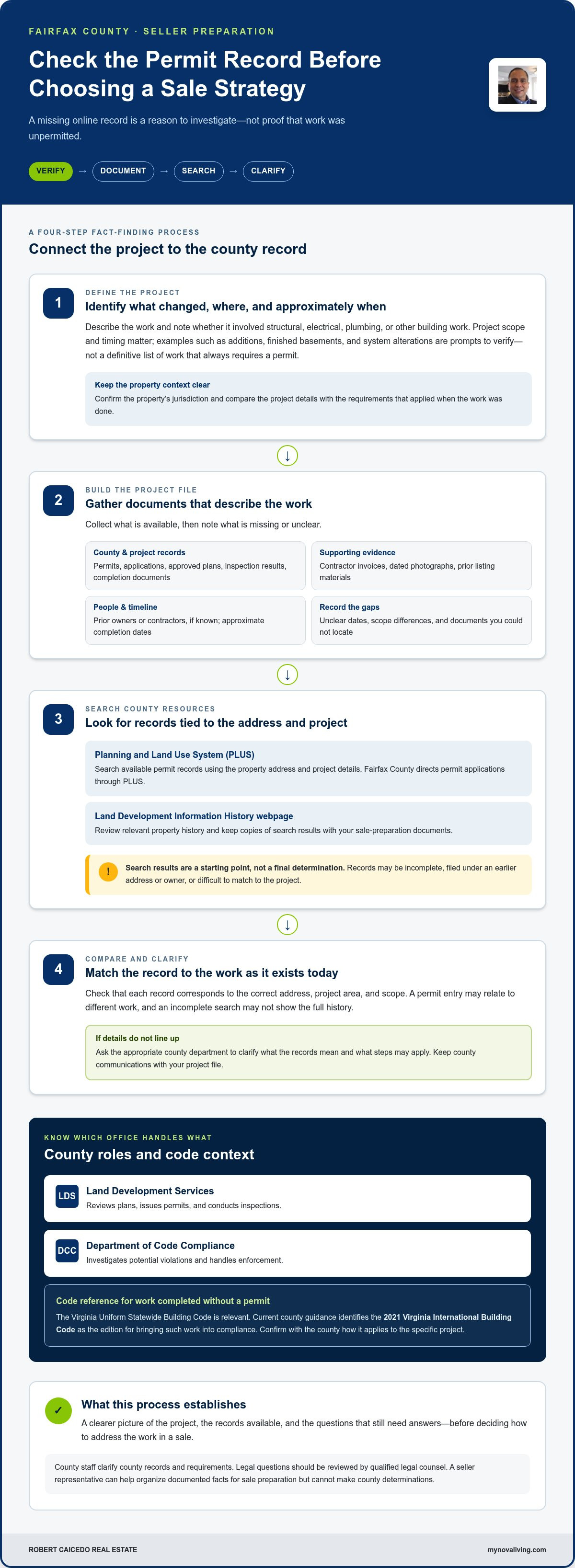
How to Check Fairfax County Permits and Understand the Approval Process
Once you’ve identified a project that needs investigation, follow a consistent record-checking process. A permit search can point you toward answers, but it isn’t a final determination that the work was approved or complies with applicable codes. Before choosing a sale strategy, connect the project’s actual scope with reliable county records.
- 1. Identify the work. Write down what changed, where it is in the home, and approximately when it was completed. Note whether the project involved structural, electrical, plumbing, or other building work.
- 2. Gather what you have. Collect permits, applications, approved plans, inspection results, contractor invoices, completion documents, and dated photographs. Record the names of prior owners or contractors if known.
- 3. Search county resources. Fairfax County directs permit applications through its Planning and Land Use System (PLUS). Search available permit records by property address and project details, and review the Land Development Information History webpage for relevant history. Use county resources for current search tools, records access, and contact routes.
- 4. Resolve gaps. Compare the record descriptions with the work as it exists today. If the search is unclear or documents don’t match the project, ask the appropriate county department what the records mean and what steps may apply.
Which Fairfax County records and details should sellers review?
Look for permit applications, approved plans, inspection results, and documentation showing completion or final approval. Check that records correspond to the correct address, project area, and scope. A permit entry may relate to different work, and an incomplete search result may not show the full history. Keep copies of search results and county communications with your sale-preparation documents.
Land Development Services (LDS) reviews plans, issues permits, and conducts inspections. The Department of Code Compliance (DCC) investigates potential violations and handles enforcement. The county’s Fairfax County Unpermitted Construction Information explains its approach to unpermitted construction. For work completed without a permit, the Virginia Uniform Statewide Building Code is relevant. The applicable code and requirements depend on the project and county review. Current guidance identifies the 2021 Virginia International Building Code as the edition for bringing such work into compliance. Confirm with the county how it applies to your project.
What can happen if the county identifies an unresolved permit issue?
The next step depends on the facts. County review may call for additional records, permits, inspections, or corrective work. If DCC issues a Notice of Violation, the county says the owner must obtain the appropriate permits and pass inspections or remove the unpermitted construction. Don’t assume a particular route, cost, or timeline before the county evaluates the situation.
Use county staff for permit and compliance determinations, and seek qualified local legal or building-code guidance for property-specific questions. When selling a home with unpermitted work in Fairfax County, seller representation can help organize preparation around verified information and buyer responses. Explore seller representation guidance as you consider your next steps.
Resolve the Work or Sell As-Is? Compare Your Fairfax County Options
An unresolved permit issue doesn’t automatically make a sale impossible. Options may include asking the county for direction, pursuing applicable approvals, correcting work, or selling as-is with clear documentation. The right path depends on the project, county guidance, contract terms, and current law. Compare the practical trade-offs before committing.
| Option | Documentation | Coordination | Potential buyer response | Timing considerations |
|---|---|---|---|---|
| Seek county guidance | Organize project records and describe the work accurately. | Clarify what county records show and what steps may apply. | Verified information can help answer questions, though it may also surface issues to address. | Allow time for responses and any follow-up the county identifies. |
| Pursue applicable approvals | Applications, plans, and related project details may be needed. | May involve county review and inspections. | Approval documentation may reduce uncertainty, but buyers may still review the work and records. | Review and inspection needs vary by project. |
| Correct the work | Keep records of changes and any resulting inspections or approvals. | May require coordination with county processes and qualified building professionals. | Addressing identified concerns may support buyer confidence, but no outcome is guaranteed. | Scope and review requirements can affect the schedule. |
| Sell as-is | Prepare accurate records and required disclosures. | Be ready to discuss the condition and known permit questions. | Buyers may ask for more information, negotiate terms, or decide the property isn’t the right fit. | Contract contingencies and negotiations can shape the timeline. |
When might resolving permits or correcting work make sense?
Consider this route when county records, inspections, or visible conditions leave important questions unanswered, especially if the work may affect safety or function. Permit concerns can also raise questions about financing, insurance, and buyer confidence. County review can clarify what documentation, approvals, inspections, or corrections may be relevant. Don’t assume the work will be approved, what changes may be required, or how long the process will take before the specifics are reviewed.
What should sellers weigh before choosing an as-is sale?
An as-is approach may suit your plans, but the wording doesn’t automatically settle disclosure or other legal obligations. Buyers can still ask about the work, request records, and negotiate. Their response may depend on the property, financing, and contract terms. Review current disclosure requirements and proposed contract language with qualified real estate and legal professionals.
When selling a home with unpermitted work in Fairfax County, compare each option against your priorities: certainty, preparation, and flexibility in negotiations. Seller representation can help you organize verified facts and assess buyer responses while county and legal professionals address compliance and legal questions.
Prepare Fairfax County Sale Documents and Buyer Conversations
A well-organized file turns scattered renovation paperwork into a clear account of what you know, what the records show, and what still needs clarification. That preparation helps keep listing details and buyer conversations consistent. It also makes it easier to respond accurately when questions arise during due diligence.
Organized permit records help buyers assess a home’s documented history without confusing confirmed facts with unanswered questions.
What records should you have ready before listing?
Create a folder for each project, then sort documents by date, contractor, permit status, and inspection outcome. Include the materials you have, even if the file is incomplete, and label uncertain items rather than treating them as proof of approval.
- Permits, applications, approved plans, and completion documents
- Contractor invoices, agreements, and available project descriptions
- Inspection records, photographs, and relevant prior listing documents
- Written county communications and notes about unresolved questions
A simple timeline can make the file easier to understand: when the work occurred, what changed, which documents are available, and what remains unclear. Keep county correspondence with the related project records so a buyer can distinguish an official response from your own interpretation.
How should sellers handle buyer questions about unpermitted work?
Answer from verified records. If you can’t confirm whether a project received approval, say that the available documentation doesn’t establish its status rather than describing it as approved. Coordinate listing language, disclosures, and responses with your seller representative so the same facts are presented consistently.
Virginia is generally described as a buyer-beware state, but sellers have disclosure duties concerning known material defects, including unpermitted work. The forms and obligations that apply can depend on current law and the transaction’s facts. Before listing, review required disclosures and questions about what must be stated with qualified legal counsel. Have counsel interpret contract language specific to your sale as well.
When selling a home with unpermitted work in Fairfax County, avoid guessing during a showing, in an email, or on a disclosure form. If a buyer asks about a document you haven’t reviewed, locate it before responding. A seller representative can help organize preparation and present verified facts, while county staff address permit determinations and legal counsel advises on disclosure obligations.
Explore seller representation for your home sale as you prepare your records and buyer conversations.
Plan Your Fairfax County Sale with Clear Options and Seller Representation
A thoughtful sale plan brings property records, listing details, and buyer conversations together. Seller representation can help you organize what’s known, present verified facts consistently, and assess offers in light of the questions a permit issue may raise. It doesn’t replace county guidance or legal advice, but it can help keep those decisions connected to your sale priorities.
How can seller representation support a more informed sale?
Robert Caicedo Real Estate provides seller representation for Northern Virginia clients. Whether you’re preparing to sell in Aldie, Leesburg, Middleburg, Ashburn, Sterling, Reston, or Washington, D.C., a seller representative can help coordinate property information and listing preparation, keep marketing language aligned with documented facts, and support communication as buyers ask questions. Unresolved concerns shouldn’t be minimized or described as settled. Clear, consistent answers give buyers a more accurate basis for evaluating the property.
Review offers as a whole. Alongside price, consider contingencies, buyer questions, requested credits or repairs, and any permit-related terms. A higher offer may come with conditions that affect your plans; another offer may better fit your preferred timing or level of certainty. Discuss the terms with your representative, and bring legal or compliance questions to the appropriate professionals. No approach can promise a particular buyer response, sale price, or timeline.
What should you do first if your home may have unpermitted work?
Start with a measured review, not assumptions. Use this checklist to set your next steps:
- List potential projects. Note the area, approximate timing, and type of work for each item you’re unsure about.
- Gather available records. Collect plans, permits, invoices, inspection documents, photographs, and written county communications.
- Review county resources. Compare records with the work, and write down questions that remain for Fairfax County staff.
- Clarify professional questions. Use qualified building-code guidance for technical issues and legal counsel for disclosure or contract interpretations.
- Choose a sale path. Weigh county guidance, professional advice, your sale priorities, and how you’ll present verified information to buyers.
When selling a home with unpermitted work in Fairfax County, progress starts with knowing what you can document and what still needs an answer. You don’t have to make every decision at once. If you’re preparing to sell, discuss seller representation with Robert Caicedo Real Estate to bring your records, priorities, and transaction plan into focus.
Move Forward with a Clearer Sale Plan
Selling a home with unpermitted work in Fairfax County starts with verified facts, not assumptions. Gather the records you have, clarify what county records can and can’t confirm, then weigh applicable approvals or corrections against an informed as-is sale. Clear, consistent documentation can help you prepare for buyer questions, while disclosure and contract questions deserve careful review with qualified legal professionals.
Seller representation can bring your property information, listing preparation, and offer review into one thoughtful plan. Robert Caicedo Real Estate focuses on seller representation for Northern Virginia real estate clients. Plan your home sale with Robert Caicedo Real Estate.
You can take the next step with care, one verified detail at a time.
Frequently Asked Questions
Can you sell a house with unpermitted work in Fairfax County?
Yes, a home with unpermitted work may still be sold, but the issue can affect preparation, buyer questions, and negotiations. First, determine whether approval was required and whether county records confirm the work’s status. You may consider seeking county guidance, pursuing applicable approvals or corrections, or selling as-is with accurate disclosures. Selling a home with unpermitted work in Fairfax County isn’t automatically impossible, but each property and project is different.
How do I check whether work on my Fairfax County home had a permit?
Search Fairfax County’s Planning and Land Use System (PLUS) and Land Development Information History webpage using the property address and project details. Look for permit applications, approved plans, inspection results, and completion records. Compare those documents with the project’s actual scope, and gather invoices, photographs, and prior records. A missing search result isn’t definitive proof that no permit was issued. Ask Fairfax County Land Development Services to clarify records or project-specific requirements.
What happens if Fairfax County finds unpermitted work?
The next steps depend on the work and the county’s review. Land Development Services handles permits, plans, and inspections; the Department of Code Compliance investigates potential violations. If DCC issues a Notice of Violation, the owner is directed to obtain the appropriate permits and pass inspections or remove the unpermitted construction. Failure to comply may lead to legal action. Seek county guidance and qualified local legal or building-code advice for your situation.
Do I have to disclose unpermitted work when selling a home in Virginia?
Virginia disclosure requirements depend on current law, the transaction, and the forms that apply. Known material defects, including unpermitted work, are relevant to seller disclosures. Don’t rely on assumptions or a general description of Virginia law to decide what applies to your sale. Review the current required forms and ask qualified legal counsel about your specific obligations and how to respond accurately to buyer questions.
Can unpermitted work affect a buyer's inspection, financing, or insurance?
It can. Buyers may ask for records or raise concerns during inspections and negotiations. An appraiser may not include an unpermitted area in the home’s valuation, and a lender may require an issue to be addressed before closing or decline financing for significant unpermitted structures. Insurance coverage can also be affected, particularly if damage results from unpermitted work. The impact depends on the project, buyer, lender, insurer, and transaction details.
Should I get a retroactive permit or sell the house as-is?
Compare both options after reviewing the work and getting project-specific county guidance. A retroactive permit may involve an application, inspections, and, in some cases, opening finished surfaces so underlying work can be examined. Corrective work may also be needed. An as-is sale may avoid completing that process before listing, but can bring buyer questions or negotiation over terms. Consider your priorities, records, and timing, and discuss the sale strategy with your representative.
Does selling a home as-is remove the need to disclose permit issues?
No. As-is wording doesn’t automatically eliminate disclosure duties or settle other legal obligations. Requirements depend on current law, transaction facts, and applicable forms. Be accurate about what you know, and don’t present uncertain work as approved. Have qualified legal counsel review disclosure questions and contract terms. Seller representation can help keep listing information and buyer conversations consistent while legal professionals address questions about your specific obligations.


