

A leased solar system doesn’t automatically make an Ashburn home harder to sell. Selling a home with leased solar panels in Ashburn, VA can move forward by transferring the lease to the buyer or using a buyout option allowed by the contract. The lease terms determine which options are available, and a transfer may require buyer approval and paperwork.
It’s understandable to wonder whether a buyer will welcome a long-term solar agreement or see it as an added complication. Clear information about the contract, system warranties, energy-bill savings, and net metering credits can help buyers understand what comes with the home.
This guide explains how lease transfers and buyouts work, what buyers may want to know, and why notifying the installer matters before closing. You’ll also learn how to present the system’s costs and potential benefits clearly, so the solar agreement is part of the sale discussion from the start, not a last-minute surprise.
Key Takeaways
- Review the lease terms to understand whether the buyer can assume the agreement or whether a buyout option may apply.
- Organize the lease, warranty, and system details so buyers can understand their responsibilities and the protections that may transfer.
- Use electricity bills and solar production records to show how the system has affected household costs and net metering credits.
- Notify the solar installer when a sale is planned so transfer steps and timing can be coordinated with the transaction.
Do solar warranties transfer when you sell your home?
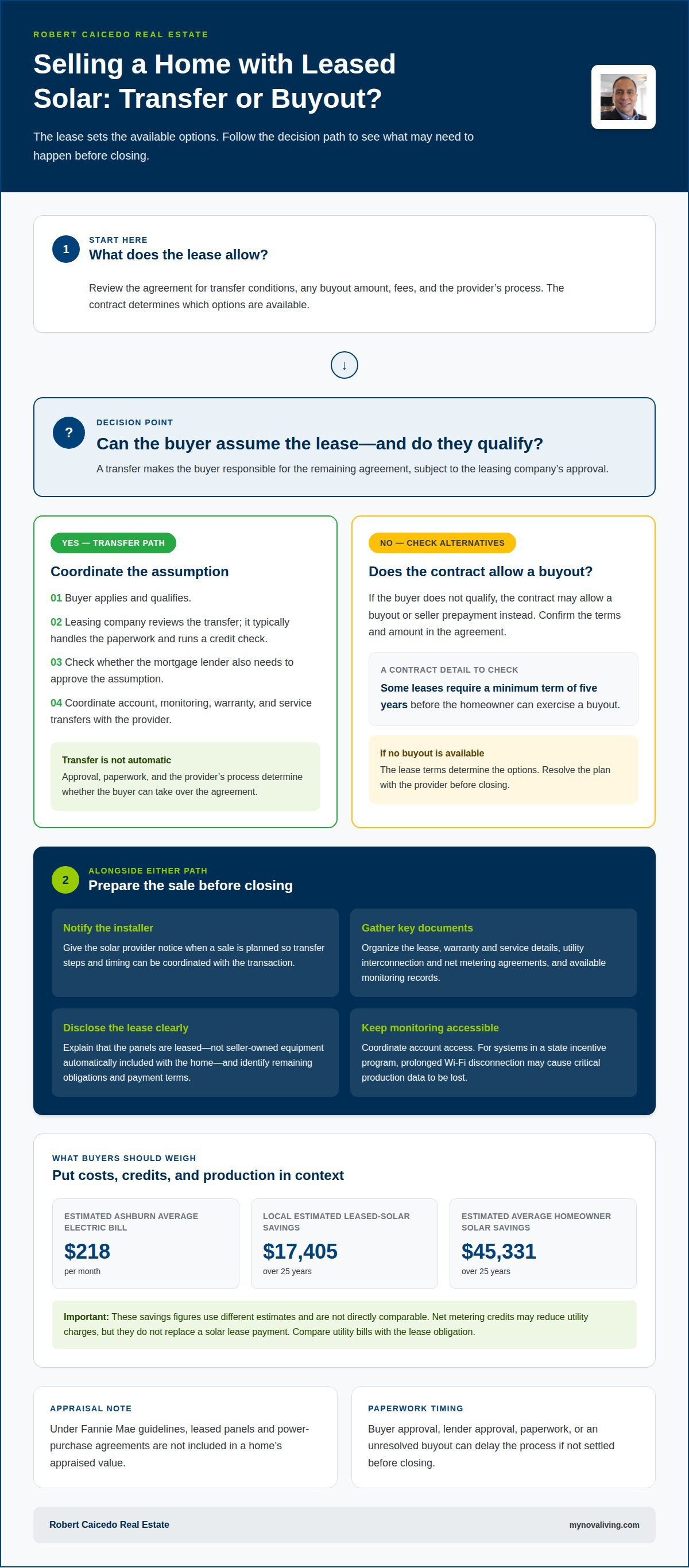
With a leased solar system, the buyer generally assumes the lease or the seller uses an available buyout option. Warranty, service, and monitoring transfers depend on the agreement and the provider’s process.
Warranty and Service Agreement Transfers
A warranty or service agreement transfer carries eligible system protections or support to the next owner. Before listing, review the warranty’s transfer conditions and process, then gather the documents for the buyer. Coverage can matter when a system needs repair, while clear terms help the buyer understand what support continues after closing. A U.S. Department of Energy study found that buyers were willing to pay $15,000 or more for solar-powered homes.
Lease Transfers and Buyer Credit
A lease transfer makes the buyer responsible for the remaining agreement, subject to the leasing company’s approval. The company typically handles transfer paperwork and runs a credit check; the buyer must apply and qualify. A mortgage lender may also need to approve the assumption. If the buyer doesn’t qualify, the contract may allow a buyout or seller prepayment instead. Some solar leases require a minimum term of five years before the homeowner can exercise a buyout.
Monitoring and Support Transfers
Monitoring access lets the new owner view system performance, while support arrangements explain how service is handled. Include account-transfer details in closing coordination so the buyer can receive access and know whom to contact about the system. For systems in a state incentive program, monitoring communications shouldn’t be disconnected from Wi-Fi for too long, because critical production data may be lost. A gap in account access can also make production history harder to follow.
Transfer Requirements and Fees
Transfer requirements and fees are set by the lease agreement and the provider’s process; the buyer generally applies and passes a credit check. The contract also states any buyout amount, which may decrease over time. Virginia General Assembly describes § 56-594.02 as a pilot-program provision for third-party power purchase agreements, rather than a general lease-transfer procedure. Leased panels and power-purchase agreements aren’t included in a home’s appraised value under Fannie Mae guidelines. Delays can arise if buyer approval, lender approval, paperwork, or a buyout isn’t settled before closing.
Buyer understanding and contract concerns
A solar lease affects more than the equipment on the roof. Clear disclosure and organized records help buyers assess the agreement alongside the home’s other costs.
Solar Lease Disclosure
Disclose that the solar system is leased, not seller-owned equipment automatically included with the home. This distinction matters because the buyer may inherit payment obligations and contract terms. The agreement may include an escalation clause that changes payments each year. Buyers should understand the remaining commitment and available options before deciding whether the home suits their plans.
In July 2023, Northern Virginia Association of Realtors standard-form changes included a solar panel addendum to the listing agreement and a solar panel contingency addendum to the sales contract. These forms help document the system’s status and address solar-related terms in the transaction. Listing details should not imply that leased panels are owned by the seller or included without an obligation.
Buyer Questions and Documentation
Buyer documentation brings the system’s costs, operation, and obligations into view. Assemble the solar contract, utility interconnection and net metering agreements, lease or financing documents, warranty information, and available monitoring records. Buyers can then review payment terms, transfer conditions, and service details together, rather than piecing them together during closing.
A buyer may ask how long payments continue, whether the agreement’s escalator changes future costs, and how much electricity the system produces. A solar lease can leave the buyer with a 20-year contract, so the remaining term and obligations deserve clear attention. Sharing monitoring records, including actual production and monthly bill savings, gives buyers concrete information to weigh against the contract.
Buyer-agent guidance can help keep these details visible during review. The agent can explain where the solar agreement fits in the transaction, identify documents that describe buyer obligations, and track solar-related terms in the sales contract. If the paperwork leaves the buyer unsure about payments or ownership, address those questions before closing.
Energy-bill savings and net metering credits
Selling a home with leased solar panels in Ashburn, VA means explaining both solar savings and ongoing lease costs. Buyers get a clearer picture by comparing household utility bills with the lease obligation, rather than looking at panel production alone.
For anyone selling a home with leased solar panels in Ashburn, VA, incentives, net metering, and utility accounts are distinct considerations. The buyer should review the utility interconnection and net metering agreements alongside the lease, since policies and rates vary by location. The IRS says the federal solar tax credit for solar buyers expired at the end of 2025.
Net metering credits generally reflect electricity sent to the grid under the utility’s applicable terms. The credit value and how it appears on bills depend on the utility arrangement. Credits may reduce utility charges, but they don’t replace a solar lease payment. Buyers evaluating the purchase should account for both expenses.
Ashburn’s estimated average electric bill is $218 per month. Local estimates put leased-solar savings at $17,405 over 25 years, while the average homeowner’s estimated solar savings are $45,331 over 25 years. These figures use different estimates, so they aren’t a prediction for an individual property.
Present a full year of electricity bills to help buyers understand the home’s energy use. A buyer can review 12 months to account for seasonal changes, then compare utility charges with lease payments and recorded credits. One low-bill month may not reflect the system’s contribution across the year.
Ashburn residents are estimated to spend about $103,300 on electricity over 25 years when inflation is factored in. This broad estimate provides context, not a substitute for the property’s own bills. Pairing actual costs with the credit arrangement helps buyers see how solar fits their energy budget.
Notifying the solar installer about a home sale
Notify the solar installer as soon as you know a sale is coming. Early notice gives you time to coordinate the system agreement, account access, and closing schedule instead of leaving transfer details until the final days. For an Ashburn home, discuss the sale timeline and solar arrangement together.
Start with the address and expected sale timing, then identify whether the system is leased or under a lease-to-own agreement. State whether the buyer is expected to assume the agreement or whether you’re considering a buyout. These details help the installer direct the transfer process and clarify which paperwork applies. Keep the installer’s response with the sale documents.
Ask for the transfer steps and required documents early enough to coordinate them with the buyer’s application and closing paperwork. The leasing company typically handles lease-transfer paperwork and a credit check. If the buyer must qualify, the process can affect the transaction timeline. If you plan a buyout or prepayment, have written payoff information available before closing.
Also coordinate the handoff of system monitoring and support. Confirm how the buyer will receive monitoring access, what information is needed to move the account, and how service questions will be handled after the ownership change. Preserve available production records through the handoff. For systems participating in a state incentive program, don’t disconnect monitoring communications from Wi-Fi for too long, since critical production data may be lost.
Keep a simple record of each milestone: installer notification, transfer paperwork, buyer approval, account handoff, and closing. For example, if the buyer assumes the lease, the file should show the transfer status and who will manage the monitoring account. If the seller buys out the system, retain the payoff documentation and note the ownership change. Clear records help align the solar handoff with the home sale. Plan your home sale timeline with the solar transfer in view.
Robert Caicedo Real Estate: New Construction Homes
Robert Caicedo Real Estate can guide you through the sale when a leased solar agreement becomes part of your home’s story. With seller representation, you can bring lease terms, buyer questions, and the solar handoff into the wider transaction conversation. This helps keep the home’s features and obligations clear as you prepare to move.
If your next step is a newly built home, Robert Caicedo Real Estate also offers new construction home representation. Buyer representation can support your search, while investment property consulting can help you consider a property as part of a broader portfolio. The right direction depends on what you’re planning after the sale.
For guidance on your home sale or your next move, contact Robert Caicedo Real Estate.
Shape your next move with confidence
Selling a home with leased solar panels in Ashburn, VA can be one part of a larger transition. As you plan your move, consider how your sale timing connects with the kind of home or investment you want next. A clear real estate plan can help you make decisions with your priorities in view, rather than treating the solar agreement as the whole story.
Robert Caicedo Real Estate represents sellers and buyers and supports clients exploring new construction homes. Whether you’re preparing to list or beginning to consider what comes next, thoughtful guidance can help you move forward with intention. Your next chapter deserves the same care you bring to this sale.
Contact Robert Caicedo Real Estate to discuss your next real estate move and take the first step with confidence.
Frequently Asked Questions
Are houses with solar panels easier or harder to sell?
Neither outcome is automatic; buyer response often depends on ownership, contract obligations, and clear system records. A buyer may view an owned array differently from leased equipment because a cash-purchased system transfers with the property as a fixture. For leased panels, clear information about payments and transfer options can help buyers assess the home without confusing equipment ownership with the property sale.
Can I Take the Panels With Me?
Usually, moving leased panels to your next home isn’t practical. Solar systems are designed for a specific roof, location, and electricity rates, and removal can damage both equipment and roofing. The lease terms shape your options: a buyer may assume the agreement, or an applicable buyout or payoff may resolve it. Treat panel removal as a contract and system issue, not a routine moving task.
How does a leased solar panel agreement affect selling a home in Ashburn, Virginia?
The agreement adds a separate obligation for the buyer to understand alongside the home purchase. It can affect who pays for the system, how payments may change under an escalation clause, and what must happen before closing. For example, a buyer planning to assume the lease may need approval, while a seller pursuing a buyout needs to coordinate that option with the sale timeline.
Can a buyer assume a solar lease when purchasing a home in Loudoun County, VA?
Yes, a buyer may assume a lease if its terms allow transfer and the buyer qualifies. The leasing company typically processes the application and credit check; a mortgage lender may also need to approve the assumption. For a Loudoun County purchase, the buyer should account for both home financing and the separate solar agreement, so the transfer is addressed within the transaction timeline.
Can a seller buy out or pay off a leased solar panel contract before closing?
Often, a seller can use a buyout or prepayment option if the lease contract provides one. The contract sets the buyout amount, which may decrease over time, and some leases restrict when a buyout can occur. Obtain a written payoff quote well before closing, then coordinate the selected option with the sale documents. Paying ahead can remove the buyer’s need to qualify for the lease.
What documents about a solar lease should a seller provide to buyers and the title company?
Prepare the solar contract, lease or financing records, utility interconnection and net metering agreements, and warranty information. Add transfer or payoff paperwork as it becomes available, along with installer or monitoring details relevant to the handoff. Sharing an organized document set with buyers and the title company helps distinguish the solar obligation from the home’s other transaction records and clarifies what remains before closing.


