

The buyer’s agent’s compensation is negotiable, but FSBO sellers often agree to pay it. When negotiating with a buyer's agent as a FSBO seller in Sterling, settle who pays and how much before accepting an offer. You can negotiate directly with the buyer while the agent handles communication, or work through the agent on the purchase contract.
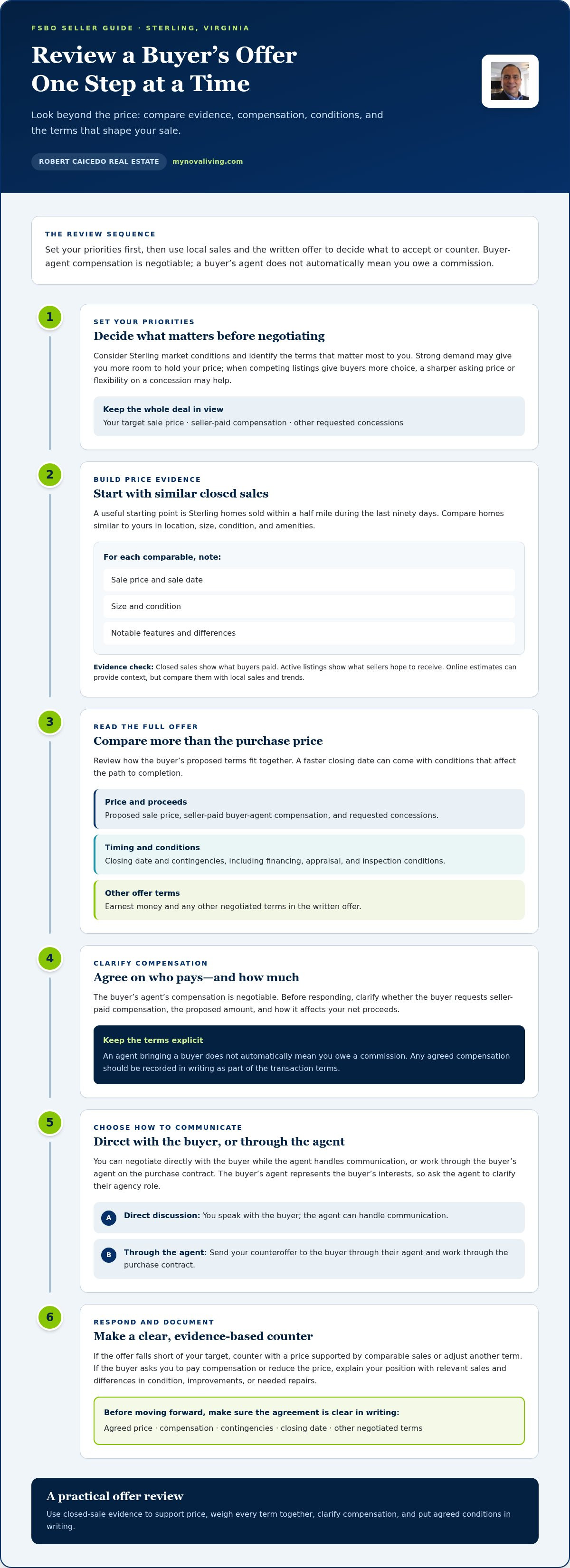
It’s natural to focus on compensation when you’re selling without your own agent. But a strong deal weighs the whole picture: a price supported by comparable sales, the buyer’s financing and contingencies, the closing date, and any requested concessions. This guide explains how to assess those terms and respond confidently. You’ll learn how to support your asking price, negotiate compensation, and choose whether to speak directly with the buyer or through their agent, so the agreement is clear before you move forward.
Key Takeaways
- Clarify who pays the buyer’s agent and agree on any compensation as part of the offer terms.
- Use similar closed sales, property condition, and improvements to explain your asking price and support a counteroffer.
- Compare closing dates, contingencies, and earnest money alongside the purchase price when assessing an offer.
- Set your priorities before negotiating, then stay firm on essential terms while considering flexibility on smaller details.
- Choose whether to negotiate directly with the buyer or communicate through their agent, and put agreed terms in writing.
1. Who Pays The Buyer’s Agent In FSBO Transactions?
In a for-sale-by-owner transaction, the seller often pays the buyer’s agent, but payment is negotiable. An agent bringing a buyer does not automatically mean you owe a commission. Before responding to an offer, clarify whether the buyer requests seller-paid compensation, the proposed amount, and how it affects your net proceeds. Put any agreement in writing as part of the transaction terms.
Shape your approach around Sterling’s market conditions rather than assuming every buyer has equal negotiating power. Strong demand may give you more room to hold your price, though buyers can still negotiate. When competing listings give buyers more choice, you may need a sharper asking price or flexibility on a concession. Compare local listings and recent closed sales, then decide which terms matter most before discussing compensation.
Compare homes similar to yours in location, size, condition, and amenities. A useful starting point is closed comparable sales within a half mile from the last ninety days. Note meaningful differences, such as a renovated kitchen, unfinished basement, or additional parking, and consider how each affects your price. Online home-value estimates can provide context, but compare them with local real estate trends before relying on them.
Use the same evidence when countering an offer. If a buyer asks you to pay the agent’s compensation or reduce the price, respond with a clear calculation supported by sales. For example, cite a nearby closed sale with a similar layout and condition, then explain how your home’s improvements or needed repairs compare. A fact-based counteroffer keeps the discussion practical instead of turning it into a disagreement about what feels fair.
Marketing also shapes the conversation. While real estate agents typically manage access to a multiple listing service (MLS), FSBO sellers in many markets use flat-fee listing options—such as Pay It Forward Realty in Utah—to get on the MLS while keeping commission costs low. An agent’s pricing and marketing experience can help position a property, present its features, and manage buyer inquiries. If you’re handling these steps yourself, prepare accurate property details, strong photographs, and a clear plan for responding to offers.
Calculate your bottom line before negotiating with a buyer’s agent as a FSBO seller in Sterling. Compare the proposed sale price, seller-paid compensation, and other requested concessions together. If the offer falls short of your target, counter with a price supported by comparable sales or adjust another term. Keep your response prompt, specific, and professional, and record the agreed compensation and conditions in the contract.
2. Justifying the asking price with comparable sales
Start with closed sales, not a buyer’s agent’s opinion or an online estimate. Select similar Sterling homes sold within a half mile during the last ninety days. Compare location, size, condition, and amenities, then account for meaningful differences. A renovated kitchen may support a higher asking price than an outdated one. A home needing repairs may justify less.
Build a simple comparison sheet with each property’s sale price, sale date, size, condition, and notable features. Add your home’s corresponding details beside each sale. If a comparable has a finished basement and yours does not, explain the difference when discussing price. Recent closed sales offer stronger evidence than active listings, which show what sellers hope to receive, not what buyers paid.
Use online home-value estimates as a starting point, then compare them with local sales and market trends. If Sterling homes similar to yours are taking longer to sell, an ambitious asking price may reduce buyer interest. In a buyer’s market, support your position with evidence and consider a modest concession. In a seller’s market, demand may strengthen your position, but buyers can still negotiate.
A buyer’s agent represents the buyer’s interests, even when you’re selling FSBO. Ask the agent to clarify whom they represent and send your counteroffer to the buyer through that agent. For a price-adjustment request, provide comparable sales within a half mile from the last ninety days, plus a concise explanation of your property’s condition and improvements. Specific evidence keeps the exchange focused.
An appraisal offers another perspective on value, but serves a different purpose from your comparison sheet. If an appraisal or buyer’s offer differs from your asking price, review the properties and features used to support that figure. Explain how your home differs, using documented improvements and comparable sales rather than relying on an online estimate alone.
Virginia sellers must provide buyers with required disclosures and material facts. Ask the buyer’s agent to clarify their agency role, and put any agreed compensation and sale terms in writing. The purchase contract should capture the agreed price, contingencies, closing date, and other negotiated terms. Have a Virginia real estate attorney review the contract and disclosures before signing.
Sterling FSBO sellers can find local real estate attorneys through the Virginia State Bar’s lawyer-referral resources. For closing support, look for Sterling-area settlement or title professionals handling residential transactions. Compare the services each provides, then identify who will prepare, review, and coordinate the closing documents. Clear responsibilities connect your price agreement to the paperwork that completes the sale.
3. Negotiating closing dates, contingencies, and earnest money
Compare the full offer, not just its price. A buyer may propose a faster closing while including financing, appraisal, and inspection contingencies. Those conditions affect the path to completion and your options if a problem arises. In a sale by owner, review each condition with the buyer’s agent and ensure the written offer explains what must happen before the sale proceeds.
Review the buyer’s financing evidence before weighing the proposed timeline. Prequalification estimates a buyer’s financial strength, while preapproval verifies it. Ask the buyer’s agent to explain the financing status and how it fits the requested closing date. Preapproval does not remove the financing contingency, so assess that protection separately when comparing offers.
Inspection and appraisal contingencies can protect the buyer if the home’s condition or appraised value affects the purchase. Keep the terms clear: identify which contingencies apply and what the buyer may do if an inspection or appraisal raises concerns. If the buyer requests repairs or a credit after an inspection, consider the report’s findings and supporting contractor estimates. Distinguish significant defects from cosmetic preferences before responding.
Earnest money shows the buyer’s commitment, but the contract should spell out the deposit amount, timing, and conditions for its return or release. Consider the deposit alongside the buyer’s financing, contingencies, and proposed closing date. A substantial deposit alone doesn’t resolve financing or inspection risks. Make sure the signed agreement says how the deposit will be handled if a contingency is invoked or the parties don’t close.
Choose a closing date around practical obligations, such as your next home’s availability, moving plans, and the buyer’s financing schedule. If the buyer needs time to sell another property, decide whether that condition fits your timeline. A FSBO seller may also make the sale contingent on finding a replacement home, reducing the risk of selling before securing the next residence. For homeowners downsizing who still need dedicated space for vehicles or gear, niche specialists like The Garage Condo Guy offer guidance on acquiring specialized garage properties. Put any such condition and its terms in the contract.
When a counteroffer arrives, compare the closing date, contingencies, and earnest money with your priorities. You might accept a flexible closing date in exchange for a cleaner offer, or request a stronger deposit while keeping buyer protections in place. Treat each change as part of the overall deal. Don’t rely on a final walk-through to reopen negotiations; address repair concerns and credits before signing the agreed terms.
Once both parties agree, make sure the purchase contract captures every negotiated detail, including deadlines and contingency conditions. Review the final version for consistency with the offer and counteroffer. Keep communication open with the buyer’s representative and respond promptly to document requests during closing. Clear records help both sides follow the same timeline from acceptance through the completed transaction.
4. Setting a buyer’s agent commission as an FSBO seller
Buyer-agent compensation is negotiable, not an automatic charge on every FSBO sale. In FSBO transactions, buyer’s agents typically receive 2-3% of the purchase price, but the parties can negotiate another arrangement. Decide whether you’re willing to offer compensation before reviewing offers. Then assess the proposed amount alongside price, contingencies, closing costs, and your expected proceeds.
To compare a compensation request with likely sale proceeds, calculate the estimated net for each offer. Start with the offer price, then subtract the proposed agent compensation and other seller-paid costs or concessions. Compare the result with your minimum acceptable net, not just your asking price. This helps you assess a higher offer with compensation against a lower offer without it.
For example, a buyer may offer close to your asking price while requesting seller-paid compensation. Another buyer may offer less without that request. Compare both offers using the same cost categories, including repairs or closing-cost contributions. Keep the calculation in writing so your counteroffer reflects the whole transaction, not just one headline figure.
Yes, a Virginia FSBO seller can offer buyer-agent compensation as a negotiated sale term. State the agreed amount or calculation method, who pays, and when it is due in the written offer, counteroffer, or purchase contract. Don’t rely on a verbal understanding; have a Virginia real estate attorney review the language before signing.
Set your initial asking price with room for discussion, anchored in comparable sales and current Sterling market conditions. FSBO sellers can start slightly above the minimum they’re willing to accept, leaving room to negotiate. Don’t inflate the price to offset a compensation request. Buyers and their agents can compare similar homes, so an unsupported figure may weaken interest.
A real estate agent’s compensation request should be considered in relation to the service and transaction terms involved, not treated as a fixed percentage. If an agent proposes 2-3%, calculate the effect on your net and decide whether the offer’s price and terms justify it. You can counter with a different amount, ask the buyer to pay, or negotiate another term instead.
Use the signed purchase contract and any written counteroffer or addendum to record the final agreement. Clearly identify the payer, compensation amount or formula, and payment timing. Include any conditions that affect payment, and make sure the wording matches the sale terms. A written record helps prevent disagreement at closing and gives each party a clear reference throughout the transaction.
5. Negotiating directly with a buyer or through the buyer's agent
Choose a clear communication route before responding to an offer. When the buyer has an agent, send proposals through that agent and copy the buyer when appropriate. This creates a shared record and reduces the risk of different versions circulating. If the buyer contacts you directly, acknowledge the message, then agree how future offers and counteroffers will be delivered and documented.
A represented buyer’s agent can relay questions, explain the buyer’s requested terms, and deliver your response. You can negotiate directly with the buyer, but don’t ask the agent to advocate for your interests. Keep your role clear: you’re the seller, and the agent represents the buyer. If you’re unsure how to handle an exchange, pause and get professional guidance before agreeing to terms.
Use a consistent process for each offer. Read the full proposal, identify the buyer’s priorities, and distinguish essential terms from preferences. Then respond with a counteroffer, a concise explanation, and a response deadline. For example, if the buyer requests a price reduction, you could counter closer to your asking price and explain which property features or recent improvements support it.
Keep the buyer’s maximum budget and personal deadlines private. Instead, ask which terms matter to them, such as the closing date or repair requests. Listen carefully, then decide whether a change improves the overall agreement. You might accept a more flexible closing date while holding firm on price, or offer a small repair instead of a larger credit. Make each trade-off deliberate.
Don’t let assumptions about a FSBO sale set the tone. Some buyers may expect a seller without an agent to accept less or negotiate less effectively. Respond calmly with comparable sales, inspection findings, or written contractor estimates when relevant. If a request seems unsupported, ask for details and keep your reply professional. You can set a firm boundary without becoming combative.
If buyer-agent compensation is part of the proposed terms, keep the discussion in the written offer and assess it alongside the full deal. One possible negotiated term is that the buyer pays the agent’s compensation instead of the seller. Don’t treat this as automatic. State who pays and how the arrangement works in the written contract.
Document every accepted change in the purchase contract or written counteroffer, and include a response deadline. Don’t rely on calls or informal messages to establish final terms. If the buyer has no agent, they may need a purchase contract to make an offer. Keep discussions respectful, respond promptly, and focus on terms both sides can accept.
Robert Caicedo Real Estate: Seller Representation
Robert Caicedo Real Estate provides seller representation for owners seeking guidance with pricing, buyer-agent discussions, offers, and sale terms. Turn to a seller’s representative when comparing offers feels complex, you need support responding to a buyer’s agent, or you want a clearer plan from negotiation through closing.
Whether you’re preparing to sell or already reviewing an offer, focused representation can help you assess the terms together and keep your priorities in view. It’s a practical next step when you want professional support for your sale.
Visit mynovaliving.com to connect with Robert Caicedo Real Estate.
Move Forward With a Clear Plan
Your next step is to decide how much guidance you want at each stage of your real estate plans. If you’re preparing to sell, seller representation can support decisions from setting priorities to evaluating offers. If a purchase follows the sale, buyer representation can help you approach that move with the same care. Exploring new construction homes may also suit your plans for a different kind of home.
A thoughtful approach to negotiating with a buyer's agent as a FSBO seller in Sterling starts with knowing when you’re ready to manage each decision yourself and when representation would help. Robert Caicedo Real Estate supports buyers and sellers with services tailored to their distinct real estate goals.
Take the next step at your own pace. Contact Robert Caicedo Real Estate to discuss your real estate plans and the support that fits them. You can move forward with clarity and a plan shaped around what matters to you.
Frequently Asked Questions
Who Pays The Buyer’s Agent In FSBO Transactions?
There’s no automatic commission for the seller simply because a buyer has an agent. In FSBO transactions, sellers often pay the buyer’s agent, but the parties can negotiate who pays and how compensation is handled. For a Sterling sale, review the offer’s payment terms before accepting. The buyer and agent may also need to address compensation under their own arrangement.
What is the typical buyer's agent commission in Sterling, Virginia, and is it negotiable?
Buyer’s agents typically receive 2-3% of the purchase price in FSBO transactions, and compensation is negotiable. Treat that range as context, not a fixed Sterling rate or an automatic seller expense. Compare the proposed amount with the offer price and other terms. For instance, a higher offer with a compensation request may leave a different net than a lower offer without one.
How do buyer-agent compensation rules work after the 2024 NAR settlement?
The practical point for a Sterling FSBO seller is to negotiate compensation explicitly rather than assume a standard amount or payer. Clarify whether the buyer or seller is responsible under the proposed transaction terms. Record any seller contribution and its conditions in writing, and have the agreement reviewed before signing so the payment terms match the deal.
Can a buyer's agent require compensation from the buyer if the seller declines to pay?
A seller can decline a request to pay, and the buyer may be responsible for compensation under their agreement with the agent. The buyer and seller can also negotiate who pays as part of the sale terms. If the buyer cannot or will not cover the amount, the parties may need to revisit the offer or compensation arrangement before proceeding. Put any revised agreement in writing.
What are the risks of negotiating directly with a buyer's agent without a listing agent?
The buyer’s agent represents the buyer, so don’t assume they’re advising you or protecting your interests. Direct discussions can also cause confusion if verbal promises, repair requests, or deadlines aren’t reflected in the written offer. For example, confirm that a counteroffer includes every accepted change. Keep records of important communications, provide required disclosures, and arrange a contract review to help protect your position.
What disclosures and agency rules apply to buyer's agents in Virginia real estate transactions?
Virginia sellers must provide buyers with required disclosures and material facts. A buyer’s agent represents the buyer’s interests, so ask the agent to clarify their agency role and put agreed compensation and sale terms in writing.


