

What if a quieter listing isn’t a signal to cut the price immediately? Navigating a price reduction strategy in Washington DC starts with reading the response to your specific home, not reacting to market headlines alone. Limited showings, recurring buyer comments, and nearby competing listings can each point to a different next step.
It’s understandable to worry that a price adjustment could weaken your negotiating position or make buyers assume you’re under pressure. But holding firm without weighing the evidence can also affect your timing and goals. First identify what the feedback says, then decide whether a price change or another practical response makes more sense.
This guide will help you assess buyer activity alongside neighborhood-level conditions, compare your options, and plan a measured next move. With seller representation, you can weigh your property’s position against local market signals and your priorities, then make a decision with greater clarity.
Key Takeaways
- Review showings, inquiries, repeat visits, offers, and recurring feedback together before deciding what your listing’s response means.
- Compare your home with nearby active listings and recent sales that share relevant location, condition, and features.
- Weigh holding the price, refining presentation, improving access, and adjusting the asking price against the response you’re seeing.
- When navigating a price reduction strategy in Washington DC, define your timing, acceptable trade-offs, and desired next step before choosing an adjustment.
- Seller representation can help organize local market evidence and shape a measured plan around your property and priorities.
Why Washington, DC Sellers Consider a Price Reduction
A price reduction is a deliberate change to the asking price, not a verdict on the home or the life built within it. Sellers may adjust to reflect new competition, buyer response, a shift in priorities, or a clearer view of comparable sales. The decision changes the price buyers see and the context in which they assess the property.
A price reduction alone does not prove seller distress; it shows that the seller has chosen to reconsider the asking price in light of goals and market evidence. Buyers may interpret a change as an invitation to negotiate, so consider the reason for the adjustment alongside photography, condition, showing access, and feedback already received. A lower asking price cannot resolve every concern a buyer may have.
What a listing price reduction does and does not signal
The asking price is a market-facing figure, not a measure of a home’s intrinsic worth or the memories and care it holds. A revised price can make a listing more competitive within a buyer’s search, but it doesn’t guarantee an offer or establish what a buyer will pay. Sellers may adjust for many reasons, including timing or a changing competitive set. Since buyers may draw their own conclusions, support an adjustment with clear reasoning and a review of the listing’s overall presentation.
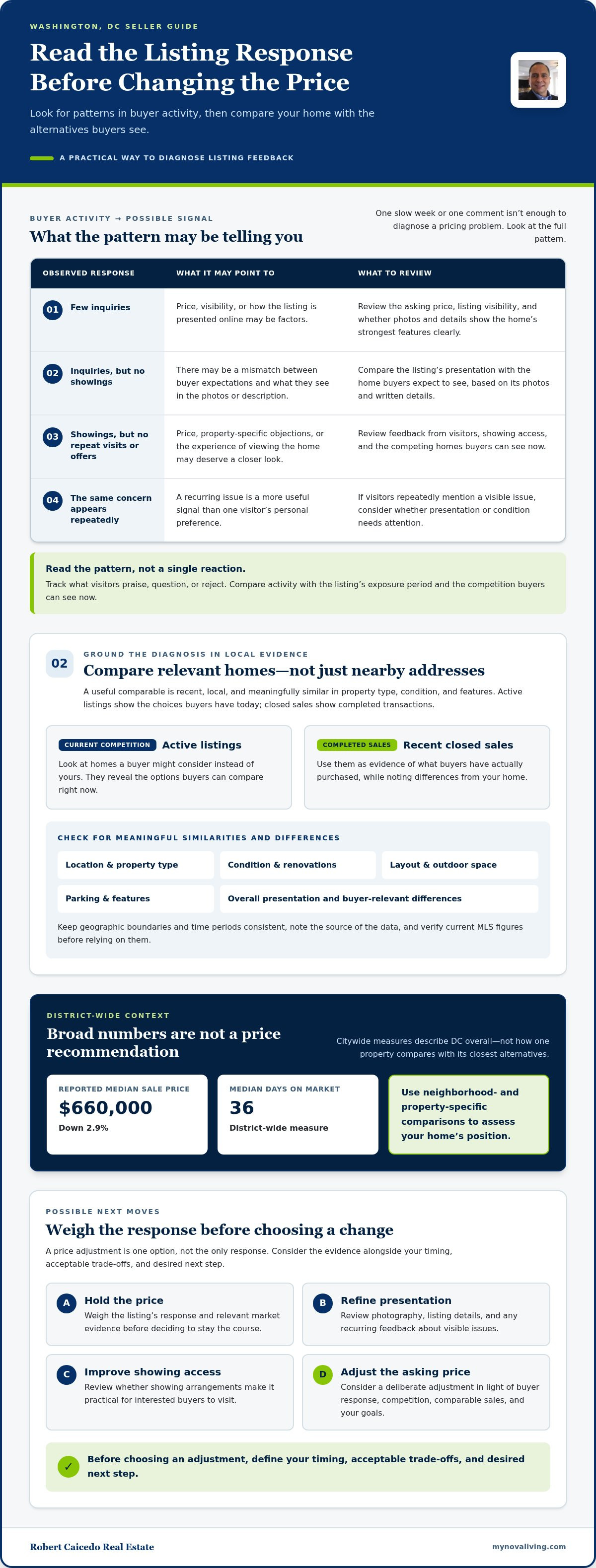
Look at the pattern, not a single reaction. If showings are happening but visitors repeatedly mention the same visible issue, presentation or condition may deserve attention. If buyers engage with the home but comparable properties draw stronger interest at different asking prices, pricing may warrant a closer look. Identify what the evidence suggests before changing course.
Why Washington, DC market conditions vary by property
Citywide numbers offer context, not a price recommendation for every address. As of October 13, 2026, the reported median sale price in DC proper was $660,000, down 2.9%, while median days on market stood at 36. Those broad measures describe the District overall. They can’t show how a particular neighborhood, property type, condition, or price segment is performing against its closest alternatives.
Compare active listings a buyer might consider instead of your home, then review recent closed sales with a similar location, property type, condition, and features. An updated row house and a condo with different amenities may attract different buyers, even if they’re nearby. The Housing in Washington, D.C. overview provides historical context on the city’s varied housing stock, but a seller’s pricing decision still needs current, property-specific comparisons.
National headlines or a trend in one luxury segment shouldn’t stand in for evidence about your home. For sellers navigating a price reduction strategy in Washington DC, the useful question is whether the property’s current position aligns with the choices buyers have in its own neighborhood and price range. The same care applies when comparing a Washington, DC home with listings in Aldie, Leesburg, Middleburg, Ashburn, Sterling, or Reston: focus on relevant local alternatives, not broad regional averages. Reviewing listing response alongside those comparisons helps clarify the decision.
How to Diagnose Whether Your Washington, DC Listing Is Mispriced
A quiet stretch can feel like a clear message, but one slow week or one buyer’s comment isn’t enough to diagnose a pricing problem. Look at the full pattern: how long the home has been on the market, whether qualified buyers are making inquiries, how showings are developing, whether anyone returns, and whether offers or recurring feedback have emerged.
A useful comparable is recent, local, and meaningfully similar in property type, condition, and features. Compare your home with active listings competing for the same buyers and recent closed sales that show what buyers have actually purchased. Keep geographic boundaries and time periods consistent, and note the source of the data. Verify current MLS figures before relying on them.
Read buyer response without overreacting to one comment
Track responses in a simple log. Record what visitors praise, question, or reject, then look for themes across multiple showings. A single remark about a room’s color may be personal taste; repeated concerns about layout or condition are more useful signals. Review activity against the listing’s exposure period and the competition buyers can see now, not an unrelated neighborhood or an earlier market moment.
Consider the whole journey. Few inquiries may point to price, visibility, or how the listing is presented online. Inquiries without showings could suggest a mismatch between expectations and what buyers see in the photos or description. Showings without repeat visits or offers may call for closer attention to price, property-specific objections, or the experience of viewing the home.
Use Washington, DC comparable listings with care
Start with nearby homes that match the property type and condition, then account for differences buyers may value: layout, outdoor space, parking, renovations, and overall presentation. Active listings reveal the choices buyers have today; closed sales provide evidence of completed transactions. Neither is a perfect stand-in, so note meaningful differences rather than treating every nearby property as interchangeable.
Separate pricing from other possible friction before deciding what the evidence means:
- Presentation: Check whether photos and listing details show the home’s strongest features clearly.
- Access: Review whether showing arrangements make it practical for interested buyers to visit.
- Marketing reach: Consider whether the listing is reaching the audience most likely to value its features.
- Buyer objections: Distinguish recurring property concerns from one-off preferences.
Then ask whether similar homes are attracting more engagement, or whether your listing has a hurdle that price alone may not solve. This evidence-based approach makes navigating a price reduction strategy in Washington DC more considered: it helps identify what to address before choosing a next step. Robert Caicedo Real Estate’s seller representation helps organize feedback and compare it with local market evidence.
Price Reduction or Another Change? Compare Your Options
A price change is one possible response, not the only one. Match your next move to the pattern you’re seeing: Is the home reaching buyers? Are they booking visits? Do they respond positively once inside? The right choice also depends on your timeline, willingness to make changes, and what nearby listings now offer. Use fresh local evidence to decide whether to hold, refresh, improve access, or adjust the asking price.
| Action | Useful signal | Potential benefit | Consideration |
|---|---|---|---|
| Hold the price | Engagement is steady, and comparable listings support the asking price. | Preserves the current position while you gather more response. | Set a review point so waiting remains a deliberate choice. |
| Refine presentation | Feedback points to photos, listing details, or how the home shows. | Helps buyers better understand the property’s appeal. | Presentation changes may not address a pricing mismatch. |
| Improve access | Interested buyers face difficulty arranging a visit. | Makes it easier for buyers to experience the home. | Consider your schedule and how access fits your priorities. |
| Adjust the asking price | Repeated feedback, limited engagement, and better-positioned competition align. | Repositions the home against current buyer choices. | Use recent comparable evidence and weigh the trade-off against timing. |
When a listing refresh may be worth considering
Look for a specific presentation or access issue. Photos may not capture natural light or room flow; listing copy may overlook a useful feature; staging may help clarify how a space functions. If scheduling is a barrier, revisit showing access. A refresh should respond to what buyers can see or experience, not replace a careful review of price evidence. Updated marketing can’t guarantee more interest or a particular offer.
Choose changes that address the actual friction. If buyers aren’t engaging with the listing online, review photography and copy. If visitors come through but struggle to picture how the rooms function, consider whether staging or a clearer layout would help. If visits are hard to arrange, assess access. Make a focused change, then observe the response rather than changing every element at once.
When a price adjustment deserves serious consideration
Consider an adjustment when several signals point in the same direction: recurring buyer comments about value, weak engagement despite a strong presentation, and competing homes that appear better positioned. Compare the current asking price with recent, similar local sales and active choices. Then weigh the evidence against your timing and priorities. Elapsed time alone isn’t a reason to reduce; a well-supported change should reflect both buyer response and your goals.
There are trade-offs. Holding may preserve flexibility but leave the listing competing in its current position. Refreshing or improving access takes coordination and may not resolve a price gap. Adjusting the price can reposition the home, but it also changes the negotiation context. When navigating a price reduction strategy in Washington DC, decide what evidence would prompt a review and what outcome matters most to you. Reassess with current market information, not assumptions based on yesterday’s competition.
How to Plan a Price Reduction Strategy in Washington, DC
A clear plan turns a difficult pricing decision into a sequence of manageable choices. Start with your goals, then connect current market evidence to a specific action. There’s no universal formula for the size or timing of an adjustment. The right approach depends on your home, its competition, buyer response, and what you need the sale to accomplish.
- Set your priorities. Clarify your preferred timing, acceptable trade-offs, and desired next step. For example, a seller focused on a particular move date may weigh continued market exposure differently from someone with more flexibility.
- Review the evidence together. Look at recent comparable sales, active competition, listing performance, and buyer feedback. Keep comparisons relevant to your property and local area, and note when the information was gathered.
- Choose the purpose of any adjustment. Decide whether the aim is to respond to competing listings, address repeated value concerns, or reach a different set of buyers. Base the decision on evidence, not an unsupported percentage or a rule tied only to time on market.
- Agree on the change and communication. Align on the revised asking price, timing, and how listing updates will be shared. Keep the explanation clear and consistent for people already interested in the home.
- Set a review point. Decide in advance which signals you’ll track and when you’ll reassess. That keeps the next decision tied to observed response rather than momentary pressure.
Agree on the decision, timing, and communication
Make the decision collaboratively. Review the evidence alongside your personal priorities, then confirm what any price change is intended to accomplish. Update the listing details so the asking price and property information are clear, and prepare consistent communication for interested buyers. A well-explained change can keep conversations grounded in the home and its current market position, rather than leaving buyers to fill gaps with assumptions.
If you’re navigating a price reduction strategy in Washington DC, seller representation can help organize feedback, comparisons, and next steps around your goals. Seller representation includes a collaborative review of the decision.
Measure the response after the change
After an adjustment, revisit the goals you set beforehand. Track inquiries, showings, feedback, and offers, and compare the pattern with the response that prompted the decision. Also watch for new competing listings and relevant sales, since the alternatives buyers see can shift. A new price may change the listing’s position, but it can’t guarantee a sale, a particular level of interest, or an offer within a fixed period.
Use what you learn to decide whether to maintain the strategy, refine another part of the listing, or reassess the price against fresh evidence. This measured cycle gives you a clearer basis for action while keeping timing and trade-offs in view.
Shape Your Washington, DC Sale with Strategic Seller Representation
A price decision carries more weight when it’s connected to the life you’re planning next. Seller representation should make the choices clearer, not push you toward a preset answer. For a Washington, DC home, that means bringing property-specific feedback and local market evidence into the same conversation as your preferred timing, priorities, and acceptable trade-offs.
What thoughtful seller representation brings to the decision
An advisor can help you sort buyer comments into useful patterns, compare your home with relevant active listings and recent sales, and consider whether price, presentation, or another factor deserves attention. The aim is not to apply a one-size-fits-all formula. It’s to understand what the evidence says about your particular property and weigh it against what matters to you.
That collaborative process can also keep the decision focused. If feedback raises questions about a home’s condition or layout, consider those concerns alongside its asking price. If competition changes, revisit the comparison. Recommendations should connect the local picture with your goals, while leaving the final decision in your hands.
Robert Caicedo Real Estate provides seller representation for residential sellers in Washington, DC and nearby Northern Virginia communities, including Aldie, Leesburg, Middleburg, Ashburn, Sterling, and Reston. An advisor can help organize the information already gathered, identify what remains uncertain, and discuss next steps that reflect both the property and your plans. This is especially useful when you’re navigating a price reduction strategy in Washington DC and want to make a measured decision rather than react to pressure.
Prepare for a focused conversation about your sale
A little preparation can make a conversation more useful. Bring the details of your listing, the feedback you’ve received, and any changes in your priorities since the home went on the market. You don’t need to arrive with a final answer. A clear sense of what you hope to achieve is a strong place to begin.
- Gather the context: Note listing details, buyer comments, showing activity, and any changes made to the home or marketing.
- Clarify your goals: Consider your ideal timing, the next step you want to take, and the trade-offs you’re comfortable weighing.
- Share your questions: Identify which parts of the feedback or local market picture feel difficult to interpret.
From there, you can review options together and decide what deserves attention first. Seller representation with Robert Caicedo Real Estate brings your goals and property questions into a collaborative discussion.
Make Your Next Move with Clarity
Your next decision doesn’t need to be made under pressure. Connect what you want from the sale with the choices in front of you. A thoughtful conversation can help turn uncertainty into a plan that reflects your property, priorities, and preferred timing.
Seller representation is Robert Caicedo Real Estate’s primary focus, with guidance for sellers in Washington, DC and Northern Virginia. If you’re navigating a price reduction strategy in Washington DC, bring your questions and goals to a collaborative discussion, then consider a next step that fits your priorities.
Discuss a strategy for your Washington, DC home sale. Move forward with greater intention, one well-considered decision at a time.
Frequently Asked Questions
Does a price reduction reset days on market in Washington, DC?
Usually, a price reduction alone doesn’t automatically restart days on market. How the figure is reported depends on MLS rules and the listing’s status; changing the price is not necessarily treated like withdrawing and relisting a home. For a Washington, DC property, your seller representative can explain its current Bright MLS status and how cumulative market time is displayed, especially when comparing it with listings in nearby areas such as Reston or Ashburn.
Can a buyer offer less than the reduced asking price?
Yes. A buyer can submit an offer below the current asking price, and you can consider the full proposal rather than focusing only on the number. Terms such as the proposed closing date, contingencies, and other requested conditions may also shape your response. You can accept, decline, or counter, depending on your priorities and the offer. A reduced asking price doesn’t set a minimum acceptable offer or require you to agree.
Will reducing my asking price affect a home appraisal?
A lower asking price doesn’t automatically determine the appraised value. An appraiser forms an independent opinion using relevant property information and market evidence; the revised price may be context, but it isn’t a guaranteed appraisal result. If an offer follows, the contract price and the home’s comparable sales may also be relevant to the appraisal process. Keep records of improvements and property details available to support an accurate review.
Should I reduce the price before or after an open house?
There’s no single right timing. If you want open-house visitors to see the home at its revised asking price, make the change early enough for the event’s advertising and listing information to reflect it. If the decision isn’t supported yet, an open house can provide another opportunity to observe buyer response. For sellers navigating a price reduction strategy in Washington DC, coordinate the timing with your goals and the event plan.
Can I change my mind after agreeing to a listing price reduction?
Possibly, but the next step depends on what you agreed to, how the change was authorized, and whether the listing has already been updated. If you haven’t finalized the change, tell your seller representative promptly and clarify your decision before moving forward. If the price has already changed, review your listing agreement and discuss the options with your representative. Keep any revised instructions clear and documented to avoid confusion.
Do Washington, DC home price reductions appear in public listing history?
They may appear in listing history on real estate websites or MLS-related displays, but what’s visible can vary by platform and the listing’s history. Some services may show earlier asking prices, while others display only current information. Don’t assume every price change is erased or that every public record contains a complete asking-price timeline. If a specific history matters to you, review the listing’s available records with your seller representative.


