

Start by making room for both of you to talk, rather than arguing for a sale. Choose a calm moment, ask what your spouse feels and worries about, then explain what is prompting you to consider a move. Treat the decision as something to work through together, not a case one of you has to win.
If you’re wondering how to convince your spouse it’s time to sell your Ashburn home, first understand why staying feels important to them. Your spouse may feel attached to the home, the neighborhood, or the memories you’ve made there. Listening before discussing a move helps you acknowledge what the home means to both of you.
This guide will help you open the conversation, compare the costs and timing of a sale, and explore your spouse’s attachment with care. You’ll also find practical ways to discuss next steps, from reviewing shared household responsibilities to agreeing on when to revisit the decision. The aim isn’t to force an answer, but to find a thoughtful path forward together.
Key Takeaways
- Start with a calm conversation, listen to your spouse’s concerns, and share your reasons without turning the decision into an ultimatum.
- Look at the full picture together, including ongoing home expenses, likely selling costs, and the responsibilities that come with staying.
- Discuss whether selling before buying or coordinating both moves better fits your finances, timing, and comfort with uncertainty.
- Make space for the memories and routines tied to your home, then agree on a manageable next step and a time to revisit the decision.
1. Sale costs and financial responsibilities
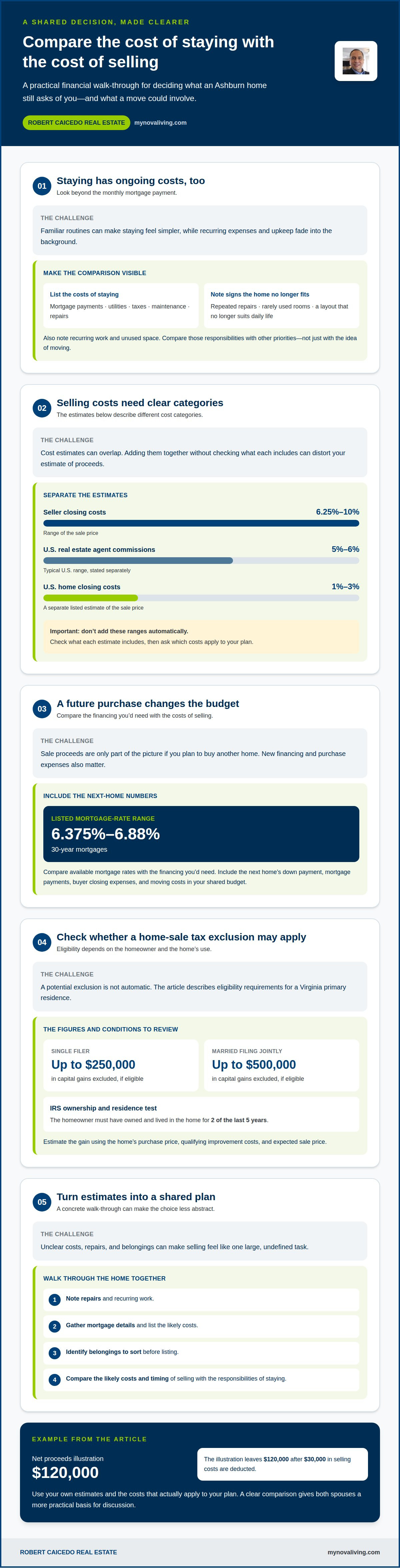
Compare the costs of staying with those of selling. List mortgage payments, utilities, taxes, maintenance, and repairs, then note any unused rooms or recurring work. Staying in an Ashburn home that no longer fits may preserve familiar routines, but its ongoing costs can compete with other priorities. Selling may simplify upkeep, but it also brings transaction costs and a move. Discuss concrete signs, such as repeated repairs, rooms you rarely use, or a layout that no longer suits daily life.
Separate selling expenses into clear categories before estimating proceeds. Seller closing costs usually range from 6.25% to 10% of the sale price; U.S. real estate agent commissions typically range from 5% to 6%. U.S. home closing costs are listed as 1% to 3% of the sale price. These figures describe different cost categories, so don’t add them without checking what each estimate includes. If buying another home, compare available mortgage rates, listed at 6.375% to 6.88% for 30-year mortgages, with the financing you’d need. Ask together which costs apply to your plan.
For a Virginia primary residence, the Internal Revenue Service allows eligible sellers to exclude up to $250,000 in capital gains for a single filer or $500,000 for married couples filing jointly. The IRS requires the homeowner to have owned and lived in the home for two of the last five years. Estimate your gain using the home’s purchase price, qualifying improvement costs, and expected sale price. For example, a net-proceeds illustration leaves $120,000 after $30,000 in selling costs are deducted.
Start with a shared walk-through: note repairs, gather mortgage details, and identify belongings to sort before listing. Then discuss likely costs and timing together. A clear estimate and practical preparation plan make the decision less abstract and help you compare selling with staying.
2. How do I start the conversation about selling with my spouse?
Choose a calm time, not the moment a repair or chore sparks frustration. Begin by asking what your spouse would miss or worry about if you moved. Listen before explaining your reasons, such as unused rooms, changing routines, or a home that would fit better. If you’re wondering how to convince your spouse it’s time to sell your Ashburn home, make the first conversation about understanding, not winning. Avoid ultimatums and repeated pressure; a shared decision needs room for both perspectives.
Resistance may be about more than the house. Your spouse might worry about disrupting children’s routines, losing neighborhood connections, managing showings, or not knowing where you’ll go next. Ask which concern matters most, then address it instead of arguing about selling in general. If uncertainty is the obstacle, explore possible next homes before deciding whether to list. If the move feels overwhelming, agree on one manageable step, such as sorting a single room. This shifts the conversation from persuasion toward a plan you can shape together.
Set a realistic timeline together. A traditional sale may take 36 days to find a buyer and another 42 days to close, with at least 78 days from start to finish. Showings, offer negotiations, and your next-home plans can affect how the process feels. Agree on when to prepare, list, and revisit the plan if circumstances change. A review date lets both spouses consider new information without turning every conversation into pressure.
Discuss proceeds before either spouse assumes what will happen. For example, $150,000 in home equity would mean a $75,000 share each if divided equally. Use that example to discuss shared goals, moving expenses, or whether one spouse might keep the home. Some homeowners have proposed an additional $5,000 to $10,000 or more from proceeds to reach agreement. Before considering that option, understand what’s driving the hesitation. If you’re deciding how to talk with your spouse about selling your Ashburn home, finish with one agreed next step and a date to talk again.
3. Deciding whether to sell before buying
Start with your reasons for moving and the equity in your current home. Selling first can clarify your budget because you’ll know the sale price, remaining mortgage balance, and proceeds before making another offer. It may also mean arranging temporary housing if the next home isn’t ready. Buying first may reduce the chance of moving twice, but carrying two homes can strain your budget. Compare which risk feels manageable for both of you.
Use a market analysis to shape a realistic plan, not a hoped-for price. Compare Ashburn homes sold in the previous 90 days, focusing on similar square footage and upgrades. A seller can use those comparisons to estimate a likely price range, then account for the mortgage balance and selling expenses. If your expected proceeds won’t cover the next down payment and moving costs, selling first may make the finances clearer. If the figures leave room for overlap, buying first may be worth discussing.
A replacement home in Ashburn or nearby may involve a down payment, mortgage payments, buyer closing expenses, and moving costs. The amount depends on the purchase price, financing, and transaction terms. Include these expenses in your budget, and read the purchase agreement carefully for deadlines, contingencies, and the closing date. Those details determine when funds are due and how the purchase proceeds.
Compare the two timelines side by side. For a sell-first plan, map out listing preparation, showings, offers, closing, and the move into temporary or permanent housing. For a buy-first plan, consider how long you could manage both mortgage obligations and other expenses if your current home takes longer to sell. Then agree on a decision point, such as reviewing comparable sales and available equity before making an offer. A shared timeline turns broad concerns into choices you can assess together.
4. Understanding a spouse’s emotional attachment and hesitation
A home can hold more than furniture and routines. Your spouse may connect a doorway’s height marks with a child’s growth, or the kitchen with family gatherings. Ask which rooms or rituals would be hardest to leave. Naming those details helps you understand the feelings behind hesitation rather than treating it as resistance to change.
Try a listening exercise before making more decisions: each of you names one thing you value about living there and one thing you’d like to change. One spouse, for example, may cherish neighborhood walks while the other feels weighed down by unused rooms. Both perspectives can be true. Reflect back what you heard, then ask what would make a move feel less like losing a meaningful chapter.
Separate attachment to the home from concerns about what comes next. Your spouse may worry about leaving familiar neighbors, finding a suitable layout, or handling the disruption of listing and showings. Discuss these concerns one at a time. If routines matter most, sketch a typical weekday in a possible new home. If community is the priority, identify which local connections you’d want to maintain through a move.
Make the possibility tangible without treating it as a commitment. Review floor plans together and discuss how your furniture, hobbies, and daily routines might fit. Sort belongings one room or category at a time, keeping meaningful items in view rather than demanding an immediate clear-out. This small step can reveal whether the hesitation is about moving or about letting go.
Property taxes and maintenance may matter in your practical comparison, but they won’t resolve grief or uncertainty on their own. Acknowledge both the home’s history and the reasons a different setting could better support your next chapter. Agree on one manageable action, such as discussing what a future home needs, then set a date to revisit the conversation. Taking time gives each spouse room to participate without making the decision to list feel forced.
Robert Caicedo Real Estate: Seller Representation
Robert Caicedo Real Estate provides seller representation when you and your spouse are ready to explore a sale together. The process can help you understand the steps involved in listing, consider how your goals shape decisions, and move from discussion toward a sale. You can begin when you’re both ready to talk through selling, even if you haven’t decided what comes next.
If your next chapter includes buying, buyer representation and new construction home services can connect the sale decision with the search for a home that better fits your routines. For couples considering an investment property instead, investment property consulting can support that separate goal. The right path depends on what you decide together, not on pressure to list before you’re ready.
Contact Robert Caicedo Real Estate to discuss Seller Representation and your plans for the Ashburn home.
Make the next conversation a shared decision
A move doesn’t have to begin with a listing. It can begin with a small agreement about what each of you needs from home and what you’re ready to change. If you’re wondering how to convince your spouse it’s time to sell your Ashburn home, shift the goal from persuasion to understanding. A decision you shape together is more likely to reflect both of your priorities.
Choose one practical next step as a couple, such as outlining what you’d like your next home to make easier or identifying what would help you feel ready. You don’t need to settle every detail in one conversation. A shared direction can emerge as you keep listening and talking openly.
When you’re ready to explore a sale, start a conversation with Robert Caicedo Real Estate. Take the next step at a pace that feels right for both of you, and make room for a future that feels like yours together.
Frequently Asked Questions
How do I start the conversation about selling with my spouse?
Ask for a dedicated conversation, then explain your reasons without expecting an immediate decision. You might say, “I’m trying to figure out how to convince my spouse it's time to sell our Ashburn home, but I want us to decide together.” This opens a discussion instead of demanding agreement. Focus on shared priorities, such as space for guests or an easier commute.
What are the most common reasons spouses disagree on selling?
Spouses often disagree because they value different parts of home life. One may want to preserve nearby friendships; the other may prefer a layout that better supports changing routines. If you’re thinking, “I need to understand how to convince my spouse it's time to sell our Ashburn home,” first identify the concern beneath the disagreement. Distinguishing attachment, practical needs, and uncertainty can make your next conversation more specific.
How do current mortgage rates and housing costs affect the decision to sell or stay?
Mortgage rates affect the financing cost of a replacement home, while your current housing expenses show what staying requires. Compare your current payment and recurring costs with estimated expenses for a new home, including its mortgage, taxes, utilities, and upkeep. A move, for example, may offer a better layout but require a higher monthly payment. Discuss which trade-offs fit your shared budget and priorities.


