

A lower asking price can be the stronger opening move. Pricing your Leesburg property below market value can draw buyer attention, and a price 5% below market value may encourage multiple offers. That’s one way to approach how to create a bidding war for your Leesburg property: set a compelling price, then let competing interest build. A bidding war happens when two or more buyers raise their offers for the same home.
It’s natural to assume a higher asking price will lead to a higher sale price. But pricing in line with the market can attract a wider pool of buyers, while a strategic price below market value may help your home stand out and encourage competition. The right approach depends on local demand, comparable sales, and the features buyers value in your property.
Learn how to assess Leesburg market conditions, prepare your home to make a strong impression, choose a launch strategy, and use offer deadlines or escalation clauses thoughtfully. The aim is to build momentum while keeping decisions grounded in your home’s value and your priorities as a seller.
Key Takeaways
- Read the pace of local sales: homes selling within 30 days or less can signal a seller’s market, while longer market times may point to a buyer’s market.
- Compare your home with similar recent sales before setting an asking price, then weigh which features make it stand out to Leesburg buyers.
- Consider pricing below market value to draw more attention; in a buyer’s market, a 5% to 15% discount may help attract interest.
- Use an escalation clause to set how an offer can rise against competing bids, while keeping a clear maximum in mind.
Assessing buyer’s and seller’s market conditions
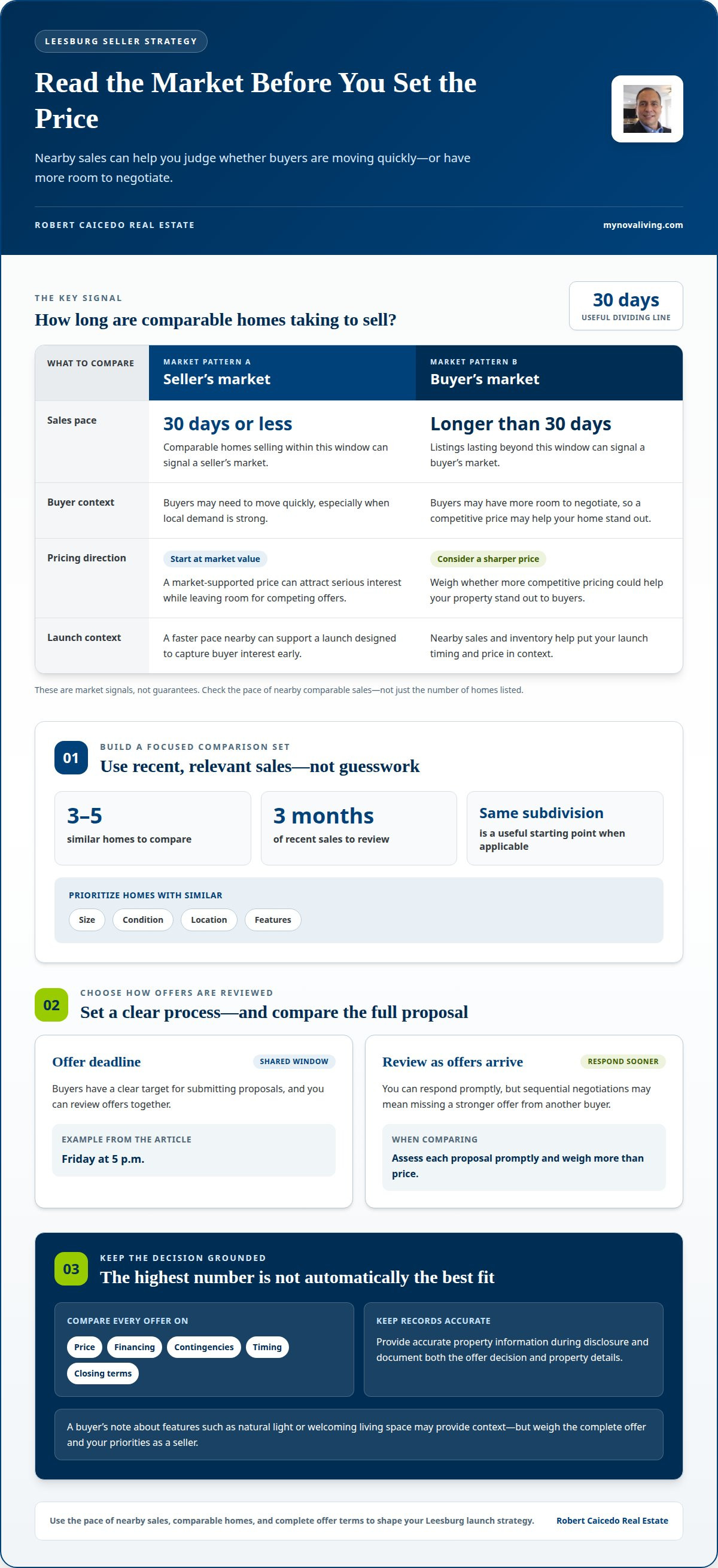
Start with Leesburg’s pace of sales. Homes selling within 30 days or less can signal a seller’s market; homes listed longer than 30 days can signal a buyer’s market. These patterns help shape your asking price and launch strategy.
Should you set an offer deadline or review offers as they arrive? A deadline gives buyers a shared window to submit proposals, making them easier to compare. Reviewing offers as they come in lets you respond sooner, but sequential negotiations may mean you miss a stronger offer from another buyer.
What Virginia rules apply to multiple offers and seller disclosures? Compare written offers by price, financing, contingencies, and timing, and provide accurate property information during the disclosure process. Document both the offer decision and the property details.
- Check the market’s direction. Review how quickly comparable Leesburg homes are selling, not just how many appear for sale. Sales within 30 days or less suggest buyers may need to move quickly; listings lasting longer than 30 days suggest buyers may have more room to negotiate. Low inventory in a popular location can intensify competition, but the pace of nearby sales gives your home’s launch useful context.
- Build a focused comparison set. Select three to five homes most similar to yours, then review sales from the last three months for a current pricing picture. Prioritize properties with comparable size, condition, location, and features. If your home is in a subdivision, start with sales from that same subdivision. Relevant comparisons help distinguish a market-supported asking price from one based on hope.
- Match pricing to market conditions. In a seller’s market, pricing at market value can attract serious interest while leaving room for competing offers. Don’t assume that starting high will produce a stronger result: buyers compare your asking price with similar homes and may pass on a listing that feels overpriced. In a buyer’s market, consider whether a more competitive price could help your property stand out.
- Set a clear offer process. Choose whether to set an offer deadline or review proposals as they arrive. A deadline, such as Friday at 5 p.m., can give buyers a clear target and allow you to compare offers together. If reviewing offers sequentially, assess each one promptly and weigh financing, contingencies, and closing terms alongside price. The highest asking amount isn’t automatically the best fit.
- Invite a personal connection without losing focus. A short note from a potential buyer may explain what they appreciate about the home, such as its natural light or welcoming living space. As the seller, weigh the complete offer rather than letting a heartfelt message determine your decision. Your advantage in a bidding war is choice: compare competing proposals and select the price and terms that best support your plans.
A favorable time to list is when comparable Leesburg homes are selling within 30 days or less, which can signal a seller’s market and faster-moving buyers. Check the pace of nearby sales and inventory to guide your launch timing.
Using an escalation clause
An escalation clause can raise a buyer’s offer if a competing bid is higher, up to a stated cap. As a seller, understand its trigger, ceiling, and appraisal implications before comparing it with other offers.
- Identify the clause’s moving parts. Read the starting offer, escalation increment, and maximum price as one package. For example, a buyer offering $300,000 might authorize increases above competing bids, with a $360,000 cap. The clause responds to documented competition; it doesn’t automatically mean the buyer will pay the maximum.
- Check the trigger and proof requirements. Review what counts as a competing offer and how the buyer’s increase is calculated. In one example, a buyer offering $500,000 for a home listed at $490,000 adds $3,000 above the highest competing offer. A $550,000 competing bid would produce a $553,000 escalated offer. Clear terms help you compare the proposal with fixed-price bids.
- Compare the cap with the full offer. A higher ceiling may strengthen an offer, but the cap also shows the buyer’s maximum willingness to pay. Assess financing, contingencies, closing timing, and the buyer’s ability to complete the purchase. Buyers should set a ceiling based on a sustainable budget, not the heat of competition. Consider mortgage payments and other ownership costs before choosing that limit.
- Account for appraisal risk. An escalation clause raises the contract offer, but an appraisal may come in lower. In an example, a home listed for $500,000 sells for $550,000, while an appraisal at $500,000 leaves a $50,000 gap. An appraisal-gap clause can specify how much the buyer will cover if the appraised value falls short. Compare that commitment with the buyer’s financing and available funds.
- Review the terms before accepting. Read the written clause alongside each offer, including its cap, escalation amount, financing, and appraisal provisions. Understand how the stated price changes if a qualifying competing offer arrives. This detail shows why the exact increment matters.
- Weigh certainty against a possible higher price. An escalation clause may help a buyer stay competitive and give a seller a path to a higher offer. Yet a fixed offer with stronger financing or fewer complications may compare favorably. Judge each proposal by its complete terms, not its headline number, and keep the closing process in view.
Pricing below market value to attract buyers
A deliberate price reduction can draw more buyers to a Leesburg listing and encourage competing offers. If you’re considering how to create a bidding war for your Leesburg property, treat the asking price as a strategic invitation, not a promise of a particular sale result.
-
Set a below-market asking price
Compare your home’s features and condition with relevant sales, then choose a price below its supported market value. Pricing 5% below market value may attract buyers and encourage multiple offers. In a buyer’s market, pricing 5% to 15% below market value may capture the interest of 90% of buyers. Use that range as a strategy to consider, not a substitute for checking how your property compares with local alternatives.
- Give the price strategy a clear purpose. A lower asking price can help your listing stand out when buyers have several properties to consider. Decide what response you hope to encourage, such as more showings or offers within a shared review period. Then prepare to assess the terms, not just the number of offers. A wave of inquiries matters less than proposals that align with your selling priorities.
-
Evaluate underpricing risks
Set your acceptable terms before listing, including the lowest offer you’d consider. If competing offers don’t arrive, a price set too low may leave you with less room to negotiate. A financed offer also involves appraisal and lender considerations, so a high bid alone doesn’t determine whether the transaction fits your plans. Don’t rely on an escalation clause to make up for choosing a price below your comfort level.
- Present the home to qualified buyers. Make the listing accurate and easy to assess. Highlight useful details about the home’s condition, layout, and standout features, and use clear photographs to show those spaces. Agents can help interested buyers understand the property and prepare a considered offer. For example, a home needing updates should be presented honestly, so its asking price and condition make sense together.
- Compare complete offers. Review financing, contingencies, and closing terms alongside price. A higher offer may include conditions that affect timing or certainty; a lower offer may better fit your plans. Consider how a home inspection contingency affects your decision, and read any escalation clause carefully. A practical plan for how to create a bidding war for your Leesburg property keeps your priorities in view as offers compete.
- Use buyer response as feedback. If showings generate interest but no suitable offers, reconsider the listing presentation and asking price together. The goal isn’t simply to generate activity, but to invite offers that support your next move. A defined pricing strategy gives you a steadier basis for deciding what to adjust. For property owners also evaluating residential or commercial sales in other regions, resources such as carolynisacovici.com illustrate how professional market positioning can help drive successful asset transactions.
Robert Caicedo Real Estate: Seller Representation
Robert Caicedo Real Estate provides seller representation for owners preparing to bring a property to market. Turn to this support when weighing a below-market asking price, planning your listing launch, or deciding how to compare competing offers. A clear strategy can help you consider buyer interest alongside your priorities, including offer terms, financing, and timing.
Seller Representation can also help you organize the decisions surrounding your sale, from presenting the home to evaluating proposals. The aim is to make each step more considered, not to pursue multiple offers at any cost. If your plans involve buying instead, Buyer Representation may fit that next move.
For guidance on positioning your Leesburg home and evaluating offers, contact Robert Caicedo Real Estate to discuss seller representation.
Make your next move with confidence
The next step is to turn your goals into a clear selling plan before the listing goes live. Consider what matters most to you: the timing of your move, the terms you can accept, and how much flexibility you want when reviewing offers. A thoughtful approach to how to create a bidding war for your Leesburg property keeps those priorities at the center, rather than letting competition alone dictate your decisions.
Robert Caicedo Real Estate offers seller and buyer representation, as well as support with new construction homes. Whether you’re preparing to sell, planning a purchase, or considering a newly built home, choose the support that fits your plans.
Contact Robert Caicedo Real Estate to talk through your next real estate move. Your Leesburg home can be the start of a fresh chapter, and a considered plan gives you a confident way forward.
Frequently Asked Questions
What is a Real Estate Bidding War?
A real estate bidding war is a competitive offer situation in which multiple buyers pursue the same home, often improving their price or terms to stand out. It isn’t a formal auction. The seller compares proposals against priorities such as financing, contingencies, and timing. For example, an offer with a workable closing date may suit a seller better than a slightly higher bid with less suitable terms.
How Do Bidding Wars Work?
Buyers submit offers, and the seller evaluates them before deciding whether to accept, reject, or negotiate. A seller may review proposals together after a stated deadline or consider them as they arrive. Buyers can compete through price, timing, and conditions, while an escalation clause may raise an offer if qualifying competition appears. The strongest proposal depends on the seller’s priorities, not price alone.
What is the current housing market like in Leesburg, Virginia?
Assess Leesburg’s market by reviewing current listing competition, recent completed sales, and how long comparable homes take to sell. Compare homes in similar property types and neighborhoods, since condition, size, and setting affect which listings are relevant. Aldie, Middleburg, Ashburn, Sterling, Reston, and Washington, D.C., provide regional context, but their market activity shouldn’t replace Leesburg-specific comparisons.
How should I price a Leesburg home to attract multiple offers?
Choose an asking price that makes your home compelling beside the listings buyers are likely to compare, while protecting your selling goals. Before launch, decide the lowest offer terms you could accept and how you’ll assess financing, contingencies, and closing preferences. For instance, a home needing updates may call for a different positioning strategy than a move-in-ready property with similar basic characteristics.
How do professional photos, floor plans, and virtual tours affect buyer interest?
Strong listing visuals help buyers understand a property before arranging a visit. Lead with clear, well-composed photos of the home’s most distinctive spaces; a potential buyer may not scroll through all 36 listing photos. A floor plan can clarify room connections and circulation, while a virtual tour lets viewers explore the layout remotely. Keep every image and representation accurate to the property.
What Virginia rules govern multiple offers and seller disclosures?
Compare written offers by price, financing, contingencies, and timing, and provide accurate property information during disclosure. Document both the offer decision and the property details.


