

Selling FSBO versus using an agent in Washington, DC, comes down to your likely net proceeds, the costs you’ll take on, and how much of the transaction you want to manage. Compare the full financial picture, not just the commission.
Wanting to keep more of your home’s value by selling on your own makes sense. But deciding between FSBO and an agent in Washington, DC, involves more than the listing fee. The sale price, out-of-pocket expenses, and effort required can all affect what you keep.
Use this guide to estimate your proceeds under each approach, set a realistic asking price, and assess a cash offer against a market listing. You’ll see which costs to include and what to weigh before choosing a path that suits your home and timeline.
Key Takeaways
- Build a realistic asking price from comparable homes and your property’s condition, then account for required disclosures.
- Compare estimated net proceeds, not just commissions, by subtracting selling and closing expenses from each expected sale price.
- Use fair market value to guide pricing; an ambitious asking price can affect buyer interest and negotiation.
- Weigh agent representation and cash offers against an FSBO sale by considering exposure, support through the transaction, and the terms that matter most to you.
Pricing a FSBO home and valuation options
An FSBO seller manages the listing, marketing, negotiations, paperwork, and closing. That means preparing the home, setting a defensible asking price, publishing the listing, responding to buyers, and guiding each offer through closing.
Buyer-agent compensation is negotiable; since August 2024, sellers and buyers negotiate agent fees directly with their agents.
Common risks include overpricing, missed disclosures, and inaccurate sale documents. Without an agent, you handle document accuracy unless an attorney helps; 36% of recent sellers without a realtor said they made legal mistakes.
- Assess the home and its likely buyer appeal. Note its condition, layout, upgrades, and location before choosing repairs. Prioritize issues that affect function or buyer confidence, then refresh presentation with cleaning, decluttering, and clear listing photos. Price repairs against their likely effect on the home’s appeal.
- Build a price from comparable DC sales. Compare homes with similar location, size, condition, and features. Adjust your estimate for meaningful differences, such as a renovated kitchen or deferred maintenance. About 17% of FSBO sellers say pricing is their most difficult task, so avoid relying on an asking price alone.
- Prepare accurate disclosures before publishing. Washington, DC sellers must complete a Seller’s Disclosure Statement detailing known material defects and major-system conditions. Federal law requires disclosure of lead-based-paint dangers for homes built before 1978, according to the U.S. Environmental Protection Agency. If a DC real-property disclosure arrives after the buyer signs, the buyer may terminate within 5 calendar days of receiving it, according to D.C. Law Library.
- Plan the listing and sale workflow. Arrange photos, write a factual description, choose an MLS route, and decide whether to offer buyer-agent compensation. Review offers for price, contingencies, and closing terms; then coordinate paperwork and closing. An attorney can help review documents, but the seller remains responsible for managing the FSBO process.
FSBO versus agent sale prices and proceeds
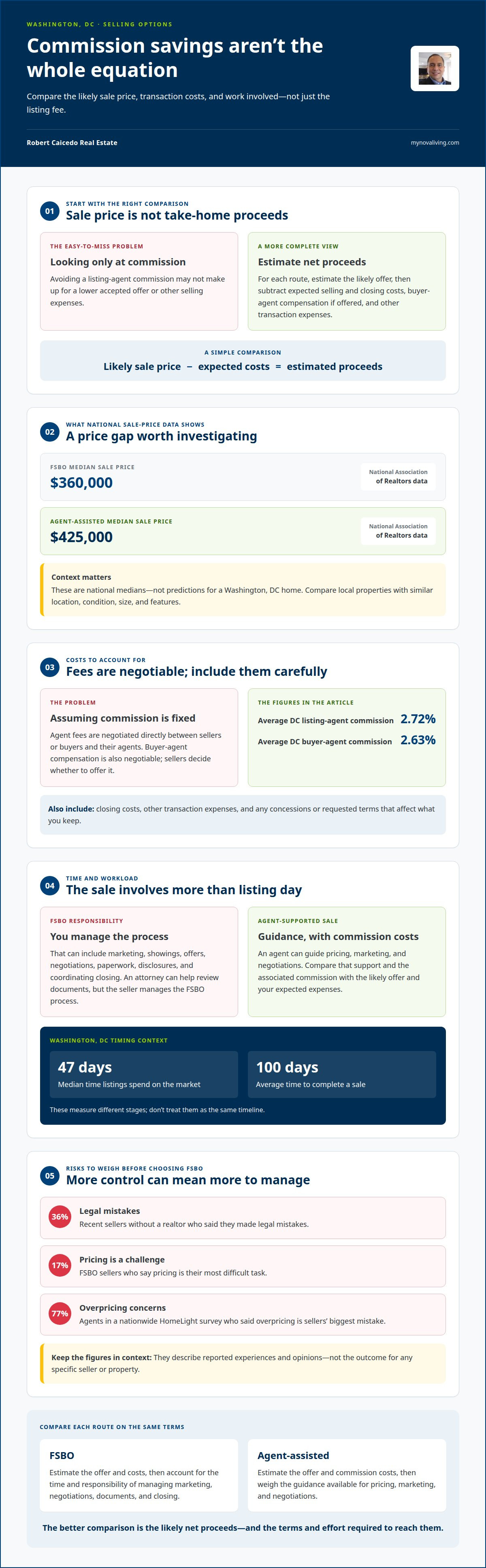
Compare expected net proceeds, not only the commission you might avoid. When weighing FSBO against an agent in Washington, DC, consider the likely sale price, any buyer-agent compensation, closing costs, and other transaction expenses together.
-
Compare FSBO and Agent Sale Prices
Start with comparable sales, then separate sale price from net proceeds. National Association of Realtors data puts median FSBO sale prices at $360,000, compared with $425,000 for agent-assisted sales. These are national medians, not predictions for a DC property. A sale by owner may avoid a listing-agent commission, but a lower accepted offer can outweigh that saving.
-
Review Typical Prices and Time on Market
Use local figures as context, not a promise of your sale outcome. Washington, DC listings spend a median of 47 days on the market, while completing a sale takes an average of 100 days. These measures describe different stages. Compare your home with local properties of similar condition and location, rather than assuming a Zillow search or broad median predicts your result.
- Calculate proceeds under both routes. Estimate the likely offer, then subtract expected costs. The average listing-agent commission in Washington, DC, is 2.72% of the sale price; the average buyer-agent commission is 2.63%. Fees are negotiable, and sellers decide whether to offer buyer-agent compensation. Your choice between selling FSBO and working with an agent in Washington, DC, should account for those costs alongside the likely offer.
- Include paperwork and transaction demands. FSBO sellers handle offers, showings, negotiations, sale documents, and closing coordination themselves. An agent can guide pricing, marketing, and negotiations, while commission reduces proceeds. Compare each offer’s terms, contingencies, and expected expenses. A higher offer, for instance, may leave you with less if it involves costly concessions or extra work before closing.
Pricing strategy and fair market value
- Set a value range before choosing an asking price. Use recent comparable sales, the home’s condition, and its location to establish a realistic range. An asking price is a strategy, not proof of fair market value. A renovated home and a similar property needing repairs, for example, shouldn’t automatically have the same price.
- Use an appraisal when you need an independent estimate. A professional appraiser can assess the home’s features and relevant market evidence. The appraisal offers a reference point, but the eventual sale price still depends on the offer and contract terms.
- Resist pricing above the evidence. A nationwide HomeLight survey found that 77% of real estate agents said overpricing is sellers’ biggest mistake. An inflated asking price can deter potential buyers who compare similar homes. It can also leave less room for productive negotiations if the listing draws limited interest.
- Watch for market feedback after the listing goes live. About 20.14% of Washington, DC listings see price drops. If showings or offers are limited, review the price alongside buyer feedback, condition, and competing listings. A considered adjustment can renew attention; repeated reductions may make buyers question the original valuation.
- Compare offers by net value and terms. A strong offer means more than a high headline price. Review contingencies, requested concessions, financing conditions, and the proposed closing timeline. A lower-priced offer may leave you with more if it requires fewer seller-paid concessions.
- Keep negotiations aligned with your target proceeds. Decide which contract terms matter most, such as the closing date or repair requests. Set a minimum acceptable net amount after expected costs, then assess each offer against it. This gives you a clear basis for responding without letting every price reduction derail your plan.
Alternatives to FSBO, including agents and cash offers
FSBO isn’t the only way to manage your sale. Compare the support, buyer reach, offer terms, and responsibilities involved in each approach.
- Choose an agent-led sale for hands-on transaction support. A listing agent can coordinate marketing, showings, buyer communication, and negotiations while guiding the selling process. Zillow research cited in the market findings says 93% of sellers used an agent in some way, and 69% hired one to promote their home and find potential buyers. That support may suit sellers who prefer a clear point person.
- Consider a limited-service listing if you want selected support. A flat-rate listing can put a home on the MLS while leaving showings, offer review, and paperwork to you. This middle route may suit experienced FSBO sellers who mainly want broader exposure. It doesn’t necessarily include the negotiation guidance or transaction coordination of full-service representation.
- Evaluate a cash offer by its complete terms. Compare the proposed price with the expected net proceeds from a market listing. Review the closing date, contingencies, requested repairs, and any other written conditions. A cash offer may simplify some financing-related steps, but its price and contract terms still determine whether it suits your priorities.
- Match the option to your priorities. If reaching a broad pool of buyers matters most, an agent can help expose your home through MLS access, listing portals, social media, and agent connections. If speed or simplicity matters more, weigh a direct cash offer against the potential exposure and competition of a listed sale.
- Decide who will manage each task before accepting an offer. Write down who handles inquiries, showings, negotiations, contract details, and closing coordination. For example, an FSBO seller may retain control but carry each responsibility, while an agent can guide several steps. Explore support for your home sale if representation would better fit your goals.
Robert Caicedo Real Estate
Robert Caicedo Real Estate can help you evaluate your selling options and choose the support that fits your goals. With Seller Representation, you can work with a real estate professional on positioning your home, considering offers, and assessing transaction terms. If your sale is part of a future move, Buyer Representation can help you plan the purchase as well.
Bring your priorities to the conversation: expected proceeds, timing, the work you’re comfortable managing, and whether you’re considering an agent-led sale or a cash offer. This context helps shape a practical next step without reducing the decision to commission alone.
Contact Robert Caicedo Real Estate to discuss your home sale options.
Choose the Sale That Supports Your Next Move
Choosing between FSBO and an agent in Washington, DC, also means deciding how you want to manage your next transition. Consider how involved you want to be in the sale, what support you value during negotiations, and how your plans after closing affect the best path forward.
If selling connects to a purchase, plan both decisions together. You may be looking for a home that suits a new routine, exploring new construction homes, or coordinating your move. Knowing what comes next can help you choose a sale strategy that feels intentional rather than rushed.
Robert Caicedo Real Estate can help you consider the real estate options tied to your plans. Discuss your next move with Robert Caicedo Real Estate, and take the next step with a plan shaped around your goals.
Frequently Asked Questions
How much can I save by selling without a realtor?
Your savings depend on the listing-agent commission you avoid, minus the expenses you take on yourself. Professional marketing, legal help, and buyer-agent compensation can all affect what remains after closing. Compare the expected net proceeds for each route using the same likely offer price and sale terms. This gives you a practical estimate of the trade-off, rather than treating avoided commission as pure savings.
Should I sell without a realtor?
Selling without a realtor may suit you if you have time to manage buyer inquiries, property access, negotiations, and transaction details. It can also feel more manageable when you already have a serious buyer and clear priorities. Consider how comfortable you are handling competing offers and organizing each step. If you want guidance through those decisions, agent representation may be a better fit.
Should you sell your DC home by owner?
A by-owner sale may suit a Washington, DC homeowner who prefers direct control and can stay involved throughout the transaction. Before choosing this route, consider how you’ll handle buyer questions, showing requests, offer comparisons, and follow-up. Knowing a buyer can simplify initial outreach, but you’ll still need to agree on terms and keep the sale moving through closing.
Unsure About Selling FSBO in Washington, DC?
Start by identifying the part of the sale you feel least prepared to manage. If marketing seems straightforward but negotiating offers feels difficult, compare full representation with more limited support. Consider your schedule, comfort with paperwork, and whether a buyer is already interested. Writing down your priorities can make the choice clearer before you commit to a selling route.
What does for sale by owner mean?
For sale by owner means the homeowner markets and sells the property without hiring a listing agent to represent the sale. The owner leads the process, including communication with prospective buyers and decisions about offers. In Washington, DC, the phrase describes who is managing the sale, not the property’s condition or the level of buyer interest it receives.
What is FSBO?
FSBO stands for “for sale by owner.” It describes a home sale in which the owner takes the lead instead of using a listing agent. An FSBO seller, for example, may arrange property access, answer buyer questions, and manage offer discussions directly. The term describes the seller’s approach; it doesn’t indicate whether the home is listed on the MLS.


