

Virginia closing costs follow strict statutory formulas, but the final check you bring to the settlement table is rarely set in stone. Whether you are stepping into a vibrant new neighborhood or parting with a cherished residence, estimating closing costs in virginia often feels like deciphering a moving target. You shouldn't have to endure eleventh-hour surprises from regional deed taxes, municipal transfer levies, or confusing settlement line items right before you receive the keys.
You deserve complete financial clarity long before your final Closing Disclosure arrives. In this comprehensive guide, you will master the exact breakdown of state transfer taxes, lender fees, and unique Northern Virginia expenses so you can protect your hard-earned equity. We'll walk through precise buyer versus seller responsibilities, uncover regional recording quirks across Loudoun and Fairfax, and reveal actionable contract strategies to optimize your settlement costs with effortless ease.
Key Takeaways
- Master statutory fee formulas and discover how closing costs in virginia divide cleanly between buyers and sellers.
- Protect your hard-earned equity by identifying distinct buyer mortgage escrows versus seller transfer obligations long before settlement day.
- Prepare for Northern Virginia regional nuances, including the regional congestion fee and statutory caps on HOA resale document packages.
- Deploy tactical contract structuring and smart settlement timing to minimize your cash requirements at the closing table.
Understanding Closing Costs in Virginia: Baseline Expectations and Rules
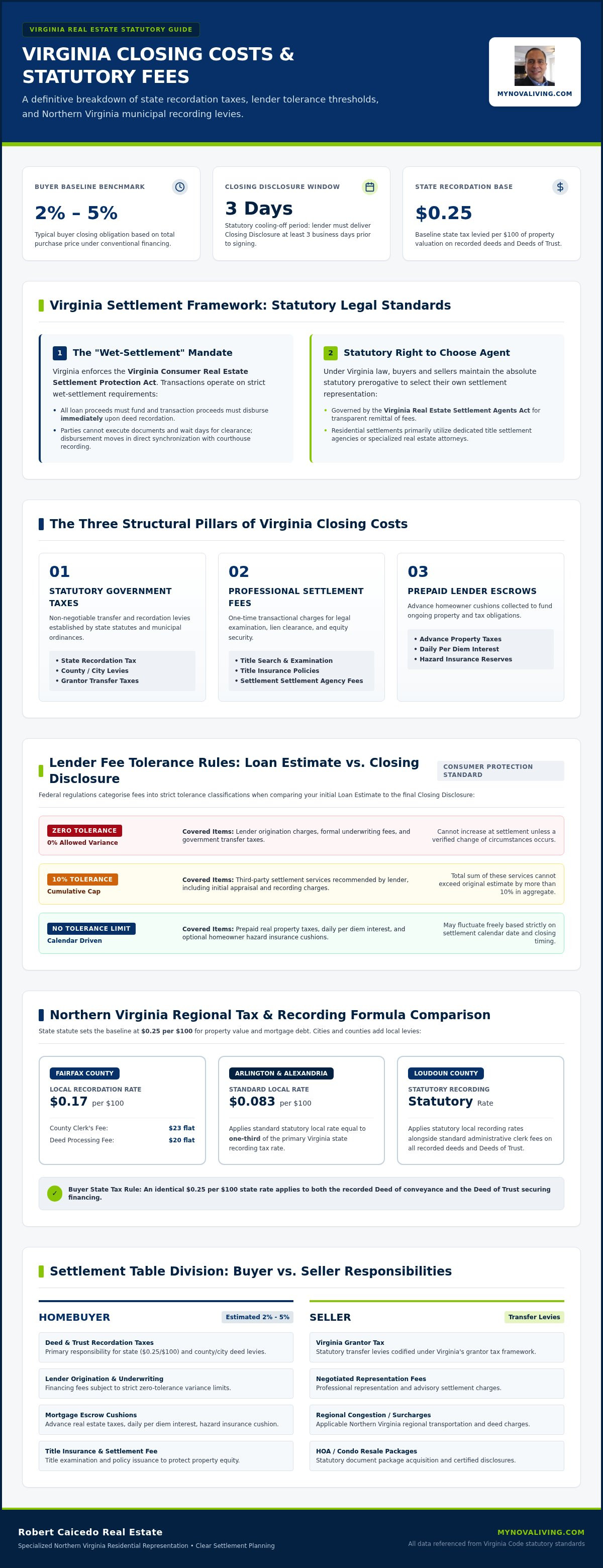
Every home purchase or sale culminates at the settlement table, where ownership transfers and accounts settle. Baseline closing costs in virginia encompass three distinct categories: statutory government transfer taxes, professional settlement fees, and prepaid lender escrow reserves. Getting a firm grip on understanding closing costs helps you distinguish one-time transaction charges, like title examinations and deed recordings, from ongoing homeowner obligations like advance property taxes and hazard insurance cushions.
Total out-of-pocket expenses shift based on your purchase price, municipal tax rates, and financing structure. Buyers using conventional financing commonly encounter closing obligations ranging between 2% and 5% of their purchase price. Sellers face different expenses, traditionally covering state transfer taxes and negotiated representation fees. Working with an attentive real estate advisor ensures you model these figures accurately well before final paperwork arrives.
The Settlement Process in Virginia
Virginia operates as a wet-settlement state under the Virginia Consumer Real Estate Settlement Protection Act. This legal standard means the loan must fund and all transaction proceeds must disburse immediately once the title company records the deed at the county courthouse. You cannot sign paperwork and wait days for funds to clear; everything moves in lockstep on recording day.
Virginia law also grants buyers and sellers the absolute statutory right to choose their own settlement agent. Most residential closings across Northern Virginia rely on specialized title settlement agencies or real estate attorneys rather than general legal practices. Your title company conducts exhaustive title searches to clear prior encumbrances, resolves municipal boundary questions, and issues essential title insurance policies to protect your equity against unrecorded liens.
Closing Disclosure vs. Loan Estimate Timelines
Federal lending rules protect home financing through strict consumer disclosure windows. Your lender must deliver your formal Closing Disclosure at least three business days before you sign final documents. This mandatory cooling-off period gives you dedicated time to audit every line item without rushing.
Compare this Closing Disclosure side-by-side with your original Loan Estimate. Real estate regulations group closing fees into strict tolerance categories:
- Zero-tolerance fees: Lender origination charges, underwriting fees, and transfer taxes cannot increase at settlement unless a verified change in circumstances occurred.
- Ten-percent tolerance fees: Third-party settlement services recommended by your lender, including initial appraisal and recording charges, cannot increase by more than 10% in aggregate.
- No-tolerance limits: Prepaid property taxes, daily per diem interest, and optional homeowner insurance premiums fluctuate freely based on your settlement calendar date.
Virginia Taxes and Statutory Fees: The State and Regional Breakdown
State tax statutes establish non-negotiable transfer levies that form the backbone of closing costs in virginia. Unlike lender origination fees, which allow for comparison shopping, statutory recording charges follow strict formulas codified under state law. The Virginia Real Estate Settlement Agents Act governs how settlement officers collect and remit these revenues, creating a transparent, predictable ledger for every recorded transaction.
State and Local Recordation Taxes for Homebuyers
Homebuyers shoulder the primary responsibility for deed recordation taxes when acquiring real property. The Commonwealth assesses a baseline state recordation tax of $0.25 per $100 of the property value or sales price. When you finance your purchase, an identical state rate applies to the recorded Deed of Trust securing the loan.
Cities and counties layer local levies on top of state baselines. Most jurisdictions collect an additional recording fee equal to one-third of the state tax, though rates diverge across regional borders:
- Fairfax County: Assesses a local recordation rate of $0.17 per $100, alongside specific county recording charges including a $23 clerk's fee and a $20 deed processing fee.
- Arlington County and Alexandria: Collect a standard local rate of $0.083 per $100 of property valuation.
- Loudoun County: Applies statutory local recording rates while assessing standard administrative clerk fees on recorded deeds and mortgages.
The Grantor Tax and Regional Surcharges for Sellers
Sellers handle statutory transfer taxes under Virginia's grantor tax framework. The state imposes a standard grantor tax of $1.00 per $1,000 (or $0.50 per $500) of the property's gross sales price. If you sell a property located in Northern Virginia, you encounter an additional regional transportation surcharge.
Jurisdictions within the Northern Virginia Transportation Authority assess a regional congestion relief grantor fee of $1.50 per $1,000 of consideration. This brings the cumulative regional grantor tax rate to $0.40 per $100 of sale proceeds ($0.25 state baseline plus $0.15 regional allocation). Partnering with a skilled advisor for premier seller representation in Northern Virginia ensures your settlement statement correctly allocates these statutory levies, keeping your net equity fully protected.
Buyer vs. Seller Closing Costs: Who Pays What at the Settlement Table?
Settlement statements in the Old Dominion separate costs across two distinct columns. While buyers fund loan underwriting and future home reserves, sellers resolve property conveyance taxes, legal releases, and professional representation. Knowing where each responsibility lands gives you immense leverage when mapping your net proceeds or out-of-pocket cash needs. Clear boundaries eliminate surprises, turning closing costs in virginia from an intimidating mystery into an organized financial roadmap.
Every transaction maintains room for tactical contract negotiations. Depending on market competition, buyers and sellers frequently adjust who shoulders specific administrative or settlement fees. A dedicated buyer representative can structure purchase offers that request targeted seller subsidies, effectively reallocating closing overhead to preserve your liquid savings.
Detailed Buyer Closing Expenses in Virginia
Purchasers taking out mortgage financing encounter settlement fees directly tied to loan setup and legal defense of title. For buyers managing more complex financing scenarios or investment properties, consulting specialized advisory teams like LoansByJB (The Nuhome Team) demonstrates how tailored, investor-focused loan strategies affect upfront settlement requirements. Beyond standard down payment commitments, buyer line items include:
- Lender origination and processing: Covers underwriting reviews, credit checks, document preparation, and professional property appraisal fees.
- Title examination and insurance: Includes closing agent settlement fees, title searches, mandatory lender's title insurance, and optional owner's title insurance policies.
- Prepaid escrow cushions: Advance deposits funding your impound account for local property taxes, annual hazard insurance premiums, and daily per diem mortgage interest.
Typical Seller Expenses and Prorations
Sellers experience closing obligations primarily as deductions from their final sales proceeds rather than upfront cash outlays. Beyond statutory grantor taxes and regional transit surcharges, seller expenses include:
- Professional brokerage compensation: Agreed fees for listing representation and negotiated buyer brokerage compensation.
- Municipal tax and utility prorations: Daily credits or debits ensuring property taxes and municipal utility fees balance precisely through the exact day of legal transfer.
- Administrative legal releases: Deed preparation expenses by an attorney, courier fees, wire transfer charges, and formal recording fees to release existing mortgage liens.
Northern Virginia Real Estate Realities: HOAs, Condos, and New Construction
Settling into an amenity-rich enclave in Loudoun or Fairfax County brings distinct community fees that alter closing costs in virginia. Master-planned environments across Reston, Ashburn, and Leesburg elevate daily living with resort-style clubhouses, miles of paved fitness trails, and integrated retail centers. These community assets require dedicated reserve funding, which directly shapes your settlement statement through upfront association contributions.
HOA and Condominium Settlement Requirements
Virginia strictly regulates association disclosures through the Virginia Resale Disclosure Act. Sellers must provide the official resale package to the purchaser within 14 calendar days of an order. Virginia caps the electronic delivery fee for this initial disclosure packet at $176.64, payable by the seller, while an expedited five-business-day turnaround carries an optional $70.66 surcharge.
Buyers entering these managed environments face community transfer obligations at settlement:
- Working capital contributions: Master associations commonly charge incoming owners an upfront capital contribution equal to one or two months of regular dues to fortify reserve accounts.
- Post-closing record updates: Management firms often bill a statutory post-closing ownership transfer fee, typically $70.66, to register the buyer's profile in the community registry.
- Condominium reserve deposits: Multi-family condominium regimes regularly require buyers to prepay several months of assessment fees into escrow accounts before settlement finalizes.
Navigating New Construction Closing Costs
Purchasing fresh development property follows a completely different financial rhythm than buying existing resale real estate. Production builders regularly use proprietary sales contracts that alter customary settlement habits. Builders frequently attempt to shift grantor conveyance taxes, regional congestion fees, and water meter tap-in charges directly onto the homebuyer.
You can effectively offset these builder-transferred expenses through strategic negotiation. Most regional developers offer substantial closing credit packages when you utilize their affiliated financing teams. When planning a custom build or spec purchase, study our guide on new construction homes to understand builder contract nuances. If you are comparing neighborhood options, explore our tailored strategies for new homes in Aldie, VA to identify developments offering strong closing incentives. Ready to structure an exceptional home purchase? Connect with Robert Caicedo Real Estate for expert advocacy that shields your investment at every phase.
How to Minimize and Negotiate Closing Costs in Virginia
Proactive planning turns settlement from an unpredictable expense into an optimized financial victory. You don't have to accept standard fee estimates at face value. With thoughtful contract structuring and sharp scheduling, you can dramatically lower your out-of-pocket cash requirements for closing costs in virginia while protecting your hard-earned equity.
Strategic Contract Negotiations and Seller Subsidies
Negotiating seller concessions creates immediate breathing room for purchasers. In balanced or shifting market conditions, you can structure your purchase offer to include a seller-paid closing credit. This subsidy directly offsets your allowable settlement charges, discount points, or title examination fees.
Every loan program enforces strict limits on interested party contributions:
- Conventional mortgages: Cap seller contributions between 3% and 9% of the sales price, scaled directly to your down payment percentage.
- FHA financing: Permits seller concessions up to a maximum ceiling of 6% toward buyer closing expenses.
- VA loans: Restrict seller concessions to 4% of the total loan amount, though normal loan discount points are excluded from this cap.
Engaging dedicated strategic buyer representation ensures your offer captures maximum allowable seller credits without jeopardizing property appraisals or loan underwriting approvals.
Title Insurance and Timing Optimizations
Smart administrative choices deliver immediate settlement savings. When selecting your settlement company, ask about a re-issue rate on your title insurance policy. If the current owner purchased or refinanced the residence within the last several years, title underwriters frequently discount the title examination premium by 10% to 30% because the prior title history is already certified.
Your closing calendar date offers another effortless lever. Lenders collect daily per diem mortgage interest from your settlement date through the final day of that closing month. Closing on the 28th requires only a few days of interim interest on your settlement ledger, whereas closing on the 3rd requires funding nearly a full month upfront.
Strategic preparation transforms your real estate journey into an empowering, seamless experience. Connect with Robert Caicedo Real Estate to design a bespoke negotiation strategy that preserves your liquid capital and elevates your lifestyle from contract to keys.
Take Confident Control of Your Virginia Settlement
Navigating closing costs in virginia doesn't have to be an intimidating mystery. When you master statutory transfer taxes, anticipate distinct regional fees across Loudoun and Fairfax, and deploy proactive contract concessions, you protect your equity well before settlement day. Clear insight transforms final paperwork from a stressful hurdle into an effortless celebration of your next lifestyle milestone.
Every home journey deserves attentive, elevated guidance. Affiliated with Spring Hill Real Estate, serving Northern Virginia communities since 2005, Robert Caicedo Real Estate delivers bespoke buyer and seller advisory designed to protect your wealth at the closing table. You can approach your next transaction with complete peace of mind. Connect with Robert Caicedo Real Estate for expert Northern Virginia representation and step confidently into your future today.
Frequently Asked Questions
How much are typical buyer closing costs in Virginia?
Buyer closing costs in Virginia typically average between 2% and 5% of the total purchase price. On a $500,000 home in communities like Ashburn or Reston, this equals $10,000 to $25,000 at the settlement table. These funds cover lender underwriting, property appraisal, title search fees, mandatory recordation taxes, and initial escrow deposits for property taxes and homeowners insurance. Exact totals vary based on your loan program and purchase timeline.
Who pays the transfer and deed recording taxes in Virginia?
Statutory guidelines divide transfer taxes cleanly between both parties. Homebuyers pay the state recordation tax of $0.25 per $100 of consideration plus applicable local city or county recording fees. Sellers are legally responsible for paying the state grantor tax of $1.00 per $1,000 of the sales price, along with the regional transportation fee if the home is located in Northern Virginia. These statutory divisions are settled directly by the title agent.
Can buyers negotiate for sellers to pay closing costs in Virginia?
Yes, buyers frequently negotiate seller-paid closing subsidies directly within their Virginia purchase agreements. A seller credit reduces out-of-pocket settlement obligations by applying funds toward eligible fees, rate buy-downs, or prepaid escrow reserves. Loan programs limit these concessions: conventional loans allow between 3% and 9% depending on your down payment, FHA permits up to 6%, and VA loans cap seller concessions at 4% of the loan amount.
What is the Northern Virginia regional transportation tax?
The regional transportation surcharge is a state-mandated grantor fee collected across Northern Virginia jurisdictions, including Loudoun and Fairfax counties. Sellers pay an additional $1.50 per $1,000 of the sales price (or $0.15 per $100) at settlement. These dedicated tax receipts fund regional highway expansions, transit upgrades, and congestion relief projects managed by the Northern Virginia Transportation Authority, supplementing the baseline state grantor tax.
Why is title insurance necessary when purchasing a Virginia home?
Title insurance defends your legal homeownership against undiscovered past claims, unrecorded liens, boundary discrepancies, and recording fraud. While lenders require a lender's policy to protect their financial investment, an owner's policy shields your personal equity for as long as you own the property. In vibrant markets like Leesburg or Aldie, securing an owner's policy ensures complete peace of mind through a single one-time premium paid on settlement day.
What is the difference between a Loan Estimate and a Closing Disclosure?
A Loan Estimate outlines anticipated financing rates and settlement expenses within three business days of submitting your mortgage application. The Closing Disclosure represents the finalized financial accounting delivered at least three business days before your scheduled settlement. Comparing both documents ensures your lender respected strict zero-tolerance caps on origination fees and statutory taxes, preventing unapproved cost increases right before you finalize your purchase.
Do new construction homes in Virginia have higher closing costs?
New construction properties often carry higher buyer-side closing costs in virginia because builder contracts routinely shift customary seller charges onto purchasers. Builders commonly require buyers to cover the state grantor tax, regional transportation surcharges, and municipal utility hookup fees. However, production builders across Loudoun and Fairfax frequently counter these added expenses by offering generous closing credits when you use their preferred lending partners.


