

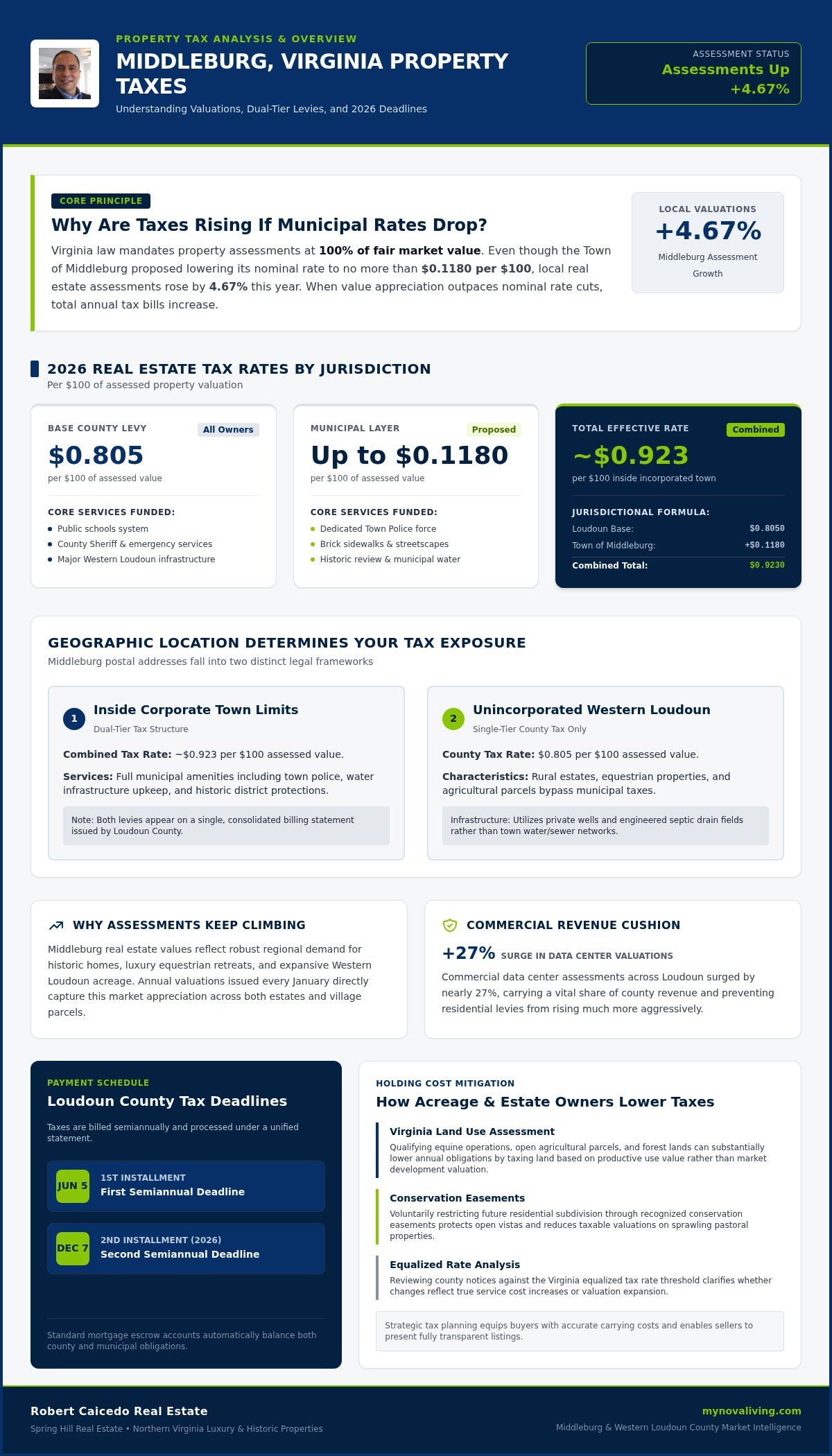
A lower tax rate does not guarantee a smaller bill. If you find yourself asking, are Middleburg VA property taxes going up, the real answer hides beneath headline percentages. While the Town of Middleburg proposed reducing its municipal rate to no more than $0.1180 per $100 to help offset rising real estate valuations, local assessments still climbed by 4.67% this year. That upward swing means your annual holding costs can quietly increase, even when tax rates appear lower on paper. Deciphering separate county and town notices shouldn't cast a shadow over the historic estate or pastoral retreat you love.
You deserve effortless clarity when planning your real estate balance sheet. We'll break down exactly how Loudoun County's $0.805 rate and the town's levy fit together, how rising valuations impact your bottom line, and the proven ways conservation easements and land-use programs can ease your tax burden. Here is everything you need to master your Middleburg property taxes in 2026 with total confidence.
Key Takeaways
- When asking are Middleburg VA property taxes going up, the answer lies in climbing assessed values rather than statutory rate hikes alone.
- Properties inside incorporated town limits experience a dual-tier tax structure, receiving a combined billing statement from Loudoun County.
- Annual January valuations from the Loudoun County Assessor directly reflect Western Loudoun's luxury estate and acreage demand.
- Qualifying horse properties and open parcels can substantially lower annual obligations through Virginia Land Use Assessment and conservation easements.
- Strategic tax planning gives buyers stronger purchasing clarity and equips sellers to present transparent, market-ready listings.
Are Middleburg VA Property Taxes Going Up? The 2026 Overview
To answer directly: are Middleburg VA property taxes going up? Yes, for the majority of residential property owners. Even when headline tax rates decline, rising property assessments almost always push final tax bills higher. Virginia law mandates assessments at 100% of fair market value. When local real estate appreciates, your annual tax obligation grows unless governing bodies lower nominal rates enough to fully offset that growth.
Understanding this balance requires distinguishing statutory rates from equalized rates. In Virginia, an equalized tax rate is the lowered tax rate required to produce the exact same revenue as the prior year after property values increase. When local officials adopt rates above that equalized threshold, homeowners experience an effective tax increase regardless of headline announcements. Setting your real estate plans with confidence means looking past the surface numbers to the true valuation trends shaping your balance sheet.
Nominal Rates vs. Total Tax Bills: The Critical Distinction
A lower statutory rate doesn't guarantee a smaller payment. If your assessment climbs faster than rate reductions, your actual tax liability expands. Across Middleburg, Virginia, enduring demand for historic homes, equestrian retreats, and luxury acreage drove town assessments up 4.67% this year. County supervisors set real property levies each spring, but your taxable base dictates your bottom-line holding costs. When property values appreciate steadily, your tax bill follows suit.
Recent Loudoun County Budget Pressures Impacting Homeowners
County expenditures directly shape homeowner obligations. Loudoun County adopted a real property tax rate of $0.805 per $100 for 2026, balancing substantial capital investments in public schools and road improvements across Western Loudoun. Residential owners also benefit from regional commercial growth. Commercial data center values surged by nearly 27% across Loudoun this year, shouldering a vital share of county revenue. This commercial cushion prevents residential real estate levies from escalating far more aggressively.
County vs. Town Taxes: How Middleburg Real Estate Is Taxed
Location dictates your overall tax exposure. When evaluating whether are Middleburg VA property taxes going up, you have to look closely at jurisdictional borders. The Town of Middleburg imposes a real estate tax on top of Loudoun County's base rate. This dual-tax structure means in-town owners fund municipal amenities, while rural acreage owners outside town limits answer exclusively to the county.
| Jurisdiction | 2026 Tax Rate (per $100) | Core Services Funded |
|---|---|---|
| Loudoun County | $0.805 | Public schools, county sheriff, fire and rescue, major infrastructure |
| Town of Middleburg | Up to $0.1180 (proposed) | Town police, brick sidewalks, historic preservation, municipal water upkeep |
Living Inside Town Limits: The Incorporated Tax Layer
Historic village life carries a dedicated municipal millage. In-town residents pay the town's proposed rate of no more than $0.1180 per $100 alongside Loudoun's $0.805 rate. This brings your combined rate to roughly $0.923 per $100. That additional layer directly finances dedicated town police protection, pristine streetscapes, and strict architectural review. For many, boutique walkability and village prestige easily justify the municipal levy.
Unincorporated Western Loudoun: Single-Tier County Taxation
Properties with a Middleburg mailing address situated outside corporate limits enjoy a streamlined single-tier tax framework. Rural farmsteads and equestrian estates bypass town taxes, paying solely Loudoun County's $0.805 levy. These parcels trade municipal water and sewer connections for private wells and engineered septic fields, enjoying wide open horizons with simpler tax obligations.
Assessment Schedules and Key Tax Payment Deadlines
Loudoun County handles all assessment notices and payment processing for both jurisdictions. Property owners receive a single unified statement rather than disjointed bills. Loudoun County real estate taxes are due semiannually on June 5 and December 5. For 2026, the second installment deadline lands on December 7. Lenders automatically balance both county and municipal obligations through standard mortgage escrow accounts. If you are balancing prospective holding costs across in-town versus countryside properties, explore tailored guidance through Robert Caicedo Real Estate to map your optimal lifestyle investment.
Why Assessments Rise: Unpacking Northern Virginia Market Dynamics
Pinpointing why are Middleburg VA property taxes going up requires looking straight at local assessment mechanics. Every January 1, the Loudoun County Department of the Assessor recalibrates property values based on fair market worth. Middleburg occupies a rarefied niche within the regional economy. While broader Northern Virginia closed sales contracted by 7.9% and median prices settled near $710,000, Hunt Country real estate retained strong pricing power. Scarcity defines this market. When acreage and historic estates trade hands at premium values, the resulting sales data pulls the baseline upward for all surrounding landowners.
The Mass Appraisal Process in Western Loudoun
Loudoun County assesses hundreds of thousands of parcels using automated mass appraisal computer models. Rather than dispatching an appraiser to evaluate your interior finishes every winter, the assessor calculates values using arms-length sales recorded across designated rural market zones. Physical field inspections happen periodically or whenever you pull a building permit. Routine exterior observations verify footprint expansions, pool installations, or new outbuildings, feeding updated data back into the county algorithm.
How Luxury and Equestrian Amenities Drive Assessed Values
Bespoke rural infrastructure directly accelerates taxable values. The assessor treats raw, uncultivated land very differently from parcels featuring operational equestrian architecture. High-value site improvements that frequently boost individual assessment calculations include:
- Custom multi-stall equestrian barns and indoor riding arenas
- Regraded riding rings with all-weather specialty footing
- Extensive four-board fencing along manicured paddock borders
- Architectural renovations expanding historic residential footprints
- Secondary guest cottages, caretakers quarters, and luxury pools
These lifestyle enhancements elevate your everyday living environment, as detailed in our guide to living in Middleburg. However, substantial structural enhancements also expand your physical footprint on record. When county analysts factor completed capital projects into computer-assisted modeling, holding costs climb alongside your estate's rising market worth.
How to Lower Your Middleburg Property Tax Burden: Relief and Programs
Rising assessments don't have to dictate your annual holding costs. If you are questioning whether are Middleburg VA property taxes going up for your specific estate, several proven avenues exist to trim your taxable basis. Virginia law empowers property owners with specialized preservation frameworks and demographic exemptions. Taking advantage of these opportunities lets you protect both your family balance sheet and the historic rural landscape that makes Western Loudoun so exceptional.
Loudoun County provides direct real estate tax exemptions for seniors aged 65 and older, as well as permanently and totally disabled residents. The county program covers the primary residence plus up to three surrounding acres, subject to income and net worth caps established by the Board of Supervisors. The application deadline for new filers seeking real estate tax relief is December 31, while vehicle tax relief applications close September 1. Disabled veterans meeting specific service-connected disability requirements may also qualify for a complete real estate tax exemption on their dwelling.
The Virginia Land Use Assessment Program for Acreage
Western Loudoun horse country thrives on the Virginia Land Use Assessment Program. This initiative taxes qualifying acreage based on its agricultural, horticultural, or forestry productive value rather than its speculative fair market potential. Parcels must meet state acreage minimums and operational standards, such as active crop farming, commercial timber management, or bona fide equine boarding and breeding activities. Keep in mind that redeveloping enrolled acreage triggers statutory rollback taxes, requiring repayment of the deferred tax savings for prior years plus interest.
Conservation Easements and Historic Preservation Tax Credits
Donating conservation easements to reputable land trusts offers substantial, permanent tax relief. By voluntarily extinguishing future subdivision and commercial development rights, you reduce the fair market value of your real estate, directly lowering future county assessments. Virginia also grants generous Land Preservation Tax Credits for qualified conservation gifts. These state credits can directly offset your Virginia state income tax liabilities or be transferred to other taxpayers, creating immediate capital efficiency while forever protecting Middleburg open space.
Challenging Your County Assessment: The Appeal Roadmap
Mass appraisal algorithms can easily miscalculate unique architectural estate characteristics. You have the right to challenge your annual notice if the county overstates your acreage, misjudges topography, or counts non-existent outbuildings. The appeal process involves clear milestones:
- Assessor Review: Submit an initial administrative appeal directly to the Loudoun County Assessor's office to correct factual property record errors.
- Board of Equalization: If informal discussions stall, present your case before the citizen-led Board of Equalization using recent, verified comparable sales from your micro-market.
Navigating rural property assessments requires local market precision. Schedule a strategic advisory consultation to review your acreage valuation, explore conservation viability, and structure your Middleburg holdings for long-term fiscal clarity.
Navigating Middleburg Real Estate: Buyer and Seller Strategies
Real estate choices across Hunt Country represent both lifestyle curation and long-term capital placement. Asking whether are Middleburg VA property taxes going up is a vital first step, but transforming that insight into an effective transaction strategy creates real financial leverage. Whether you are acquiring your first equestrian property or preparing an inherited estate for market, proactive planning ensures your balance sheet stays aligned with your lifestyle ambitions.
Buyer Due Diligence: Verifying Taxes Before Closing
Purchasing acreage demands thorough balance sheet verification before removing contract contingencies. Never rely solely on an existing owner's historical tax bill. A purchase at a higher price point can establish a new benchmark for upcoming assessment cycles. Audit existing land use filings to ensure your intended use complies with Loudoun County standards, preventing unexpected rollback liabilities after settlement. Aligning your search with experienced strategic buyer representation safeguards your purchase with accurate assessments, title reviews, and covenant audits.
Seller Positioning: Showcasing Tax-Efficient Estates
Marketing a luxury rural home requires highlighting its fiscal advantages alongside its architecture. Active agricultural status, enrolled timber management plans, and conservation easements serve as valuable selling points for affluent buyers evaluating annual carrying costs. Assemble clear documentation covering Loudoun County real estate taxes, incorporated town levies, and private utility service records. Presenting transparent, organized operational numbers upfront builds immediate buyer confidence and protects your listing's valuation during negotiations.
Long-Term Value Preservation in Loudoun Hunt Country
Holding costs inevitably adjust, but Middleburg's legacy value remains virtually unmatched. While suburban buyers explore dense developments like new homes in Aldie, Middleburg offers expansive acreage, protected view corridors, and historic distinction that cannot be replicated. When you consider are Middleburg VA property taxes going up, view those expenses as an investment in an irreplaceable community fabric. Connect with Robert Caicedo Real Estate for personalized buyer or seller representation, bringing curated market fluency and seasoned advisory to your next transaction.
Master Your Middleburg Real Estate Strategy
Assessing your bottom line shouldn't complicate the joy of Hunt Country living. While asking are Middleburg VA property taxes going up reveals that climbing valuations drive annual carrying costs, you hold substantial control over your balance sheet. Distinguishing between Loudoun County levies and incorporated town layers gives you immediate fiscal clarity, while mechanisms like Virginia land-use assessment and conservation easements provide proven avenues to protect family wealth.
Every acreage parcel or historic village residence represents both a personal haven and a significant financial investment. Affiliated with Spring Hill Real Estate, trusted across Northern Virginia since 2005, Robert Caicedo delivers curated advisory across Western Loudoun luxury acreage and equestrian properties. Whether you require strategic buyer representation, seller advocacy, or land development consulting, you gain an attentive partner who looks far beyond standard MLS listings. Connect with Robert Caicedo Real Estate today to navigate Middleburg's evolving market with absolute poise and complete peace of mind.
Frequently Asked Questions
Why did my Middleburg property tax bill increase if the tax rate remained unchanged?
Your tax bill increased because your property's assessed value rose, expanding your overall taxable base. Virginia assesses real estate at 100% fair market value. Even if local tax rates stay flat or decline slightly, an assessment increase means the applied percentage yields a larger annual dollar amount. In Middleburg, steady buyer demand for acreage continually nudges assessments upward regardless of rate stability.
Do residents inside the Town of Middleburg pay both town and Loudoun County real estate taxes?
Yes, homeowners within incorporated town limits pay both jurisdictions. This dual-tax structure combines Loudoun County's real estate rate with Middleburg's municipal levy. Since 2019, Loudoun County handles billing and collection for both entities on a single consolidated statement. Owners outside town limits in unincorporated Western Loudoun pay solely the county rate. Many owners find asking are Middleburg VA property taxes going up leads straight to this distinction.
How often does Loudoun County reassess residential real estate values in Middleburg?
Loudoun County reassesses all real property annually as of January 1. The Department of the Assessor conducts computerized mass appraisals by analyzing comparable market sales, recorded deeds, and permitted property improvements across regional micro-markets. You typically receive your official assessment notice by late winter, providing an updated valuation benchmark ahead of the county's spring budget hearings and June tax payment deadlines.
What qualifies a Middleburg horse farm or estate for the Virginia Land Use Assessment program?
Qualifying requires meeting state acreage minimums and demonstrating bona fide agricultural, horticultural, forestry, or open-space usage. For equine properties, owners must actively board, breed, train, or graze horses on at least five dedicated agricultural acres. Enrolling taxes your land according to productive agricultural value rather than speculative market pricing, substantially lowering annual obligations for larger Western Loudoun parcels.
What are rollback taxes, and when do they apply to Western Loudoun real estate?
Rollback taxes represent deferred taxes recaptured when land-use enrolled property converts to an ineligible non-agricultural use or undergoes subdivision. If an owner rezones acreage for dense residential development or stops qualifying agricultural operations, Loudoun County assesses taxes on the full market value difference for the current year plus the five preceding years, alongside statutory interest penalties.
How do I appeal an unfair property assessment with Loudoun County?
You can initiate an appeal by filing for an administrative review directly with the Loudoun County Assessor's office shortly after receiving your assessment notice. If errors in square footage or condition remain unresolved, you may petition the citizen-led Board of Equalization. When readers evaluate are Middleburg VA property taxes going up, presenting recent comparable sales data of similar local estates provides the strongest leverage to successfully contest overvaluations.
Are there property tax exemptions available for seniors or disabled residents in Middleburg?
Loudoun County provides dedicated real estate tax relief for residents who are at least 65 years old or permanently and totally disabled. The program provides an exemption on your dwelling and up to three surrounding acres, contingent upon specific annual household income and net worth limitations. New applicants must file their paperwork with the Loudoun County Department of the Assessor by December 31 to secure relief for the upcoming tax cycle.


