

An online estimate can give you a starting point, but it does not set your asking price. To price my home for sale, use an estimator to gauge its value, then verify the property details and compare recent nearby sales. Local buyer demand and your home’s features help shape a realistic asking price.
It’s easy to focus on the number an estimator displays. But that figure depends on the information behind it and may not reflect your home’s condition, updates, or distinctive features. Treat it as one useful clue, then refine the picture with accurate property details and comparable homes.
You’ll learn how online estimates work, which details to review, and how local inventory, buyer activity, and nearby sales can inform your pricing decision. We’ll also explain where automated estimates fall short and when a comparative market analysis can help you choose an asking price with confidence.
Key Takeaways
- Use an online estimate as a starting point, then compare it with your home’s condition, upgrades, and distinctive features.
- Check property details in public records, since inaccurate information about your home can affect an automated estimate.
- Compare recent nearby sales, generally from the past 3 to 6 months, and account for differences in size, location, and condition.
- Look beyond the sale prices: local inventory and buyer demand can influence how your asking price fits the market.
- Use a comparative market analysis to bring property details and local sales together when setting your asking price.
Why use a home value estimator tool?
If you’re asking, “How do I price my home for sale?”, an online estimator offers a practical first step. It uses available property information and market trends to estimate value, providing a reference to examine, not a final asking price.
Use the estimate to identify which property details and local sales deserve closer attention. Changes in buyer demand, neighborhood inventory, and your home’s condition can all affect the pricing picture.
Factors Affecting Home Value
Location, age, condition, size, and comparable home prices all influence a home’s value. An estimator may also consider bedrooms and bathrooms, recent sales, and local market trends. Two homes with the same floor area can still receive different estimates if their condition or features differ.
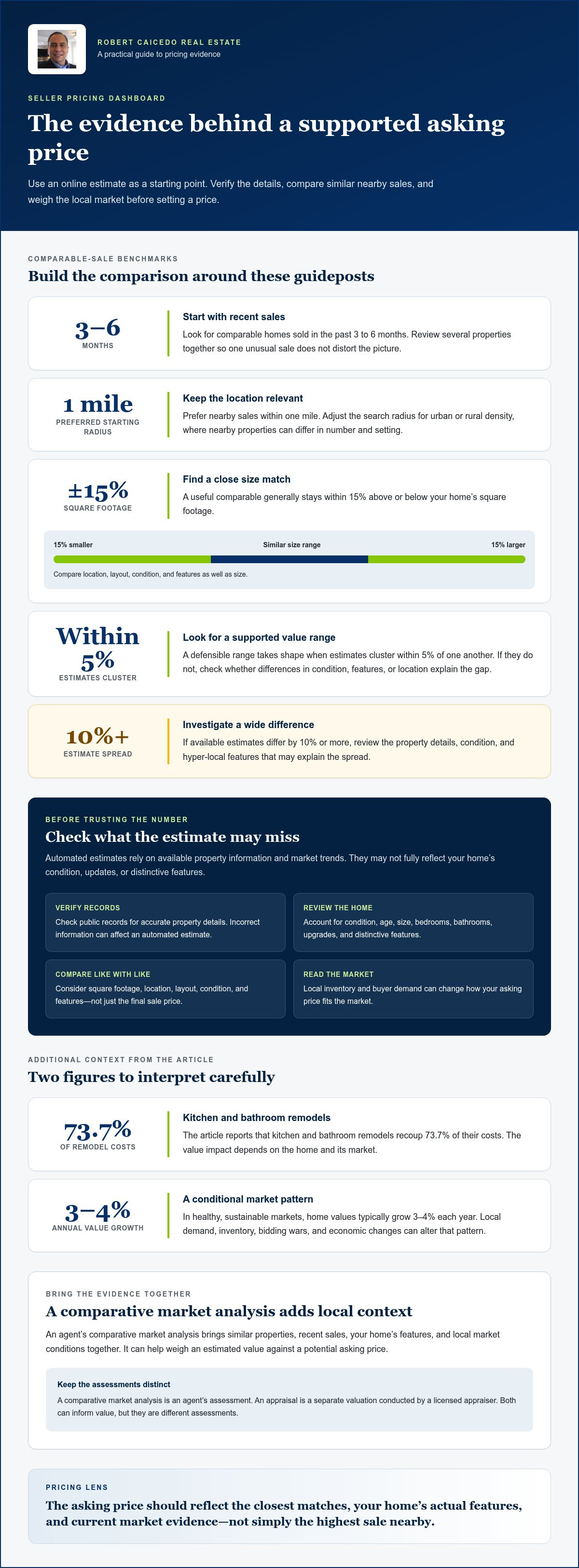
Review improvements alongside those basics. Replacing an old roof, updating kitchen appliances, improving energy efficiency, or adding square footage may help increase value. Kitchen and bathroom updates can also affect an estimate; kitchen and bathroom remodels recoup 73.7% of their costs. The value impact depends on the home and its market.
Estimating a Sale Price
How do you estimate your home's market value before selling? Start with an online estimator, enter or confirm the property details, then compare the result with recent sales of similar homes nearby. If available estimates differ by 10% or more, investigate whether property details, condition, or hyper-local features explain the spread.
Use the estimate as a guide while you assess current demand and local sales. A real estate agent can prepare a comparative market analysis that accounts for your home’s features, location, and market conditions. For the question, “How should I price my home for sale?”, this analysis adds context an automated calculation may miss, helping you weigh an estimated value against a potential asking price.
Track the value estimate when your plans change, such as before selling, refinancing, or seeking a home equity line of credit. In healthy, sustainable markets, home values typically grow 3-4% each year, but local demand, inventory, bidding wars, and economic changes can alter that pattern. Check trends again before setting your price.
Pricing and Overpricing Risks
What are the risks of overpricing a home for sale? An asking price above what comparable sales and current demand support may discourage buyers and make your home harder to position against similar listings. An estimator cannot fully account for disrepair or superior materials, so compare its figure with your home’s actual condition.
When and how should you reduce your home’s listing price? Revisit it when buyer response and newer comparable sales suggest the original figure no longer fits the market. Review the evidence with a real estate agent, then make a considered adjustment based on local sales, property features, and current buyer demand.
Comparative market analysis from a real estate agent
A comparative market analysis brings recent sales and local property details together to inform an asking price. Its usefulness depends on choosing genuinely similar properties and carefully accounting for their differences.
Comparable Sales and Market Data
Start with homes sold in the past 3 to 6 months, preferably within one mile. Adjust the search radius for urban or rural density, where nearby properties may differ greatly in number and setting. A useful match generally stays within ±15% of your home’s square footage. Compare location, layout, condition, and features, not just the final sale price.
To find recent sale prices, search online real estate databases for historical sales. A local real estate agent can also use Multiple Listing Service data to identify sales and property details. Review several comparable properties together, since one unusual sale can distort your sense of neighborhood value.
Using Comparable Homes for Pricing
Use comparable homes to understand what buyers have paid for similar properties under local market conditions. Compare each home’s square footage, bedrooms, bathrooms, condition, and location with yours. Then account for meaningful differences, such as a renovated kitchen or a less desirable setting. The goal is a supported price range, not a direct copy of another home’s sale price.
A defensible home value range takes shape when estimates cluster within 5% of one another. If comparable sales point in different directions, examine whether their condition, features, or locations explain the gap. The final asking price should reflect the closest matches and current market evidence, rather than the highest sale in the area.
Valuation Reports and Appraisals
A comparative market analysis is an agent’s assessment of similar properties, recent sales, your home’s features, and local market conditions. An appraisal is a separate valuation conducted by a licensed appraiser, who evaluates factors such as condition, size, location, and comparable sales. Both can inform value, but they are different assessments.
Review a valuation report’s comparable properties and the reasons behind each comparison. A home value estimate alone may not explain how your property’s condition or distinctive features affect the suggested price. For a clearer neighborhood picture, consider the report’s sales data alongside your home’s details.
Pricing Below Market Value
Should you price below market value to attract multiple offers? A lower asking price may draw buyer attention, but multiple offers depend on demand, inventory, and competing properties. Compare local conditions with recent sales before choosing a strategy. A below-market price does not guarantee stronger offers or a higher final sale price.
To estimate net proceeds, subtract the agreed real estate commission and other selling costs from the sale proceeds. These costs reduce what remains after closing, so consider them alongside the asking price. For a more tailored view of local property decisions, explore local real estate insights as you assess your pricing approach.
Accuracy and limitations of online estimators
Automated estimates can help you understand a home’s possible market value, but their accuracy depends on the property data and local sales behind the calculation. Use the result as a starting reference, then consider where the model’s assumptions may differ from your home.
Online Estimate Accuracy
Automated valuation models use publicly available real estate information, recent sales, local trends, and recorded property characteristics. Their accuracy can vary with public-record availability, municipal reporting speed, and local transaction volume. A model may also miss distinctive design details that set your property apart from nearby homes.
Condition is a major limitation. Automated models generally assume homes are in similar average condition, so they may not account for damaged floors, a broken pipe, or superior materials. If estimates differ by 10% or more, investigate whether property details, condition, or hyper-local features explain the spread.
Check the property facts used in the estimate before relying on it. Public records have an incorrect property field for roughly 5% to 15% of homes, and a wrong field can shift an automated valuation by 10% or more. Compare the estimate’s recorded size and room count with your home. A 2,000-square-foot, four-bedroom property should not be assessed as a 1,500-square-foot, two-bedroom home.
Correct the estimator’s property details where possible, then note renovations and features public records may not capture. A recent kitchen upgrade or distinctive layout can affect buyer interest, even if an automated calculation does not reflect it. Compare estimates with similar local sales rather than relying on a single result.
Online Estimates and Appraisals
A formal appraisal offers a different kind of valuation. A licensed appraiser evaluates a home’s condition, size, location, and comparable sales, while an online estimate calculates a suggested value from available data. An appraisal typically takes 7 to 10 business days and typically expires after 90 days as real estate markets fluctuate.
To compare an appraisal with an online estimate, first align the property details and valuation dates. Then review the appraiser’s comparable properties and note whether renovations, condition, or location explain the difference. For example, if the automated estimate omits a recent improvement, it may not reflect the same evidence considered in the appraisal.
Neither figure should be treated as an asking price without local context. Buyers consider a home’s condition, comparable options, and current demand, while an appraisal and an automated estimate serve different valuation purposes. Bring those details together before deciding what the evidence supports for your listing price.
Gathering and verifying property details
An online estimate starts with your property address and recorded facts. Those details may come from assessor records, deeds, and the multiple listing service. Before using an estimate to inform your listing price, compare its property profile with what you know about your home. An incorrect bedroom count or square footage can lead the calculation away from relevant recent sales.
Enter the full address carefully, including the unit number for a condominium or multi-unit property. Then compare the estimator’s displayed facts with your home and available records. Pay close attention to details that shape comparisons, including living area, bedrooms, bathrooms, and property type. Note any updates or features the profile misses, such as a renovated kitchen or expanded living space.
Use this simple review before relying on an estimate:
- Match the displayed address and unit with your property.
- Compare room counts and square footage with your records.
- Review property type and other listed characteristics.
- Note renovations or condition details that could distinguish your home from comparable sales.
Public records can contain errors. If an official property fact is incorrect, Pennymac says homeowners must contact their local county tax assessor’s office to update it. Some county property tax records are public and may also show past assessments. An assessment is a recorded tax value, so treat it as a separate reference rather than assuming it equals a current selling price.
Sale-price information also varies by location. Alaska, Idaho, Indiana, Kansas, Louisiana, Maine, Mississippi, Montana, New Mexico, North Dakota, Texas, Utah, and Wyoming, along with some Missouri counties, may not disclose home sale prices in public records. In those places, public information may provide less detail for comparing recent sales, which can affect the records available to an estimator.
A confidence score, when provided, is best read as a signal about the available data, not a promise of accuracy. Sparse local transaction information, delayed municipal reporting, or mismatched property facts can weaken an estimate’s foundation. Review the displayed details and nearby sales before treating a high or low score as a verdict on your home’s value.
Keep market value separate from your mortgage balance. The amount remaining on a loan affects the proceeds you may receive after selling, but it does not determine what buyers will pay. For a clearer pricing picture, use corrected property facts alongside comparable sales and your home’s actual condition.
Local market trends and nearby home sales
Neighborhood sales show what buyers have paid, while local trends reveal how those results fit current conditions. Use both to judge whether a potential asking price reflects today’s market.
Local Housing Market Data
Where can you find local housing market data to price your home accurately? Review recent sales in online real estate databases, public property records, and Multiple Listing Service information available through a local real estate agent. Consider neighborhood inventory, buyer demand, bidding activity, and economic changes alongside sale prices.
Inventory helps explain how much choice buyers have. Housing inventory was 20% below pre-pandemic levels, but that broad figure doesn’t describe every neighborhood. Compare the homes currently competing with yours against recent sales. If buyers have several similar options, their condition and asking prices can influence how your home is positioned.
Interest rates also shape affordability and buyer demand. Changes in borrowing costs can affect which properties buyers consider and how much they can offer. If you’re also weighing a refinance, remember that a lender’s valuation for that purpose addresses a different decision than setting a sale price. For a listing, focus on current neighborhood sales and competing homes.
Build a concise local snapshot before choosing a price. Note whether similar properties are selling, how many comparable listings are available, and whether asking prices are changing. Treat each signal as context: a high asking price is not the same as a completed sale, and one sale may not represent the broader neighborhood.
Nearby Home Sales
Start with comparable homes sold in the past 3 to 6 months. Look within one mile, adjusting the radius for urban or rural density, and compare properties within ±15% of your home’s square footage. These boundaries create a useful starting set, not a substitute for examining condition, layout, location, and distinctive features.
Keep closed sales separate from active listings in your notes. Closed sales show what buyers paid, while active listings show the alternatives available now. For example, if a nearby home sold after substantial updates, compare its condition with yours before using its price as a guide. Differences in size or location may also explain a gap.
Look for patterns across several sales instead of focusing on the highest result. If similar homes cluster around a consistent range, that pattern can support your pricing decision. If one sale stands apart, look for a property feature or market circumstance that sets it apart. An agent’s Multiple Listing Service data can add historical details where public sale records offer limited information.
Refresh your comparisons as the market changes. New nearby sales, shifts in competing listings, or stronger buyer activity can change how your home fits the neighborhood. Revisit your pricing evidence, then weigh the closest comparable properties against your home’s condition and features before settling on an asking price.
Robert Caicedo Real Estate: Seller Representation
Robert Caicedo Real Estate provides Seller Representation to help you move from valuation research toward a considered listing strategy. When you’re preparing to sell, this representation helps you weigh your home’s features, comparable sales, and local market conditions as you decide on an asking price.
Bring together the details you’ve reviewed: property records, recent sales, estimator results, and updates that distinguish your home. A clear view of these factors can support pricing conversations and help you approach the next steps with focus. If your plans involve purchasing instead, Buyer Representation may be relevant; New Construction Homes and Investment Property Consulting support different real estate goals.
For a conversation about selling your home, contact Robert Caicedo Real Estate.
Make Your Next Move With Clarity
Choosing an asking price is also a decision about the next chapter you want your home to open. Before setting it, consider how your timing, plans after selling, and the buyer you hope to reach fit together. A thoughtful pricing conversation can connect your home’s market position with the move you’re preparing to make.
If you’re asking how to price my home for sale, Robert Caicedo Real Estate provides Seller Representation to support your selling plans. The firm also provides Buyer Representation and works with New Construction Homes for readers whose next step involves purchasing or exploring a newly built home. Choose guidance that fits the move ahead, whether you’re preparing a listing or planning what comes next.
Contact Robert Caicedo Real Estate to start a conversation about your real estate plans. Your next move can begin with a clear, considered step.
Frequently Asked Questions
How much is my home worth?
Your home’s market value reflects what buyers are likely to pay for a comparable property under current local conditions. An online estimate can offer a starting figure, while recent sales show how similar homes have performed. For example, a renovated home may compare differently from a nearby property needing repairs. Treat the estimate as a pricing reference, not a guaranteed sale amount.
How can I find out the current value of my home?
Start with an online estimate, then review your home’s details and compare them with local sales. Focus on properties that resemble yours in size, layout, condition, and setting. In Aldie, Leesburg, Middleburg, Ashburn, Sterling, Reston, and Washington, D.C., neighborhood-level sales can provide more useful context than broad regional trends. Save the estimate’s date and inputs so you can compare later results consistently.
How much is my house worth?
Your home’s estimated value reflects buyer demand, location, condition, size, and comparable sales. It is separate from your equity: your mortgage balance affects how much you may keep after selling, not what buyers may offer. For a clearer personal estimate, note your home’s current condition and meaningful updates, then compare it with similar sold properties. Those details help explain why your home may differ from a nearby sale.
Is this the same as an appraisal?
No. An online value estimate is generated from available property information and market data. An appraisal is a valuation conducted by a licensed appraiser, who evaluates the property’s condition, size, location, and comparable sales. The results can differ because they use different methods and information. When comparing them, make sure they refer to the same property details and consider the date of each valuation.
What is the Home Valuation Report?
A Home Valuation Report presents an estimated value alongside information that helps explain it. An estimator report may show property details, nearby similar homes sold within the previous six months when sales data is available, and a local market snapshot. Use it to see which facts inform the result, then note any renovation or condition details that could change how your home compares with those properties.
Are the online estimates accurate?
Online estimates can provide a useful general reference, but their accuracy depends on the available information and sales data. They may miss a damaged floor, a broken pipe, recent renovations, or a distinctive feature. Compare more than one estimate and investigate meaningful differences. A wide spread may indicate that a model lacks relevant property details or local context, rather than proving one estimate is correct.
What comparable home sales should I use to price my house?
Choose completed sales that closely match your home’s location, size, property type, layout, and condition. A nearby detached home may be a weaker comparison for a condominium, even if both have similar square footage. Review several sales instead of relying on an outlier, and keep sold properties separate from active listings. Listings show current competition; completed sales show what buyers actually paid.
How do location, condition, size, and upgrades affect home value?
Location connects your home to neighborhood demand and nearby comparable properties. Size and room count shape which homes buyers may consider alongside yours, while condition affects how much work a buyer expects. Updates such as newer kitchen appliances or an improved roof may influence value, but their effect depends on local preferences and the home itself. Describe upgrades accurately when comparing your property with recent sales.


