
The obvious move in Northern Virginia real estate is buying a polished resale home in an established neighborhood. But that obvious move might be exactly what's costing you equity before you even get the keys. Investing in new construction Northern Virginia is where the real opportunity lives in 2026, and it's hiding in plain sight inside master-planned communities that haven't fully arrived yet.
You already sense it. You've watched corridors like Ashburn transform from farmland into some of the most coveted zip codes in the DMV, and you're wondering where that story repeats itself. The hesitation is fair, too. Builder contracts can feel designed to protect everyone except you. Delays happen. And the last thing any serious investor wants is to buy into a sub-market that already peaked six months ago.
This guide cuts through all of that. You'll learn how to spot the pre-construction equity gap before the infrastructure catches up, which NoVA growth corridors still have room to run, and how to walk into a builder's sales office with a strategy that actually protects your interests. The next Ashburn is out there. Let's find it together.
Key Takeaways
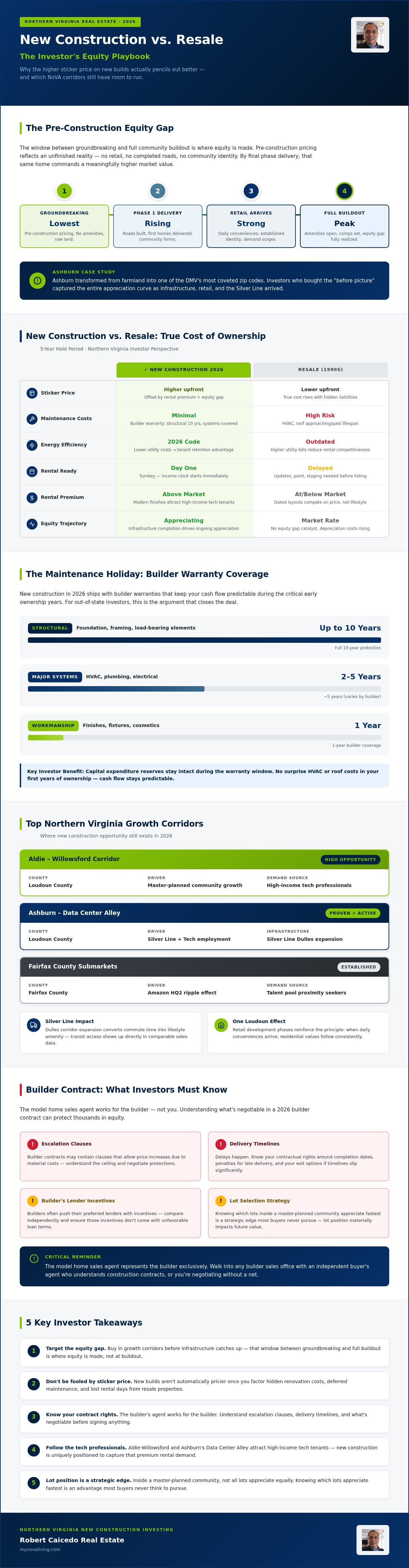
- Investing in new construction Northern Virginia means targeting growth corridors before infrastructure catches up — that gap between groundbreaking and full buildout is where equity is made.
- New builds aren't automatically the pricier choice once you factor in the hidden renovation costs, deferred maintenance, and lost rental days that resale properties routinely carry.
- The model home sales agent works for the builder — not you. Understanding what's negotiable in a 2026 builder contract, from escalation clauses to delivery timelines, can protect thousands in equity.
- Corridors like Aldie-Willowsford and Ashburn's Data Center Alley are attracting high-income tech professionals, creating rental demand that new construction is uniquely positioned to capture.
- Land development expertise changes the game: knowing which lots inside a master-planned community will appreciate fastest is a strategic edge most buyers never think to pursue.
Why New Construction in Northern Virginia is a 2026 Power Move
Northern Virginia's economic identity has shifted permanently. The ripple effects of Amazon's HQ2 in Arlington didn't stop at the county line. They triggered a regional recalibration: employers chasing proximity to that talent pool, tech workers demanding housing that matches their lifestyle expectations, and a rental market that keeps absorbing demand faster than resale inventory can answer it. Investing in new construction Northern Virginia right now means positioning yourself at the front of that wave, not chasing it from behind.
The "equity gap" is the core concept here. When a master-planned community breaks ground, pre-construction pricing reflects an unfinished reality: no retail, no completed road network, no established community identity. By the time the final phase delivers and the amenity core opens, that same home commands a meaningfully higher market value. You're not just buying a house. You're buying the before picture, and letting the infrastructure write the after.
The Maintenance Holiday: A Landlord's Best Friend
For out-of-state investors especially, this is the argument that closes the deal. A new construction home in 2026 ships with builder warranties that typically cover structural elements for up to ten years and major systems for shorter but still significant windows. That means your first years of ownership aren't spent budgeting for a new HVAC unit or a roof replacement. Cash flow stays predictable. Capital expenditure reserves stay intact.
Energy efficiency standards built into 2026 construction also matter for tenant retention in ways that get underestimated. Modern renters, particularly the high-income tech professionals filling Loudoun and Fairfax County, actively compare utility costs when choosing between units. A home built to current energy codes competes differently than a 1990s resale property. Lower monthly overhead becomes part of your leasing pitch, and that translates into lower vacancy rates and longer tenancies.
The turnkey factor is real. New construction requires no cosmetic updates before your first tenant walks in. No staging, no fresh paint, no replacing dated fixtures. The home is move-in ready from day one, which means your rental income clock starts immediately.
Infrastructure Drivers of Appreciation
The Silver Line's Dulles corridor expansion fundamentally changed the calculus for Ashburn and the communities feeding into it. Transit access converts commute time into a lifestyle amenity, and that conversion shows up directly in comparable sales data. Retail developments like the expanding phases of One Loudoun reinforce the same principle: when daily conveniences arrive, residential values follow.
The Northern Virginia tech corridor's gravitational pull on six-figure earners makes new construction the region's most reliable vehicle for building long-term rental equity in 2026.
Decoding the ROI: New Construction vs. Resale for Investors
The sticker price on a new construction home can stop investors cold. It reads higher than the comparable resale down the street, and that gap feels like an immediate disadvantage. But the sticker price is not the investment price. Once you build out the true cost of ownership over a five-year hold, the math shifts in ways that consistently favor new builds for serious investors.
Rental yield tells part of the story. High-income tech professionals relocating to Loudoun and Fairfax County aren't shopping for the cheapest unit available. They're comparing finishes, layouts, and utility costs. A 2026 new build commands a rental premium over a dated resale precisely because it delivers the lifestyle those tenants are willing to pay for. That premium doesn't just cover the initial price difference; it compounds across your hold period through lower vacancy rates and longer lease terms.
The Real Cost of Older Homes in Loudoun County
A 1990s resale in Loudoun County carries a predictable set of liabilities. HVAC systems from that era are approaching or past their functional lifespan. Roofs installed during the original construction are expensive line items waiting to materialize. And the floorplans, designed for a different era of living, often feel closed-off and compartmentalized compared to the open, flexible layouts today's renters expect.
Modernizing a resale home to 2026 tenant expectations isn't cosmetic work. It's structural. You're looking at kitchen reconfigurations, bathroom overhauls, and system replacements that can collectively represent a significant capital outlay before your first tenant signs a lease. That capital doesn't disappear; it just moves from your down payment into your renovation budget, often with less predictability and more timeline risk. Understanding how land development in Northern Virginia shapes property values helps you see why the lot and its surrounding infrastructure matter just as much as the structure sitting on it.
There's also the psychological dimension. Never-lived-in spaces carry a genuine appeal to quality tenants. No history of wear, no ambiguity about cleanliness, no previous occupant's choices to work around. That clean-slate quality attracts the demographic you want: stable, high-earning renters who treat a home with care because they chose it deliberately.
Appreciation Potential: Timing the Market
Master-planned communities have a documented appreciation pattern. Phase 1 pricing reflects an unfinished neighborhood. By the time Phase 3 or 4 delivers, the amenity core is open, the retail is operating, and the community identity is established. Early buyers capture that entire appreciation arc. Established neighborhoods, by contrast, are already priced for what they are. The upside is incremental rather than structural.
Investing in new construction Northern Virginia means buying before the neighborhood's story is fully written. That's where equity is created, not captured. Knowing which phase to enter and which lots within a community carry the strongest long-term positioning requires the kind of granular market knowledge that a builder's sales agent won't volunteer. That's exactly why buyer representation from someone who understands both the builder's incentive structure and the local development pipeline changes your outcome so meaningfully.
Think about the exit. In 2031, a five-year-old new construction home in a fully built-out master-planned community competes as a modern, move-in-ready resale. A thirty-year-old home in that same year competes as an aging property with deferred maintenance risk baked into the buyer's calculus. The depreciation curve runs in opposite directions, and that divergence shows up clearly in your eventual sale price.
Top Northern Virginia Corridors for New Build Appreciation
Most investor guides point you toward Arlington or Fairfax City and call it a day. That's the conventional answer, and it's the wrong one for 2026. The real appreciation story in investing in new construction Northern Virginia is happening further west, where land is still being entitled, infrastructure is actively arriving, and pricing hasn't yet caught up to the demand that's already there.
Aldie and Ashburn: The Twin Engines of Growth
New homes in Aldie, VA represent the gold standard for 2026 investors targeting the luxury segment. Communities like Willowsford have redefined what a master-planned development can deliver: resort-caliber amenity cores, working farms integrated into the community identity, and architectural standards that hold value over time. These aren't starter neighborhoods. They're lifestyle destinations that attract dual-income households with the income profile to sustain premium rents.
The work-from-home demographic has been particularly transformative for this corridor. Buyers and renters who no longer commute daily aren't trading square footage for transit proximity. They want dedicated office space, flexible layouts, and outdoor access. New construction in Aldie delivers exactly that, with floorplans designed around the reality of how people actually live now rather than how they lived in 2005.
Ashburn's tech corridor tells a complementary story. Data Center Alley, the dense concentration of hyperscale facilities running through Loudoun County, employs a high concentration of engineers, cloud architects, and infrastructure specialists. These are renters with strong income stability who prioritize proximity to work and quality of finishes. Luxury townhomes in Ashburn's newer phases lease quickly to this demographic, and vacancy rates in well-positioned new builds have remained consistently tight.
The Emerging West: Leesburg and Beyond
Leesburg is mid-transition. It's no longer just a historic market town at the edge of the metro; it's absorbing significant new residential development as buyers price out of Ashburn and push west along Route 7. That pressure creates a compelling entry window for investors who move before the narrative fully solidifies.
Middleburg operates on entirely different logic. Supply is structurally constrained by geography, zoning, and the community's fierce commitment to its equestrian identity. New construction here is rare by design, which means when it does come to market, it commands serious attention from high-net-worth buyers and investors building luxury-tier portfolios. If that market interests you, understanding the full lifestyle context matters: the guide to living in Middleburg, VA captures why this community commands the premiums it does.
Reston and Sterling round out the picture with infill and transit-oriented opportunities. Reston's continued densification around the Silver Line stations creates demand for modern units that aging resale inventory simply can't satisfy. Sterling's price point relative to Ashburn makes it an accessible entry corridor for investors who want Loudoun County exposure without Ashburn pricing. These aren't frontier plays. They're steady, infrastructure-supported bets that reward investors who understand where the commuter math works.
Knowing which corridor fits your strategy, and which specific lots within each community carry the strongest positioning, is where professional guidance on investing in new construction Northern Virginia pays for itself many times over.
Navigating the Builder Contract: Protecting Your Investment
Here's the rule that changes everything: the friendly agent greeting you in the model home works for the builder. Full stop. Their job is to sell homes at the best possible margin, and the contract they hand you reflects that priority. Understanding this dynamic is the foundation of every smart move you'll make when investing in new construction Northern Virginia.
Builder contracts aren't standard purchase agreements. They're builder-drafted documents loaded with addendums that protect the builder's timeline, pricing flexibility, and liability exposure. Two clauses deserve immediate scrutiny in 2026:
- Escalation clauses: Some builders reserve the right to pass material cost increases to the buyer during the build cycle. Know exactly what triggers this clause and whether it has a cap before you sign.
- Delivery timelines: Vague completion language like "estimated" or "anticipated" delivery dates gives builders significant wiggle room. Push for specific outside closing dates with defined remedies if those dates slip.
Independent inspections are non-negotiable. Two stages matter most: the pre-drywall inspection, where a third-party inspector can see framing, plumbing, electrical, and HVAC rough-ins before they're concealed, and the final walkthrough inspection, which goes beyond the builder's own punch-list process. Builders won't volunteer this. You have to demand it.
The design center is where investor discipline gets tested. Upgraded countertops and premium flooring feel essential in the moment, but many structural upgrades recoup value while cosmetic ones rarely do. Prioritize lot premiums, finished basements, and additional bedrooms over decorative tile packages and cabinet hardware. Focus your upgrade budget on what appraisers count and tenants actually pay for.
Negotiating with National vs. Local Builders
National builders like NVR and Toll Brothers operate with tighter contract standardization, but they carry real leverage in one direction: closing cost credits. In a 2026 market where builders are managing their own absorption rates, closing cost assistance funded through their preferred lender is often negotiable, especially in communities still in early phases. Local and boutique builders tend to offer more flexibility on specifications and lot selection, but less room on pricing. Know which type you're dealing with before you sit down.
One critical risk to understand: waiving the appraisal contingency in a new construction contract means you're legally obligated to close even if the home appraises below the contract price, leaving you to cover the gap out of pocket.
The Role of Professional Representation
A consultant who genuinely understands land development in Northern Virginia brings a different lens to the builder negotiation. They can identify which lots within a community carry stronger long-term positioning, flag contract language that shifts risk unfairly to the buyer, and monitor the build cycle on your behalf across a six-to-twelve month timeline when you can't be on-site.
Robert Caicedo Real Estate exists precisely for this gap. As an independent consultant with deep roots in Northern Virginia's development pipeline, Robert represents your interests against a builder's sales infrastructure, from contract review through final walkthrough. That's the kind of aligned representation that protects your equity from day one.
Don't walk into a model home without someone in your corner. Connect with Robert Caicedo Real Estate to get builder-savvy representation before you sign anything.
The Robert Caicedo Advantage: From Land Development to Portfolio Growth
Most real estate agents see a new construction transaction as a sales event. Robert Caicedo sees it as a land development play. That distinction is everything when investing in new construction Northern Virginia, because the equity isn't made at closing. It's made in the decisions that happen before you ever walk into a model home.
The approach starts at the lot level. Before a single brick is laid, there's a story embedded in the land itself: topography, orientation, proximity to the community's planned amenity core, how traffic patterns will evolve as later phases deliver. Most buyers never think to ask these questions. Robert asks them first, because the lot you choose inside a master-planned community can meaningfully separate your appreciation trajectory from your neighbor's, even when you're buying the same floorplan at the same price.
A Sophisticated Guide for Serious Investors
This isn't a volume brokerage. It's curated, deliberate consulting built around what actually drives long-term value in Northern Virginia's development pipeline. That means analyzing site potential before committing, understanding the emotional resonance a property will carry for future tenants and buyers, and tailoring every recommendation to whether you're building a residential portfolio, entering the market as an international buyer, or targeting a single high-conviction acquisition.
Global investors entering the NoVA market face a specific challenge: they're navigating builder contracts, local entitlement timelines, and corridor-level demand dynamics from a distance. Robert's international real estate services bridge that gap directly, providing the on-the-ground intelligence and contract-level advocacy that remote investors can't replicate on their own.
The focus stays on quality over volume. That means fewer clients, deeper engagement, and a consulting relationship that treats your investment as a lifestyle environment with long-term financial stakes, not a transaction to be processed.
Your 2026 Portfolio Strategy Starts Here
Northern Virginia's top new developments won't wait for you to get comfortable with the idea. The corridors that still offer genuine pre-buildout pricing, the communities where Phase 1 buyers are still capturing the full appreciation arc, the lots inside those communities with the strongest positioning: that intelligence has a shelf life.
A curated property tour of the region's most compelling new construction opportunities is the right starting point. Not a generic open house circuit. A structured, strategic walkthrough of the developments that actually fit your investment profile, with someone who understands the builder's incentive structure and the land development fundamentals driving each community's long-term value.
Investing in new construction Northern Virginia in 2026 rewards the prepared and the well-advised. The opportunity is real. The window is open. The next move is yours.
Your 2026 Entry Point Won't Wait
The case for investing in new construction Northern Virginia in 2026 comes down to three realities: the equity gap between groundbreaking and full buildout is real, new builds consistently outperform aging resale over a five-year hold when you account for true ownership costs, and the growth corridors with room to run won't stay underpriced for long.
What separates investors who capture that upside from those who watch it happen is preparation. Knowing which communities are still in early phases, which lots carry the strongest positioning, and how to negotiate a builder contract that actually protects you, that's not information a model home agent will hand over. It requires someone in your corner who understands both the builder's incentive structure and the land development fundamentals shaping each community's trajectory.
Robert Caicedo brings exactly that: land development consulting expertise, direct new construction buyer representation, and nearly two decades of Northern Virginia market knowledge through Spring Hill Real Estate. The opportunity is in front of you right now.
Frequently Asked Questions About Investing in New Construction Northern Virginia
Is it better to invest in a new construction townhome or a single-family home in Northern Virginia?
It depends on your target tenant and exit strategy. Townhomes typically carry lower entry prices and attract the high-income tech professionals concentrated along the Loudoun County corridor, making them strong performers for rental yield. Single-family homes command higher rents and broader buyer appeal at resale, but they require more capital upfront. In communities like Ashburn's newer phases, luxury townhomes have maintained tight vacancy rates precisely because they match what the local workforce actually wants.
For investors prioritizing cash flow over a five-to-seven year hold, townhomes often deliver stronger returns relative to purchase price. If long-term appreciation and eventual owner-occupant resale value matter more to your strategy, single-family lots in master-planned communities with strong school district positioning tend to outperform at exit.
How do builder warranties work for real estate investors?
Builder warranties typically follow a tiered structure: one year covering workmanship and materials, two years covering mechanical systems like plumbing and electrical, and ten years covering structural defects. As an investor, these warranties transfer to your tenants' benefit but remain your legal asset as the property owner. That means warranty claims are yours to file, not your tenants'.
Read the warranty documentation carefully before closing. Some builders require you to register the warranty within a specific window after settlement, and certain coverage categories have strict notice requirements. A missed deadline can void a claim that would otherwise cover a significant repair. Professional representation during the purchase process helps ensure these details don't fall through the cracks.
What are the best school districts in Northern Virginia for new construction investment?
Loudoun County Public Schools consistently ranks among Virginia's top-performing districts, which directly supports property values in communities across Ashburn, Aldie, and Leesburg. Families relocating for tech sector roles actively filter their housing search by school assignment, making district quality a genuine driver of both rental demand and resale pricing. New construction in communities zoned for well-regarded elementary and secondary schools commands measurable premiums over comparable homes in weaker-rated zones.
Fairfax County Public Schools carries similar weight in the eastern corridor. When evaluating a specific lot or community, confirm the actual school assignments rather than relying on general district reputation. Attendance boundaries shift as new communities are built, and the assigned school can meaningfully affect your tenant pool and exit value.
Can I negotiate the price of a new construction home in 2026?
Direct price reductions from national builders are rare, but that doesn't mean the contract price is truly fixed. Closing cost credits funded through the builder's preferred lender, lot premium adjustments, and structural upgrade packages are all negotiable, particularly in communities still in early absorption phases. Builders manage their pricing carefully to protect comp values across the development, so they'd rather offer you $15,000 in closing cost assistance than reduce the base price by the same amount.
Timing matters. Builders working toward quarterly sales targets are more flexible at the end of a reporting period. Local and boutique builders typically offer more room on specifications and lot selection than national builders do. Knowing which levers actually move, and which requests will be declined outright, is where having experienced representation for investing in new construction Northern Virginia pays off directly.
What happens if the builder delays the completion of my investment property?
Delays are common, and most builder contracts give them significant protection through vague "estimated" delivery language. If your contract lacks a defined outside closing date with specific buyer remedies, you may have limited recourse beyond walking away and recovering your deposit, depending on the contract terms. Some contracts allow you to extend your rate lock at the builder's expense if delays push past a certain threshold, but this must be negotiated before you sign.
Practical preparation matters as much as contract language. If you're planning to rent the property immediately after closing, build a buffer into your financial projections rather than assuming an on-time delivery. Maintain open communication with your builder's project manager throughout the build cycle, and document every conversation. An independent consultant monitoring the build timeline on your behalf can flag issues early and keep the builder accountable.
Do new construction homes in Loudoun County have higher property taxes?
Loudoun County's property tax rate applies to assessed value, and new construction homes are assessed at or near their purchase price in the first assessment cycle. Because new builds in master-planned communities often carry higher purchase prices than older resale inventory in the same area, the initial tax bill can feel elevated by comparison. However, older homes in established neighborhoods sometimes carry assessments that have been appealed or lagged behind market value, which can make the comparison misleading.
The more important dynamic for investors is how assessments evolve over your hold period. As the surrounding community builds out and comparable sales rise, your assessed value will likely increase alongside them. Factor in annual assessment growth when modeling your cash flow projections, and confirm the current Loudoun County tax rate directly with the county assessor's office before closing.
Is pre-construction pricing always the lowest price for a development?
Pre-construction pricing is typically the lowest base price available, but it's not automatically the best deal. Phase 1 buyers accept the most uncertainty: unfinished surroundings, unproven community identity, and longer waits before amenities open. Builders price that uncertainty into early releases, which is where the equity gap opportunity lives. By Phase 3 or 4, base prices have risen to reflect the community's established value, but so has the certainty of what you're buying.
The caveat is lot selection. A Phase 1 buyer on a premium lot with strong orientation and proximity to the planned amenity core will likely outperform a Phase 3 buyer on a less desirable lot, even at a higher base price. Pre-construction pricing is one input, not the whole calculation. Understanding which lots within a given phase carry the strongest long-term positioning is a strategic edge that changes the outcome more than timing the phase entry alone.
How does the Silver Line extension impact new construction values in Ashburn and Reston?
Transit access converts commute friction into a lifestyle asset, and that conversion shows up in comparable sales data. The Silver Line's Dulles corridor stations have made Ashburn and Reston meaningfully more competitive for buyers and renters who want regional mobility without car dependence. New construction positioned within reasonable distance of station access points benefits from this premium, particularly for tenants who split time between remote work and in-person obligations in Arlington or DC.
Reston's continued densification around its Silver Line stations is creating sustained demand for modern units that aging resale inventory can't satisfy. For investors, this translates into a tenant pool that skews toward higher-income professionals with stable employment, which supports both rental rates and lease renewal rates. The infrastructure is in place; the appreciation story in transit-adjacent new construction along this corridor is still actively unfolding.


