

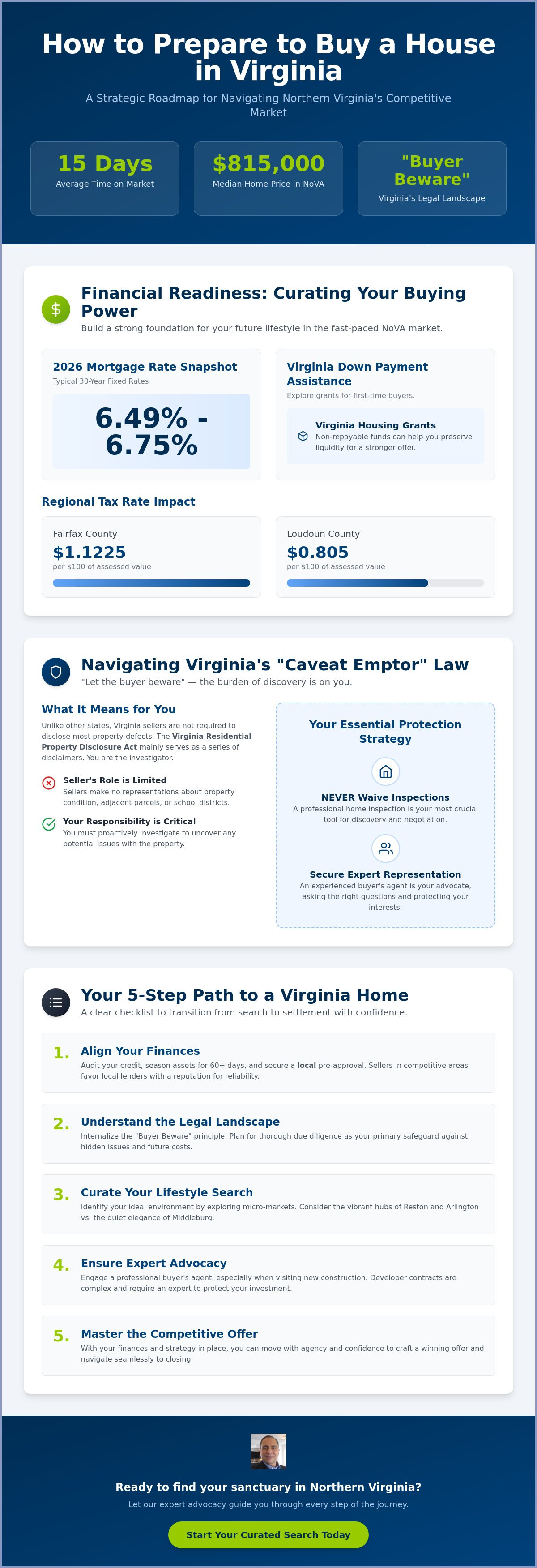
In a market where the average home sells in just 15 days, waiting until you find the perfect listing is already too late. You aren't just looking for a property. You're seeking a lifestyle sanctuary in a landscape that moves at lightning speed. Understanding how to prepare to buy a house in Virginia requires more than just a pre-approval letter. It demands a strategic mindset to navigate the Commonwealth's unique "Buyer Beware" legal environment and the competitive energy of Northern Virginia.
We know the process can feel overwhelming, especially with NoVA median prices reaching $815,000 and complex closing costs that catch many off guard. You deserve to feel confident and excited rather than anxious about the details. This guide provides a clear, sophisticated roadmap to master your move. We'll explore the essential financial milestones for 2026, explain critical legal protections like the new deed fraud prevention laws, and help you identify the neighborhoods in Ashburn and Aldie that align with your vision of home. Your journey to a curated, high-quality experience starts with a plan that prioritizes your well-being.
Key Takeaways
- Learn how to prepare to buy a house in Virginia by aligning your credit health and liquidity with the specific 2026 tax landscape of Northern Virginia.
- Navigate the "Buyer Beware" legal landscape with ease by understanding the limited protections of the Virginia Residential Property Disclosure Act.
- Curate your ideal lifestyle by identifying the subtle micro-market differences between vibrant hubs like Reston and the quiet elegance of Middleburg.
- Ensure expert advocacy when visiting new construction sites to safeguard your investment against the unique complexities of developer contracts.
- Master the competitive offer process to transition seamlessly from your initial search to a successful Virginia settlement.
Financial Readiness: Curating Your Buying Power
Financial readiness is more than just a number on a screen; it's the foundation of your future lifestyle. In the high-velocity Northern Virginia market, your buying power dictates the fluidity of your transition. As you learn how to prepare to buy a house in Virginia, start by viewing your finances through a lens of intentionality and energy. You aren't just qualifying for a loan. You're designing the framework for your new daily life.
The 2026 lending landscape requires absolute precision. With 30-year fixed mortgage rates hovering between 6.49% and 6.75% as of June 2026, your monthly commitment depends heavily on your choice of location. For instance, Fairfax County carries a real estate tax rate of $1.1225 per $100 of value, while Loudoun County offers a more modest $0.805. These variations significantly impact your lifestyle budget. Beyond the mortgage, consider the curated amenities of communities like Willowsford. High-quality HOA fees in these areas cover more than just maintenance. They invest in your social connection, health, and sense of place.
Secure a local pre-approval before you visit your first open house. In competitive neighborhoods like Arlington or Ashburn, sellers often overlook national online lenders. They prefer local professionals who understand the regional pace and have a reputation for reliability. This preparation is vital because Virginia strictly follows the principle of Caveat Emptor. Since the burden of discovery falls almost entirely on you, your financial plan must include a robust reserve for thorough inspections and potential repairs. Having your finances organized allows you to move with agency when the right opportunity appears.
Credit Health and Liquidity Mapping
Begin with a meticulous audit of your credit report. Look for discrepancies or old judgments that might hinder your momentum. Your cash-to-close involves more than just a down payment. You'll need an Earnest Money Deposit (EMD) ready the moment you find your dream home. Aim to season your assets at least 60 days before your application. This ensures a frictionless underwriting process and projects an image of effortless financial stability to your lender.
Virginia Down Payment Assistance (DPA) Programs
Explore the grants offered by Virginia Housing, formerly known as VHDA. These programs provide essential support for first-time buyers, offering grants that don't require repayment. While income limits apply and vary significantly between Northern Virginia and the rest of the state, these funds can be a powerful tool. Stacking local grants with available federal credits helps you preserve liquidity. It's a strategic way to secure a residence that serves as both a sanctuary and a sophisticated investment.
Understanding Virginia’s "Caveat Emptor" Legal Landscape
Virginia stands as one of the few remaining "Caveat Emptor" states in the country. This legal principle, translated as "let the buyer beware," creates a unique environment for your home search. Unlike states that require sellers to disclose every hairline crack or past leak, Virginia law favors the seller's silence. When you are learning how to prepare to buy a house in Virginia, you must accept that the burden of discovery rests entirely on your shoulders. You aren't just a buyer; you are an investigator.
The Virginia Residential Property Disclosure Act often surprises newcomers. It doesn't actually force sellers to provide a comprehensive history of the home. Instead, it serves as a series of "disclaimers" where the seller states they make no representations about the property's condition, adjacent parcels, or even local school districts. Effective July 1, 2026, buyers also receive a specific notice to perform due diligence regarding a property's proximity to military installations. This legal framework makes professional buyer representation an essential part of your strategy, providing a protective layer between you and potential hidden liabilities.
Your agent acts as your primary advocate in this landscape. They ensure you ask the pointed, specific questions that sellers are legally required to answer truthfully if asked. Without this proactive approach, you could inherit expensive structural or mechanical issues with no legal recourse. For more detailed guidance on the legalities of the process, you can explore Virginia Housing homebuyer resources to supplement your knowledge.
The Critical Role of Home Inspections
Never waive your right to a home inspection in a "Buyer Beware" state. In the competitive Northern Virginia market, some buyers feel pressured to drop this contingency to win a bidding war. Resist this urge. Focus your inspection on regional specifics like Radon levels and moisture intrusion in basement-heavy areas. Aging HVAC systems in older Fairfax County homes can also be a significant hidden cost. Consider a "void-only" inspection contingency. This allows you to walk away from a deal if major defects appear, keeping your offer competitive while protecting your well-being.
Title Search and Insurance in Virginia
Historic charm in areas like Leesburg or Middleburg often comes with complex property histories. A thorough title search is vital to ensure no unresolved estate claims or ancient utility easements cloud your ownership. While your lender will require a policy to protect their interest, you should always secure Owner’s Title Insurance. This one-time fee protects your equity from deed fraud, which has seen new prevention legislation as of July 2026. It ensures your sanctuary remains legally yours, free from the stress of past ownership disputes.
Crafting Your Northern Virginia Search Strategy
In Northern Virginia, your home is more than a structure. It's the backdrop to your daily rhythm. Stop browsing listings and start curating a lifestyle environment. This shift in perspective is the secret to how to prepare to buy a house in Virginia effectively. You might crave the high-energy, walkable pulse of Reston's urban core. Or, you might find peace in the pastoral, equestrian beauty of Middleburg. Each micro-market offers a distinct energy that must align with your personal well-being.
The speed of this market is breathless. According to Northern Virginia housing market statistics, homes averaged just 15 to 18 days on market in early 2026. To stay ahead, you need access to "Coming Soon" listings within the Bright MLS. These properties are visible to agents before they hit public sites like Zillow. Leveraging this window allows you to prepare mentally and financially before the crowd arrives. Using Strategic Buyer Representation in Northern Virginia ensures you have an advocate who can navigate these high-speed dynamics with ease.
Defining Your "Must-Haves" vs. "Lifestyle-Wants"
Analyze your commute patterns. While remote work remains popular, proximity to D.C. still drives long-term value. In Ashburn, school district data is a primary engine for resale health. Even if you don't have students, these ratings protect your investment. Contrast this with Aldie, where the value lies in expansive lot sizes and a sense of openness. Decide if you prefer walkable urbanism or the quiet luxury of a private acre. Your choice should reflect your desire for a frictionless existence.
Targeting Top Neighborhoods
Explore the diverse pockets that define our region. You might find your perfect fit by Living in Sterling, VA, a community known for its modern, hybrid feel. For those drawn to cobblestones and waterfront views, Alexandria, Virginia Real Estate offers a timeless blend of history and investment potential. If you need a central hub with effortless access to the entire region, look toward the crossroads of Centreville, VA. Each area offers a unique standard of living tailored to modern needs.
Evaluating New Construction vs. Resale Opportunities
Deciding between the crisp allure of a new build and the established character of a resale home is a pivotal step in how to prepare to buy a house in Virginia. Each path offers a different rhythm and set of complexities. Buying from an individual seller often feels personal and fast-paced, with the average Northern Virginia home selling in just 15 to 18 days. Conversely, purchasing from a developer involves builder-specific contracts that differ significantly from standard residential agreements. You should always enter a model home with your own representation already established. The friendly sales consultant in the office represents the builder's bottom line. Bringing your own agent ensures you have a dedicated advocate to negotiate structural upgrades and monitor construction milestones.
Resale homes typically close within 30 to 45 days, which is ideal if you need to move quickly. New construction requires a longer vision, often spanning a 6 to 12 month build cycle. This timeline allows you to watch your sanctuary rise from the ground up. For a deeper dive into specific builders and community master plans, explore our New Construction Homes in Northern Virginia guide. If you are ready to explore these options, our team provides expert Buyer Representation to guide your selection.
The Pros and Cons of New Builds
New builds offer the peak of contemporary relevance. You'll enjoy modern energy standards and "smart home" foundations that are often difficult to retrofit into older properties. The "dirt to dream" process allows you to select specific lots and structural options that reflect your personal style. In developing areas of Aldie, purchasing early in a new phase can lead to immediate equity as the community matures. However, be prepared for the dust and noise of ongoing construction as the neighborhood completes.
Resale Charm and Investment Potential
Resale homes provide a sense of place that only time can create. You'll find established landscaping, mature trees, and a settled community character in older sections of Ashburn. These properties often offer opportunities for value-add through strategic renovations, allowing you to build equity through your own design choices. By leveraging Land Development in Northern Virginia knowledge, you can spot underutilized lots or homes with expansion potential that others might overlook. This approach turns your residence into a sophisticated long-term investment.
The Offer and Closing: Navigating to the Finish Line
The moment of decision has arrived. In a market where the average closed listing sells for 100.5% of its original list price, your offer must be as sharp as your vision. Understanding how to prepare to buy a house in Virginia culminates in this high-stakes negotiation. You aren't just submitting a price. You're presenting a package that demonstrates your readiness and respect for the seller's timeline. A winning offer in 2026 often includes a clean financial profile, a flexible settlement date, and a respectful approach to contingencies.
In Virginia, we refer to the final step as "Settlement" rather than "Closing." This distinction reflects the collaborative nature of the process. Your Settlement Agent, usually a representative from a local title company, acts as the conductor for this final symphony. They coordinate the transfer of funds, ensure all legal documents are executed, and record the deed. This transition should feel like an effortless hand-off, not a bureaucratic hurdle. It's the final milestone in your journey toward a curated lifestyle.
Before you sign, perform your final walkthrough. This is your last chance to ensure the lifestyle environment you've curated is exactly as promised. Verify that all agreed-upon repairs are complete and the home's condition hasn't changed since your inspection. Check that the systems are operational and the property is "broom clean." It's the final pulse check before the sanctuary officially becomes yours, providing the peace of mind you deserve.
Contingencies: Your Safety Net
Contingencies protect your interests, but they must be used strategically. Balancing an appraisal contingency with the need to be competitive is an art form in Northern Virginia. While your lender requires a financing contingency, providing a firm "commitment letter" rather than a simple pre-approval can give you an edge. Home sale contingencies remain rare in our fast-paced market. Sellers prefer the certainty of a buyer who is ready to move immediately without the friction of a secondary sale.
The Final Settlement
Review your Closing Disclosure (CD) at least three days before settlement. This document outlines your final loan terms and exact "cash to close" requirements. When you're ready to transfer funds, prioritize security. The real estate industry faces an ongoing wire fraud epidemic, so always verify wiring instructions via a known phone number before sending any money. Once the documents are recorded, you'll receive your keys. It's the start of a new, sophisticated chapter in a home that perfectly reflects your standard of living.
Step Into Your Northern Virginia Sanctuary
Your journey toward homeownership in the Commonwealth is a sophisticated transition. You've mastered the nuances of financial readiness and learned to navigate the unique challenges of a "Buyer Beware" legal landscape. By shifting your perspective from simple house hunting to lifestyle curation, you're now equipped to choose between the modern allure of new construction and the historic charm of established neighborhoods. Each step you've taken brings you closer to a residence that reflects your personal energy and intentionality.
Mastering how to prepare to buy a house in Virginia requires a partner who understands that a residence is a sanctuary first and an asset second. Robert Caicedo brings local roots and global reach to your search, backed by an affiliation with Spring Hill Real Estate, established in 2005. Whether you're exploring complex land development opportunities or seeking a frictionless move into a new build, expert guidance ensures every detail is considered. Begin your curated home search with Robert Caicedo today and experience a standard of living designed around your well-being. Your ideal Northern Virginia lifestyle is waiting to be discovered.
Frequently Asked Questions
Do I need an attorney to buy a house in Virginia?
You aren't required to hire an attorney for a Virginia real estate transaction. Settlement agents or title companies typically manage the process, including the deed recording and fund distribution. However, you might choose to consult a legal professional if your contract involves complex land development or unique estate issues that require bespoke legal language.
How much are closing costs typically in Northern Virginia?
Plan for closing costs to range between 2% and 5% of your home's purchase price. These fees cover state and local recordation taxes, lender charges, and title insurance. Understanding these numbers is a vital part of how to prepare to buy a house in Virginia, as it ensures you have sufficient liquidity for a smooth and effortless settlement.
How long does it take to buy a house in Virginia from start to finish?
Your timeline depends on the type of residence you choose. A resale home usually moves from an accepted offer to keys in hand within 30 to 45 days. If you prefer a new construction lifestyle, expect the build cycle to last between 6 and 12 months from the initial contract. Your preparation phase should begin at least three to six months before you hope to move.
What is the "Residential Property Disclosure Statement" in Virginia?
This statement is a formal document where the seller disclaims any specific knowledge or responsibility for the property's condition. It serves as a legal reminder that Virginia is a "Buyer Beware" state. It places the responsibility on you to perform thorough due diligence and professional inspections before moving forward with the purchase.
Can I buy a house in Virginia without a real estate agent?
You can legally purchase a home without an agent, but doing so leaves you vulnerable in a market that favors seller silence. Professional representation ensures you have an advocate to navigate the high-speed Northern Virginia environment. Your agent identifies hidden risks and negotiates terms that protect your long-term investment and personal well-being.
What is the earnest money deposit (EMD) and is it refundable?
The earnest money deposit is a sum you provide to show the seller you're serious about the purchase. It's held in a secure escrow account until settlement. This deposit is generally only refundable if you exit the contract during an active contingency period, such as the home inspection or financing window, protecting your funds if the deal isn't right.
Are there specific first-time homebuyer programs for NoVA residents?
Virginia Housing provides several resources tailored for first-time buyers, including down payment assistance grants that don't require repayment. These programs are active in 2026 and can significantly lower your initial cash requirement. Learning about these grants is a smart way to understand how to prepare to buy a house in Virginia while preserving your personal liquidity.
What happens if the home inspection reveals major issues?
If major defects appear, you have several paths to maintain your peace of mind. You can negotiate for the seller to perform repairs, request a financial credit to handle the work yourself, or simply void the contract if the issues are too extensive. Your agent will help you use the inspection report as a strategic tool to ensure your new sanctuary is safe and sound.


