
Your home has likely earned more in equity this year than most people make in a decade, but how much of that wealth is truly yours to keep? In high-demand markets like Northern Virginia, rapid appreciation is a dream for your lifestyle but can become a complex puzzle when it's time to sell. Successfully avoiding capital gains tax on home sale in Virginia isn't about luck; it's about a multi-year strategy that starts long before the "For Sale" sign hits the lawn. You've worked hard to curate a beautiful life, and you deserve to see the full return on that investment.
We understand that the gap between federal exclusions and Virginia's 5.75% state income tax rate can feel overwhelming. You want clarity, not confusion. This 2026 strategy guide provides the exact roadmap you need to navigate IRS Section 121 exclusions and identify every deductible improvement that raises your cost basis. We'll explore how to structure your sale for maximum net profit, ensuring your transition to your next chapter is as seamless and rewarding as the home you're leaving behind. From understanding the $500,000 joint exclusion to mastering local tax nuances, you'll gain the confidence to move forward with ease.
Key Takeaways
- Secure your equity by mastering the Section 121 "Ownership and Use" tests to qualify for federal exclusions up to $500,000.
- Learn the essential differences between capital improvements and ordinary repairs to increase your cost basis and lower your taxable profit.
- Navigate the specific complexities of avoiding capital gains tax on home sale in Virginia, including how the state's 5.75% income tax rate applies to your proceeds.
- Explore strategic deferral options like the 1031 Exchange for investment properties that sit outside standard primary residence tax breaks.
- Identify how precise market timing and unique "Step-Up in Basis" rules for inherited properties can significantly protect your wealth in high-appreciation markets.
Understanding Capital Gains Tax for Virginia Homeowners
Selling your home is a milestone that marks the beginning of a new chapter. While the excitement of a high sale price is rewarding, it's essential to understand how much of that profit stays in your pocket. Capital gains represent the difference between what you paid for your property and what you receive when you sell it. In the high-appreciation corridors of Northern Virginia, homeowners often see their equity grow at a rate that catches them off guard. This rapid growth makes the strategy for avoiding capital gains tax on home sale in Virginia a top priority for savvy residents.
Timing is everything. If you sell a property you've owned for one year or less, the IRS classifies this as a short-term gain, which is taxed at your standard federal income tax rate. Most homeowners aim for long-term capital gains status by holding the property for more than a year. This allows you to benefit from lower federal tax rates. Understanding the U.S. Capital Gains Tax Rules is the foundation for any successful exit strategy, as these federal laws dictate the bulk of your liability.
Federal vs. Virginia State Tax: The Double Hit
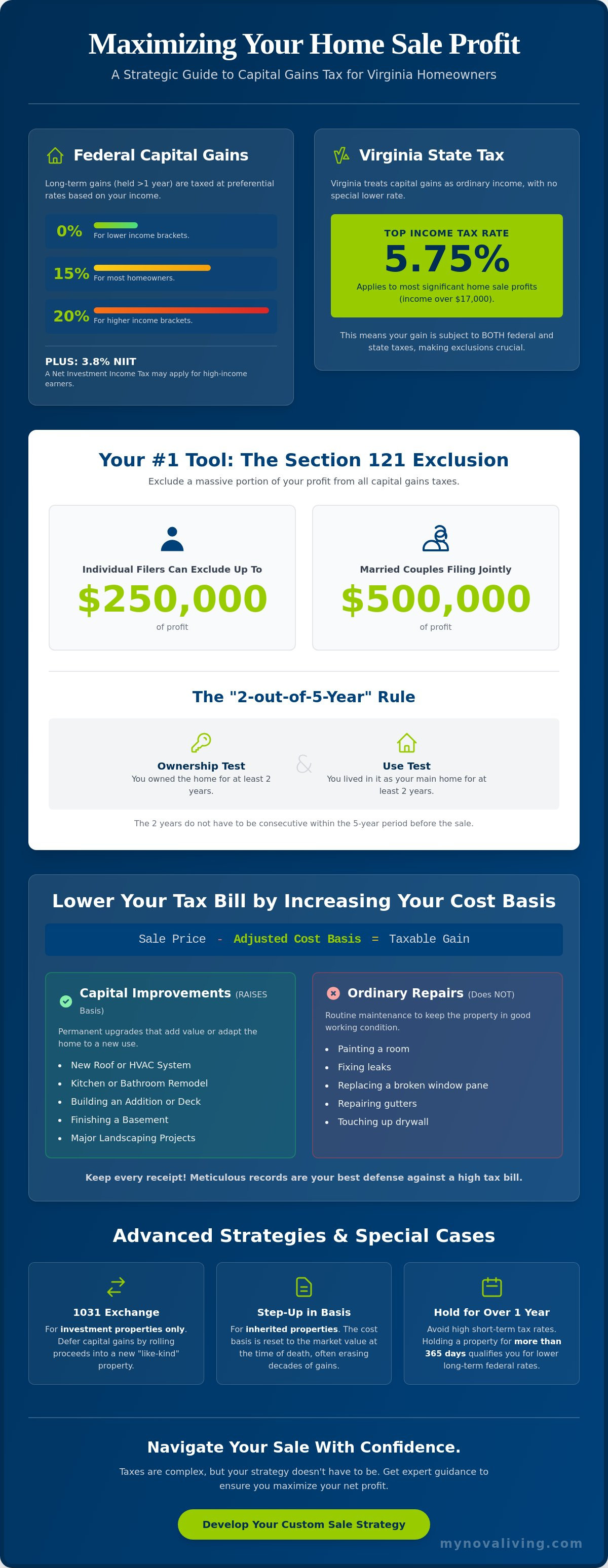
For the 2026 tax year, federal long-term capital gains rates are set at 0%, 15%, or 20% based on your total taxable income. Many sellers in our region fall into the 15% or 20% brackets due to the robust local economy. However, the federal level is only half the story. Virginia doesn't offer a lower, separate rate for capital gains. Instead, the Virginia Department of Taxation treats your home sale profit as ordinary income. With the state's top income tax rate of 5.75% kicking in for income over $17,000, almost every significant home sale will be subject to this maximum rate. High-income earners should also prepare for the federal Net Investment Income Tax (NIIT). This 3.8% surtax applies to those with a modified adjusted gross income over $200,000 for individuals or $250,000 for married couples filing jointly.
Why Your "Basis" is the Most Important Number
Your "Adjusted Cost Basis" is the most powerful tool you have for reducing your tax bill. It's the total investment you've made in the property, starting with the original purchase price and including specific closing costs. A higher basis translates directly into a lower taxable gain. This is why avoiding capital gains tax on home sale in Virginia requires a proactive approach to documentation. We believe that professional seller representation should involve more than just a listing; it should include a curated look at your financial preparation. By identifying every legal addition to your cost basis, you ensure your sale is structured for the highest possible net profit, allowing you to move into your next lifestyle environment with complete confidence.
The Section 121 Exclusion: Your $500,000 Tax-Free Advantage
The federal government offers a generous gift to homeowners, but claiming it requires precision. Under Section 121, you can exclude up to $250,000 in profit from your taxable income if you file individually. For married couples filing jointly, that number jumps to $500,000. This is the primary mechanism for avoiding capital gains tax on home sale in Virginia, effectively shielding your hard-earned equity from both federal and state reach. Consider a couple who purchased one of the stunning homes for sale in Ashburn, VA in 2015 for $600,000. If they sell today for $1.1 million, their entire $500,000 gain remains in their pockets, provided they meet the residency requirements. You can generally utilize this exclusion once every two years, making it a powerful tool for those who enjoy refreshing their lifestyle every few seasons.
The 2-Out-Of-5 Year Rule Explained
The core of the exclusion is the 2-out-of-5-year rule. You must have owned and used the home as your primary residence for at least 730 days within the five years preceding the sale. These days don't need to be consecutive. Primary residence status is determined by where you spend the majority of your time, register your vehicles, and cast your votes. If you lived there for one year, moved abroad for two, and returned for another year before selling, you still qualify for the full benefit. Special provisions exist for widowed taxpayers, allowing them to include the time their deceased spouse lived in the home. If a sudden job change or health issue forces a move before the two-year mark, you may qualify for a partial exclusion. Detailed guidance on these prorated amounts can be found in IRS Publication 523. If you're wondering how your specific timeline impacts your profit, our team can help you evaluate your property's potential.
Exceptions for Military and Foreign Service
Northern Virginia is home to a vibrant community of service members and diplomats. The IRS recognizes the unique demands of these roles and offers specialized flexibility. If you are on qualified official extended duty, you can choose to suspend the five-year test period for up to ten years. This means you could potentially live elsewhere for a decade and still claim your full exclusion upon return. This flexibility is a cornerstone of avoiding capital gains tax on home sale in Virginia for our local heroes. It ensures that military families aren't penalized for their commitment to service. It's a crucial component of a sophisticated real estate strategy in areas like Arlington and Fairfax, where duty often calls residents away from their primary homes for years at a time.
Beyond the Primary Residence: Second Homes and Investments
While the Section 121 exclusion is a perfect fit for your primary residence, the rules shift when you step into the world of second homes or vacation retreats. These properties don't qualify for the same tax-free thresholds. If you sell a weekend escape in the Blue Ridge or a stylish pied-à-terre in Arlington, the IRS treats the profit as a standard capital gain. However, sophisticated investors have a powerful alternative. By utilizing a 1031 exchange, you can defer taxes by reinvesting your proceeds into a "like-kind" property. This isn't about avoiding capital gains tax on home sale in Virginia permanently; it's about strategically delaying it to keep your capital working for you. A successful exchange requires a Qualified Intermediary to hold the funds, ensuring you never take constructive receipt of the cash during the transition.
The 1031 Exchange: Deferring Gains in Northern Virginia
The 1031 exchange is a high-stakes race against the clock. Once you settle on your relinquished property, you have exactly 45 days to identify potential replacement properties in writing. You then have 180 days to close. In our fast-paced market, these deadlines demand meticulous planning and an organized approach. Many of our clients transition from residential rentals into land development or new construction to diversify their portfolios. As long as the properties are held for business or investment use, they meet the 2026 "like-kind" requirement. This allows you to trade up into higher-value assets without an immediate tax hit, fueling your long-term wealth and lifestyle goals.
Converting Rental Property to a Primary Residence
Can you turn a rental into a tax-free primary residence? The answer is yes, but with specific caveats. Successfully avoiding capital gains tax on home sale in Virginia for a former rental property involves more than just moving in; it requires a deep understanding of the five-year ownership rule. If you move into your investment property, you must own it for at least five years and live in it for two to claim an exclusion. Even then, the IRS applies "non-qualified use" rules. They pro-rate the exclusion based on how long the property was a rental versus a home. You'll also face depreciation recapture, which is typically taxed at a flat 25% rate. Detailed breakdowns of these pro-rated calculations and eligibility requirements are available in IRS Publication 523. This strategy requires a long-term vision and precise record-keeping, but it remains a viable path to preserving your equity.
How to Increase Your Cost Basis to Lower Taxable Gain
You've watched your home's value climb, but a high sale price can be a double-edged sword if the profit exceeds your federal exclusion. When the $250,000 or $500,000 limits aren't enough to cover your growth, your "Adjusted Cost Basis" becomes your most valuable asset. Successfully avoiding capital gains tax on home sale in Virginia often comes down to the quality of your paper trail. By increasing your basis, you effectively shrink the taxable gap between what you paid and what you earned. Think of every major upgrade as an investment that pays you back twice: once through a better lifestyle and again through tax savings at settlement.
The IRS makes a clear distinction between ordinary repairs and capital improvements. Repairs, like fixing a leaky faucet or repainting a room, are considered part of routine maintenance and don't affect your basis. Capital improvements, however, must add value to your home, prolong its life, or adapt it to new uses. In 2026, digital record-keeping is your best friend. Scan every invoice and contract for major projects. These documents are the only way to prove to the IRS that your "profit" is actually a return on invested capital rather than pure taxable gain.
The Master List of Deductible Improvements
Focus on projects that provide a permanent boost to the property's utility. Inside the historic and contemporary residences of Alexandria, major kitchen and bathroom remodels are prime examples of basis-boosting investments. These aren't just aesthetic choices; they're structural and functional overhauls. Other deductible improvements include:
- System Upgrades: Installation of new HVAC systems, water heaters, or security systems.
- Exterior Longevity: Replacing a roof, installing new windows, or upgrading siding.
- Outdoor Living: In areas like Aldie or Middleburg, adding a permanent deck, stone patio, or professional landscaping counts toward your basis.
Closing Costs That Work in Your Favor
Your tax liability is based on the "Amount Realized," which is your sale price minus selling expenses. These costs are subtracted before the gain is even calculated. The real estate commission is the largest deduction, but don't overlook the smaller details. Title insurance, legal fees, and the Virginia grantor tax ($0.25 for every $100 of the sale price) all reduce your taxable profit. Even the costs of staging and professional photography, which we use to create a curated lifestyle narrative for your listing, are typically deductible selling expenses. If you want to ensure no deduction is left behind, our seller representation team can help you organize your closing strategy for maximum net profit.
Strategic Selling in Northern Virginia: Maximizing Your Net Proceeds
Timing your exit is an art form. In the fast-paced Northern Virginia market, where property values can shift significantly within a single season, your marketing timeline is inseparable from your tax strategy. Successfully avoiding capital gains tax on home sale in Virginia requires looking at the calendar through a financial lens. If you're approaching the $250,000 or $500,000 exclusion limits, the decision to list now or wait until you've reached a specific residency milestone can mean the difference between a tax-free windfall and a heavy bill. We focus on the emotional resonance of your transition, ensuring the logistics of your sale support the lifestyle you're moving toward.
Robert Caicedo acts as your attentive guide, balancing these complex financial nuances with high-end lifestyle goals. By considering the energy of the market alongside your specific equity position, he helps you navigate the friction of a busy environment with effortless reliability. Whether you're selling a contemporary estate or an urban chic condo, the goal is always to maximize your net proceeds while maintaining a sense of ease. This holistic approach transforms a transactional event into a curated, high-quality experience that prioritizes your well-being.
Inherited Property: The Step-Up in Basis Advantage
Families in Loudoun County often encounter a unique tax shield known as the "Step-Up in Basis." When you inherit a property, the IRS resets the cost basis to the fair market value at the time of the original owner's death. This reset is a powerful tool for protecting family wealth. If the home was purchased decades ago for a fraction of its current value, the heirs can often sell the property immediately with little to no capital gains tax liability. To secure this advantage, obtain a professional appraisal as soon as possible after the inheritance. This documented value serves as your new starting point, effectively neutralizing years of appreciation in the eyes of the Virginia Department of Taxation.
Your Next Move: Reinvesting in Northern Virginia
Once you've successfully protected your equity, the focus shifts to your next chapter. Many residents choose to reinvest their tax-free proceeds into the vibrant, modern hybrid lifestyle found in Sterling. This transition is about more than just square footage; it's about finding a lifestyle environment that offers intentionality and fluidity. Whether you're looking for new construction or a stylish resale, having professional buyer representation ensures your next purchase is as strategic as your sale. We invite you to schedule a consultation to discuss how we can structure your upcoming move for maximum profit and total peace of mind.
For those considering a move beyond Virginia to other high-appreciation markets, Cardenas & Company Real Estate Group provides a similarly relationship-driven approach to help you secure your next luxury residence with confidence.
Secure Your Equity and Your Next Lifestyle Chapter
Your home is more than just a commercial asset; it's the foundation of your curated life in Northern Virginia. Protecting the wealth you've built through homeownership requires a blend of meticulous record-keeping and precise market timing. By mastering the nuances of the Section 121 exclusion and identifying every deductible capital improvement, you're not just selling a property. You're strategically avoiding capital gains tax on home sale in Virginia to fund your next aspirational move. Whether you're navigating a primary residence sale or complex land development, the right strategy ensures your net proceeds reflect the true value of your investment.
Robert Caicedo brings specialized expertise in high-value markets to every transaction. Affiliated with Spring Hill Real Estate, established in 2005, he provides the attentive guidance needed to navigate investment property consulting and land development with ease. Ready to maximize your home sale profit? Schedule a strategic consultation with Robert Caicedo today. We're here to ensure your transition is seamless, stylish, and financially rewarding. Your future deserves the clarity and confidence that comes with expert preparation.
Frequently Asked Questions
Do I have to pay Virginia state tax on my home sale if I qualify for the federal exclusion?
Virginia follows federal guidelines for primary residence exclusions. If you qualify for the federal Section 121 exclusion, those profits aren't included in your federal adjusted gross income. Since Virginia uses your federal income as the starting point for state tax calculations, you won't pay the 5.75% state income tax on that excluded amount. It's a seamless way of avoiding capital gains tax on home sale in Virginia for most residents.
Can I deduct the cost of a new roof from my capital gains tax?
Yes, a new roof is a capital improvement that increases your home's cost basis. While you can't deduct the cost directly from your annual income, you add the expense to your original purchase price. This higher basis reduces your total taxable profit when you sell. Keep your digital invoices organized to prove this upgrade added longevity and value to your residence.
What happens if my home sale profit exceeds the $500,000 limit?
Any profit exceeding the $250,000 or $500,000 limits is subject to federal long-term capital gains rates of 15% or 20%. In Virginia, this excess profit is also taxed as ordinary income at the top rate of 5.75%. You may also trigger the 3.8% Net Investment Income Tax if your total income exceeds federal thresholds. Precise planning helps you manage these layers of liability.
How does the IRS define a "primary residence" for the tax exclusion?
The IRS looks for physical occupancy and legal intent to define a primary residence. You must own and live in the home for at least two of the five years before the sale. They verify this through your voter registration, mailing address on tax returns, and where you register your vehicles. It's about where you truly establish your daily life and community connections.
Can I use a 1031 exchange for my personal home in Virginia?
No, you cannot use a 1031 exchange for a property used exclusively as your personal residence. Section 1031 is strictly reserved for investment or business properties. If you've converted your home into a rental, you might qualify for a 1031 exchange, but personal homes rely solely on the Section 121 exclusion to protect your equity.
Do I need to report my home sale to the IRS if I don’t owe any tax?
You generally don't need to report the sale if your entire gain is excluded and you didn't receive a Form 1099-S. However, if the profit exceeds the exclusion limits or if you receive that form from the settlement agent, you must report the sale on Schedule D. Always review your closing documents to ensure your reporting is accurate and effortless.
Are staging and professional photography costs tax-deductible when selling a home?
Yes, costs for staging and professional photography are considered legitimate selling expenses. These fees are subtracted from your final sale price to determine your "Amount Realized." Reducing this number is a key part of avoiding capital gains tax on home sale in Virginia. These services help create an aspirational lifestyle narrative while simultaneously lowering your tax burden.
What is the "unforeseen circumstances" rule for a partial capital gains exclusion?
The "unforeseen circumstances" rule allows for a partial, prorated exclusion if you sell before the two-year mark. This applies to sudden job relocations, health issues, or multiple births from a single pregnancy. If you've lived in the home for one year instead of two, you might still exclude half of the standard $250,000 or $500,000 limit.


