

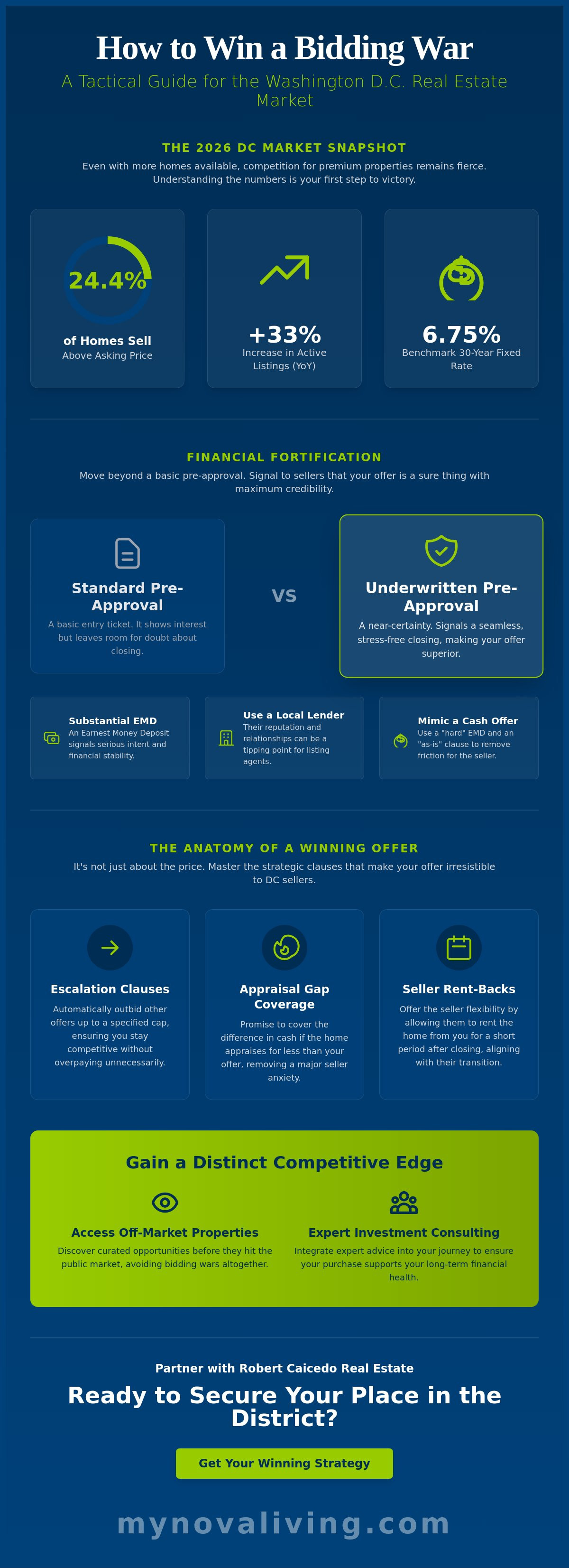
Nearly 24.4% of homes in the District still sell for over the asking price, even as the broader market finds a new equilibrium in mid-2026. If you've spent your weekends touring sun-drenched rowhouses only to lose out to a "cleaner" offer, you know that the standard playbook isn't enough. Learning how to win a bidding war on a house in Washington DC requires more than just a high number; it demands a sophisticated alignment with the seller's lifestyle transition and a deep understanding of local contract nuances.
It's exhausting to watch your dream residence slip away because of uncertainty over appraisal gaps or the anxiety of waiving inspections on a historic property. You deserve a strategy that secures your place in a curated neighborhood without sacrificing your long-term financial health. This guide provides the tactical edge you need to navigate DC-specific clauses and leverage current market data, such as the 6.75% benchmark for 30-year fixed rates. We'll explore how to bridge the gap between a competitive offer and a winning one, ensuring you move into a home that perfectly supports your lifestyle and well-being.
Key Takeaways
- Decode the 2026 landscape in District hotspots to understand why multiple-offer scenarios remain the standard for premium residences.
- Elevate your credibility by securing an underwritten pre-approval, signaling to sellers that your financing is ready for a seamless, stress-free closing.
- Master the strategic use of escalation clauses and appraisal gap coverage to learn how to win a bidding war on a house in Washington DC with financial precision.
- Utilize thoughtful contract nuances like seller rent-backs to align your offer with the seller’s transition and stand out from purely transactional bids.
- Gain a distinct competitive edge by accessing curated off-market opportunities and integrating expert investment consulting into your home-buying journey.
The 2026 Washington DC Market: Why Bidding Wars Are the New Normal
The 2026 Washington DC market is no longer a wild west of unchecked speculation. It's a calculated arena. In the District, a bidding war isn't just about who has the most cash; it's about who presents the most seamless transition for the seller. Understanding how to win a bidding war on a house in Washington DC begins with recognizing that "market value" is often just the starting line. Even with active listings up 33% year-over-year, 24.4% of homes still command prices above the list price. This persists because the District’s most iconic residences remain in high demand and low supply.
Inventory has increased, yet hotspots like Logan Circle and Navy Yard remain intensely competitive. This is driven by a lifestyle migration. Buyers aren't just looking for square footage. They're seeking curated environments that prioritize well-being and social connection. If you're waiting for a significant price drop, you might find yourself sidelined. While the median price in the city sits around $695,000, the most desirable properties sell quickly, often within the first week of listing. A "wait and see" approach often leads to missing out on the very properties that define the District's unique energy.
DC Neighborhood Micro-Climates
Capitol Hill and Georgetown remain the gold standard for historic elegance. Here, competition is
Financial Fortification: Positioning Your Offer for Maximum Credibility
A basic pre-approval letter is merely a ticket to enter the room. In the District’s high-stakes market, it isn't enough to show you can afford the home. You must prove the deal will close without a single hiccup. Mastering how to win a bidding war on a house in Washington DC requires moving beyond standard documents toward an "underwritten pre-approval." This status means a human underwriter has already vetted your files, essentially leaving only the property appraisal as the final hurdle. It transforms your bid from a conditional interest into a near-certainty.
Presentation matters just as much as the numbers. When you provide proof of funds, do so with a polished, organized summary that mirrors the sophistication of the property you're pursuing. Implementing sophisticated financial strategies for buyers, such as keeping your search price 5% to 10% below your absolute maximum, gives you the liquid breathing room to increase your earnest money deposit (EMD). A substantial EMD signals serious intent and financial stability, often soothing a seller's anxiety about market volatility. Having expert buyer representation ensures your financial profile is presented with the polish it deserves.
The Power of the Local Lender
Listing agents in DC are a tight-knit community. They often prioritize offers backed by local lenders they've worked with for years. National call centers frequently lack the nuance required for District-specific condo docs or historic rowhouse complexities. A quick phone call from a respected local loan officer to the listing agent can be the tipping point. It confirms your reliability and suggests a frictionless closing process that national banks simply can't guarantee.
Cash is King, but Strategy is Queen
You don't always need an all-cash offer to beat one. You can mimic the speed and certainty of cash by deploying a "hard" EMD. This makes a portion of your deposit non-refundable immediately upon contract acceptance. Pair this with an "as-is" clause for the inspection. This doesn't mean you ignore major structural issues, but it tells the seller you won't hold up the process over minor cosmetic repairs. It's about removing every possible point of friction for the seller while protecting your long-term well-being.
The Anatomy of a Winning Offer: Clauses, Gaps, and Contingencies
Winning in the District isn't just about the top line number. It's about the precision of your GCAAR (Greater Capital Area Association of Realtors) contract. To truly understand how to win a bidding war on a house in Washington DC, you must master the levers that remove seller anxiety. A "clean" offer isn't just one without contingencies; it's one where the risks are clearly managed and communicated. You're creating an environment of certainty that allows the seller to move forward with confidence.
A sophisticated offer strategy anticipates hurdles before they arise. In 2026, sellers prioritize frictionless transactions. This means your contract should be stripped of any clauses that suggest hesitation or a lack of preparation. By focusing on the emotional resonance of the seller's transition, you position yourself as a partner rather than just another name in a stack of folders. Having a clear understanding of these technical specifications ensures your well-being is protected while you pursue your dream residence.
Escalation Clauses: A Strategic Deep Dive
An escalation clause allows your offer to increase automatically if a higher competing bid arrives. However, a "naked" escalation without a strategic cap or increment is a recipe for overpaying. Your increment should be significant enough to discourage the next bidder, often $2,000 to $5,000 depending on the price point. Your cap should be informed by investment consulting data, ensuring the final price remains a sound financial decision for your future. Your starting price still matters; a low initial bid can sometimes signal a lack of seriousness to a savvy listing agent.
Navigating the Appraisal Gap
In a market where 26.6% of homes sell above list price, the bank's appraisal might not keep pace with your offer. An appraisal gap clause is your most powerful tool in 2026. By committing to cover a specific dollar amount between the appraised value and your contract price, you eliminate the seller's fear that the deal will fall apart at the finish line. Calculate your "walk-away" number early. This protects your financial health while signaling to the seller that you're a serious, prepared buyer. Use specific GCAAR language to define exactly how much of a gap you're willing to bridge.
In historic neighborhoods like Georgetown or Capitol Hill, waiving an inspection entirely is risky. Consider a "void-only" inspection instead. This allows you to walk away if major structural issues appear but tells the seller you won't ask for a long list of minor repairs. It preserves the "frictionless" feel sellers crave. Use this checklist to ensure your offer is as clean as possible:
- Remove unnecessary contingencies: Skip the home sale contingency if possible.
- Shorten timelines: Aim for a 14-day or 21-day closing period.
- Offer a rent-back: Give the seller 30 days to move out at no cost.
- Pre-inspect: Conduct a "walk-and-talk" inspection before you even submit your bid.
Strategic Differentiation: The Details That Influence DC Sellers
Price is a loud signal, but it isn't the only one sellers listen to. In the District's 2026 market, many sellers are navigating their own complex transitions. They're often looking for a buyer who offers more than just a high number. They want a partner who respects their timeline and reduces their moving stress. Learning how to win a bidding war on a house in Washington DC often comes down to these subtle, high-impact logistical adjustments that make your offer impossible to ignore.
Waiving a home sale contingency is practically a prerequisite for a competitive bid in neighborhoods like Logan Circle or Navy Yard. If your offer is contingent on selling another property, it suggests a level of risk that few sellers are willing to accept. Instead, focus on providing a "Seller Rent-Back." This allows the current owner to stay in the home for a set period after closing, giving them the breathing room to secure their next residence. It's a gesture of goodwill that translates to significant emotional value for a seller facing a tight move.
Logistical Flexibility as a Currency
Speed is a powerful differentiator. A 21-day closing timeline can often beat a higher offer that requires 45 days. It signals that your financing is rock-solid and you're ready to move. You can also offer to cover the seller's professional cleaning or moving costs. These are small financial gestures that remove massive logistical hurdles. Customizing your offer date to align with the seller's preferred schedule shows a level of intentionality that sets you apart from purely transactional bidders.
The Role of Professional Representation
Your choice of agent is a direct reflection of your credibility. Listing agents in DC value working with peers who have a reputation for being organized and reliable. Through Strategic Buyer Representation, your offer is presented with the professional polish required to stand out. An experienced agent performs "reconnaissance" by asking the listing agent exactly what the seller needs. Is it a specific closing date? A quick inspection period? Knowing these details allows you to tailor your bid for maximum impact.
The "personal touch" of a buyer letter has become a debated topic due to Fair Housing considerations. In 2026, it's often more effective to let the cleanliness of your contract speak for itself. When your offer is stripped of friction and aligned with the seller's goals, you create a sense of ease that no letter can replicate. If you're ready to craft a winning strategy, explore our buyer representation services today to begin your journey with confidence.
Partnering with Robert Caicedo: Your Competitive Edge in the District
Securing a residence in the District's most competitive enclaves requires more than a standard agent. It demands a partner who views real estate through the lens of long-term lifestyle and financial growth. When you're determining how to win a bidding war on a house in Washington DC, the difference often lies in the depth of your representation's network and the sophistication of their strategy. We replace typical industry stress with a sense of excitement and ease, focusing on the emotional resonance of your future home.
Robert Caicedo offers a perspective that bridges the gap between the District and Northern Virginia real estate. This dual-market expertise is invaluable for those seeking a curated lifestyle environment in the Mid-Atlantic. We understand the "Federal Factor" influencing demand and the nuances of the "Two-Tier" market, where properties over $1 million maintain a distinct competitive rhythm. By providing a deeply attentive guide, we ensure every detail of your search is handled with effortless reliability.
Consulting Beyond the Transaction
Every residence is a potential investment property. We analyze a home's long-term potential before you ever submit a bid. With a projected 1% price correction in 2026, identifying hidden value is paramount. Our expertise in land development helps you see possibilities in DC properties that others overlook. We're committed to a frictionless, high-quality experience that prioritizes your well-being. We leverage a deep local network to provide access to off-market opportunities, giving you a head start before a bidding war even begins.
Your Next Move Starts Here
Winning in 2026 requires a specific psychology. It's about being organized, stylish, and prepared to act when the right property appears. We've mastered the strategies required to navigate 30-year fixed rates of 6.75% while still securing premium District real estate. We invite you to a curated consultation to define your search and refine your strategy. Together, we'll implement a winning offer that aligns your financial health with the life you want to lead. Let's find your place in the District's contemporary world.
Secure your competitive advantage with Robert Caicedo today.
Secure Your Future in the District
Success in the 2026 market requires a shift from transactional bidding to strategic alignment. You've learned that financial fortification, such as securing an underwritten pre-approval, is your baseline for credibility. You now understand that nuances like appraisal gap coverage and seller rent-backs are the levers that move your offer to the top of the pile. Mastering how to win a bidding war on a house in Washington DC is as much about emotional intelligence as it is about financial precision.
By partnering with a guide who offers expertise in both residential and investment property consulting, you gain a distinct advantage. We leverage deep roots in the DC and Northern Virginia brokerage community to find your curated lifestyle environment. Our aspirational approach ensures your move is more than a change of address; it's an elevation of your well-being. Ready to win your DC home? Connect with Robert Caicedo for expert representation.
Your dream residence is within reach. With the right strategy and a dedicated partner, you can navigate this competitive landscape with total confidence and ease.
Frequently Asked Questions
What is an escalation clause and how does it work in DC?
An escalation clause is a contract addendum that automatically increases your offer if the seller receives a higher competing bid. You set your initial price, a maximum cap, and a specific increment, such as $5,000. This tool allows you to stay competitive in real-time without immediately offering your absolute maximum. It only triggers when the listing agent provides proof of a bona fide competing offer.
Should I waive the home inspection to win a bidding war in a historic neighborhood?
Total waivers are rarely advisable in historic areas like Capitol Hill or Georgetown due to the age of the properties. Instead, consider a "void-only" inspection. This gives you the right to cancel the contract if major structural or safety issues appear, but you agree not to request credits for minor cosmetic repairs. It provides the seller with the "as-is" certainty they crave while protecting your well-being.
How much over the asking price should I bid on a DC house in 2026?
Your bid should be based on a detailed analysis of recent neighborhood comps rather than a fixed percentage. While 24.4% of DC homes sold over list price in early 2026, every micro-market behaves differently. We evaluate the current inventory and the number of competing offers to help you find a number that is competitive yet remains a sound investment for your curated lifestyle.
What is appraisal gap coverage and why is it necessary?
Appraisal gap coverage is a commitment to pay a specific amount out of pocket if the bank’s appraisal is lower than your offer price. This is a critical component of learning how to win a bidding war on a house in Washington DC. It removes the seller's fear that the deal will fall through due to financing, making your offer significantly more attractive than bids without gap protection.
Can I win a bidding war with an FHA or VA loan in Washington DC?
You can absolutely win with FHA or VA financing by strengthening other parts of your offer. Lead with a substantial earnest money deposit and offer a flexible closing timeline that suits the seller's needs. We focus on communicating the strength of your pre-approval to the listing agent, ensuring they see your offer as a reliable path to a successful closing despite the stricter appraisal requirements.
How does a seller rent-back agreement help my offer stand out?
A rent-back agreement allows the seller to remain in the home for a set period after the closing date. This provides them with the time and ease needed to transition to their next residence without the stress of a rushed move. By offering this logistical flexibility, you transform your bid from a transactional document into a thoughtful solution that prioritizes the seller's peace of mind.
What is the role of earnest money in a competitive bidding situation?
Earnest money acts as a financial "handshake" that demonstrates your serious intent to purchase. In a competitive scenario, increasing your deposit to 3% or 5% of the purchase price signals financial stability and commitment. It reassures the seller that you are a reliable partner who is fully invested in the transaction, reducing their anxiety about the deal potentially falling apart before settlement.
Why is a local lender better than a national bank for DC real estate?
Local lenders have established relationships with District listing agents and understand the complexities of DC property types. When you're discovering how to win a bidding war on a house in Washington DC, having a lender who can personally vouch for your file is a massive advantage. National banks often struggle with local timelines and condo requirements, which can create friction that scares away savvy sellers.


